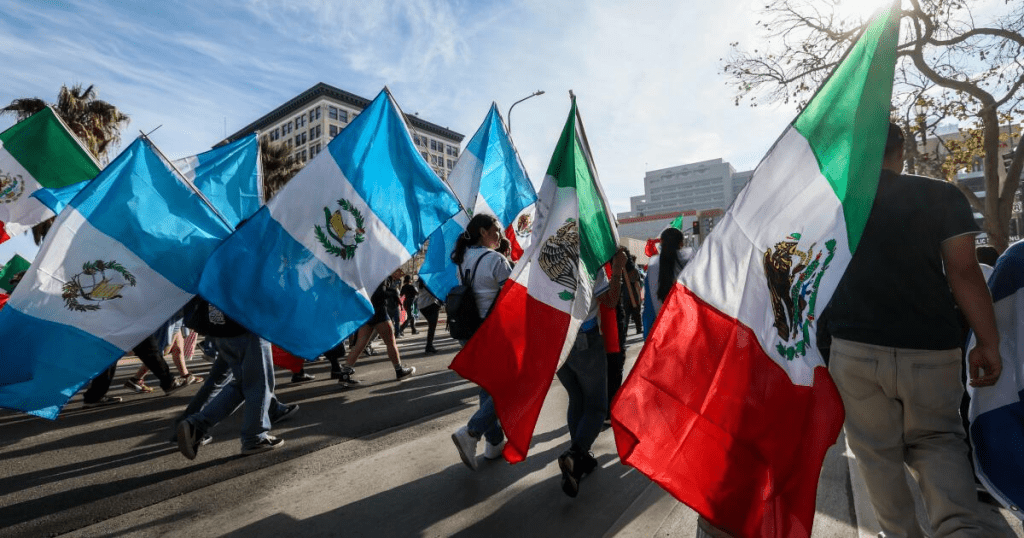
In June 2025, a pointed question has emerged amid President Donald Trump’s escalating immigration enforcement: if undocumented immigrants proudly wave Mexican flags at U.S. protests, why do they resist deportation to Mexico? Sparked by scenes of Mexican flags during Los Angeles anti-ICE demonstrations, this sentiment, voiced by Trump’s fervent base, underscores the charged debate over national loyalty, cultural identity, and the consequences of mass deportations. As the administration pushes its “America First” agenda, the issue highlights deep divides over belonging and free expression in a polarized nation.
The controversy ties to Trump’s aggressive policies, including 142,000 deportations and ICE’s record 2,200 arrests in a single day, projecting a 3.2 million pace over four years. Protests in Los Angeles, where demonstrators waved Mexican flags while opposing raids, have fueled perceptions of defiance. Supporters of deportation, backed by 90% of 2016 Trump voters per a 2025 Gallup poll, argue that such displays signal allegiance to Mexico, justifying removal. Policies like the Safeguard American Voter Eligibility Act and Wyoming’s proof-of-citizenship voting law reflect this push for national sovereignty, with 62% of Americans favoring stricter enforcement, per a 2024 Pew survey.
Critics, however, argue the question oversimplifies complex realities. Waving a Mexican flag often expresses cultural pride, not a rejection of the U.S., with 7.6% of Americans identifying as non-citizen or non-heterosexual, contributing $79.7 billion annually, per a 2024 Center for American Progress study. The Supreme Court’s 1989 Texas v. Johnson ruling protects such acts as free speech, and the ACLU, citing 35 wrongful detentions in 2025, warns against punishing expression. Many undocumented immigrants, fleeing violence or poverty in Mexico—where homicides reached 29,675 in 2024, per Mexico’s government—seek stability in the U.S., not a return to danger.
The Los Angeles protests, met with tear gas and 2,000 National Guard troops, highlight the stakes. Demonstrators, including those waving Mexican flags, oppose raids like the Tallahassee construction site operation, where workers fled. Economic concerns loom: deporting 11 million undocumented immigrants could cost $315 billion, per a 2024 American Immigration Council study, disrupting industries like construction, where 34% of workers are undocumented, per a 2022 Kaiser study. Critics argue resistance to deportation reflects fear of upheaval, not hypocrisy, with 55% of Americans in a 2025 Pew poll viewing Trump’s policies as excessive.
Historical parallels add context. Weak history education—only 13% of eighth graders proficient per a 2023 NAEP report—obscures lessons from 1954’s Operation Wetback, which caused widespread hardship. Trump’s 2025 rhetoric, like charging Biden aides with treason and pardoning 1,500, including Capitol rioters, echoes his 2020 call to shoot protesters, raising authoritarianism fears. The Indiana teacher’s “8647” shirt incident underscores the polarized climate.
As the 2026 midterms approach, the Mexican flag debate galvanizes Trump’s base but risks alienating moderates. Tariffs, increasing household costs by $1,300 annually per a 2025 Brookings study, and legal challenges over protester arrests highlight broader tensions. The question—pride versus punishment—reflects a struggle over what it means to live in America, pitting cultural expression against demands for assimilation in a nation at odds with itself.