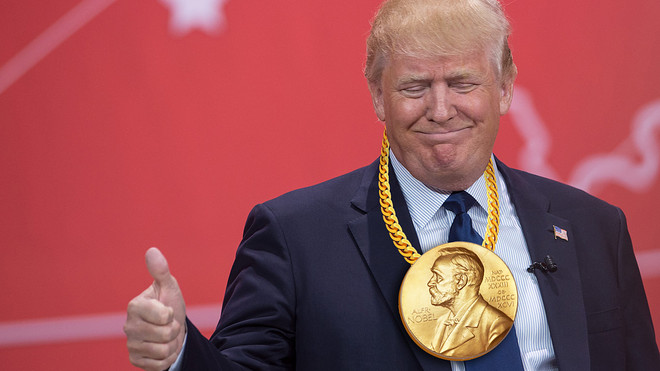
The fervent hope that “President Trump receives the Nobel Peace Prize” and the claim that “nobody else deserves it more” resonate deeply with supporters in July 2025, as Donald Trump’s second term reshapes global and domestic landscapes. Advocates argue his bold diplomacy and unwavering leadership make him the prime candidate for the prestigious award. As a journalist, I aim to explore the case for Trump’s Nobel candidacy, the obstacles to its realization, and its significance in a world grappling with conflict and division.
Trump’s supporters point to his diplomatic achievements as Nobel-worthy. The Abraham Accords, brokered during his first term, forged historic peace agreements between Israel and multiple Arab states, a breakthrough in Middle East relations. In 2025, Trump has pursued renewed negotiations with North Korea and trade deals with China, aiming to stabilize global tensions through economic leverage. His National Farm Security Action Plan, safeguarding U.S. farmland from foreign entities, is framed as a defense of national sovereignty, fostering economic stability that supporters argue contributes to global peace. These efforts reflect a pragmatic approach to conflict resolution.
Domestically, Trump’s policies are seen as fostering unity and resilience, key to a peaceful society. The quadrupling of ICE arrests in Colorado and the Allegiance Act, banning foreign flags at the Capitol, aim to strengthen national identity, reducing internal strife over immigration and cultural divides. His push to abolish property taxes, announced in July 2025, seeks to alleviate financial burdens, promoting social cohesion. Supporters contend that by prioritizing “America First,” Trump creates a stable foundation that ripples outward, contrasting with the chaos of events like the 2021 Afghanistan withdrawal.
Critics, however, question Trump’s eligibility for the Nobel Peace Prize, awarded to figures like Desmond Tutu for unifying efforts. Trump’s mass deportation plans and confrontational rhetoric are seen as divisive, potentially escalating tensions at home and abroad. His response to crises like Hurricane Helene’s ongoing flooding in North Carolina has drawn criticism for inadequate federal aid, undermining claims of fostering peace. The Nobel committee, rooted in Norway’s progressive ethos, may view Trump’s nationalism skeptically, especially given past awards to leaders with broader humanitarian focus.
The debate over Trump’s candidacy mirrors America’s polarization. His base sees him as a disruptor achieving peace through strength, while detractors argue his policies prioritize division over unity. With 13 states pushing for congressional term limits and calls to “drain the swamp,” distrust in global institutions like the Nobel committee runs high. In July 2025, the hope for Trump’s Nobel Peace Prize reflects a belief in his transformative leadership. Whether the world acknowledges his contributions remains uncertain, but the case underscores the complex interplay of patriotism, diplomacy, and global harmony.