Doha, Qatar – On May 14, 2025, President Donald Trump landed in Qatar on the second leg of his Middle East tour, greeted with an extravagant welcome that included a parade of mounted camels and red Cybertrucks, a spectacle that underscored the Gulf nation’s eagerness to impress. The visit, marked by a $200 billion deal for Qatar Airways to purchase 160 Boeing jets and a controversial $400 million Boeing 747-8 gifted to serve as Air Force One, has sparked intense speculation about what Trump may have promised in return, raising concerns about the intersection of diplomacy, business, and ethics.
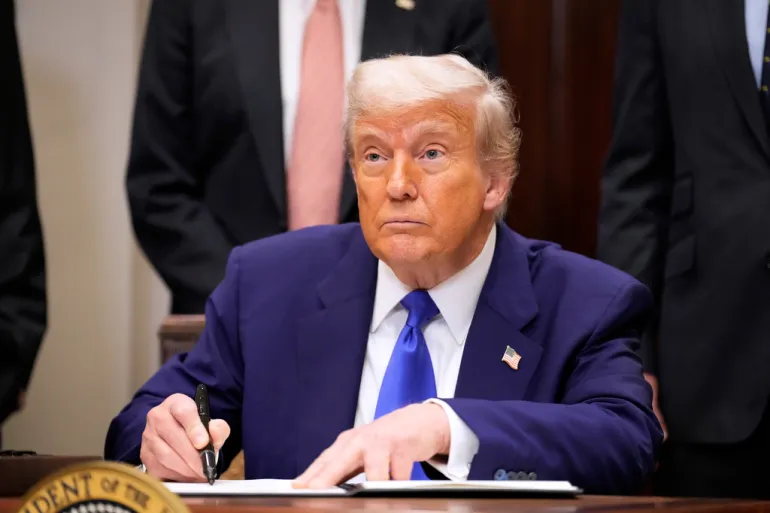
Trump arrived at Hamad International Airport at 11:30 AM local time, where Qatar’s Emir Sheikh Tamim bin Hamad Al-Thani welcomed him atop a red carpet. The parade, featuring traditional camel-mounted guards alongside modern red Cybertrucks—a nod to Trump’s ties with Elon Musk—set the tone for a day of high-stakes diplomacy. At a signing ceremony later that day, Trump and the emir oversaw the Boeing deal, which Trump hailed as “the largest order of jets in Boeing’s history,” a claim echoed by Boeing CEO Kelly Ortberg, who attended the event. The agreement, reported by Reuters, is a boon for the struggling American manufacturer, which saw orders plummet in 2024 after safety issues with its 737 Max.
The $400 million plane gift, a 13-year-old luxury Boeing 747-8 dubbed a “flying palace,” has drawn particular scrutiny. Trump confirmed on May 12 via Truth Social that the U.S. Department of Defense would accept the plane to temporarily replace the aging Air Force One fleet, with plans to transfer it to his presidential library after his term. However, Qatari official Ali Al-Ansari clarified that the deal remains under review, with no final decision made, per a statement to POLITICO. Ethics experts, including NPR-cited sources, argue the gift violates the Constitution’s Foreign Emoluments Clause, which bars federal officials from accepting foreign gifts without congressional approval. Rep. Ritchie Torres (D-NY) called it a “flying grift,” demanding an ethics probe on May 12, while Sen. Bernie Sanders labeled it “farcically corrupt” on X.
The scale of these deals prompts questions about Qatar’s expectations. While Trump’s public remarks focused on economic wins—highlighting the Boeing deal’s impact on U.S. jobs and a defense agreement involving MQ-9 drones, as noted in CNN’s live updates—the lack of transparency fuels speculation. Qatar, a key U.S. ally hosting the Al Udeid Air Base, has long sought to strengthen its geopolitical influence. The emir likely sees Trump as a gateway to enhanced military cooperation and economic partnerships, especially as Qatar diversifies beyond gas exports. Posts on X, like those from
@TopstepEddie, noted Trump’s discussions with the emir on Russia, Ukraine, and Iran, suggesting broader diplomatic concessions may be in play.
Critics, however, fear Trump’s business ties in the region—his organization has a new golf course in Qatar—could skew U.S. policy. The Washington Post reported on May 13 that the plane, currently in San Antonio for potential upgrades, poses security risks, as retrofitting it to Air Force One standards could take years and billions, per U.S. officials. Democrats, including Sen. Chuck Schumer, have vowed to block Trump’s Justice Department nominees until the gift’s legality is clarified, citing emoluments concerns.
Trump’s Qatar visit, while a diplomatic win on paper, underscores the ethical tightrope he walks. The $200 billion Boeing deal and $400 million plane gift may bolster U.S. industries, but at what cost to national integrity? Without clear answers on what Qatar expects in return, the specter of foreign influence looms large, leaving many to wonder if this lavish welcome masks a deeper, less transparent bargain.