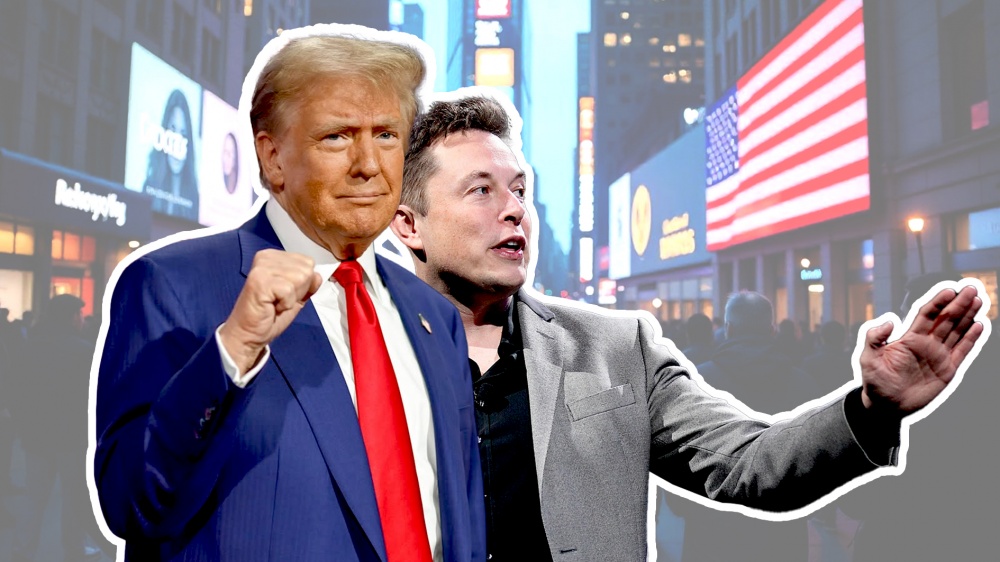
President Donald Trump’s ambitious plan to overhaul the federal government through the Department of Government Efficiency (DOGE), led by Elon Musk and Vivek Ramaswamy, has hit significant roadblocks in its first 100 days, marked by policy reversals and widespread criticism. A viral image highlights the chaos, noting Trump’s “biggest U-turns” as initial moves to slash federal budgets and freeze spending were quickly undone amid legal challenges, public outcry, and operational failures.
DOGE, a non-governmental advisory panel launched on January 20, 2025, aimed to cut $1 trillion from the federal budget, a goal later scaled back to $150 billion, per X posts in April 2025. The strategy involved mass layoffs and automation, with 75,000 federal employees taking buyouts—comparable to natural retirement rates—and tens of thousands of recent hires terminated, according to USA Today on February 11, 2025. A team of 50 to 100 IT specialists embedded in agencies to overhaul systems, but the rapid pace drew sharp criticism. Harvard professor Elizabeth Linos told NPR on February 27, 2025, that the cuts caused “harms not easily undone,” impacting communities reliant on federal jobs.
One of DOGE’s most controversial moves was the cancellation of USAID’s Ebola prevention programs, which Musk later admitted was “accidental” and claimed was “immediately restored,” per The Washington Post on February 27, 2025. However, former USAID official Nidhi Bouri contradicted this, telling The New York Times on February 28, 2025, that response teams were dismantled, and contracts with UNICEF were terminated. Public health experts warned that the U.S. capacity to handle outbreaks like Ebola was severely compromised, with operation centers shuttered. The reversal came after public outcry, exposing the risks of DOGE’s hasty approach, as The New York Times on March 8, 2025, criticized the “haphazard demolition campaign.”
Another major U-turn involved a spending freeze on federal grants and loans, announced on January 20, 2025, to align foreign aid with Trump’s “America First” agenda, per Reuters on February 4, 2025. The freeze halted billions in USAID programs, disrupting global lifesaving initiatives. Facing legal challenges, the White House rescinded the policy, as reported by U.S. News on February 27, 2025. U.S. District Judge Amir Ali ruled on March 7, 2025, that the administration must pay nearly $2 billion to foreign aid contractors, affirming that “appropriations are not optional,” per USA Today on March 9, 2025. Democrats, including Rep. Jaime Raskin, accused Musk of “unconstitutional interference,” arguing Congress controls spending, per The Guardian on February 5, 2025.
These reversals are part of a broader pattern in Trump’s first 100 days, with U.S. News reporting on February 27, 2025, that the administration backtracked on cuts to nuclear safety and the World Trade Center Health Program after bipartisan pushback. Public sentiment on X is divided:
@MarioNawfal on February 13, 2025, praised DOGE for uncovering fraud, while
@jbendery on May 1, 2025, noted that DOGE’s $12.6 billion in savings—0.173% of the 2025 budget—might be offset by legal costs and inefficiencies.
Critics argue that DOGE’s focus on spectacle, symbolized by Musk’s chainsaw-wielding, prioritizes ideology over functionality. The Urban Institute on January 30, 2025, warned of economic fallout in smaller communities, while The New York Times on March 8, 2025, highlighted Musk’s own conflicts of interest, noting his businesses have received over $38 billion in government support. The reliance on a private figure like Musk raises questions about democratic oversight, with some Cabinet members reportedly uneasy about his methods, per Trump’s own statements.
As of May 8, 2025, DOGE’s early stumbles underscore the challenges of implementing sweeping reforms without careful planning. While the administration aimed to eliminate waste, the reversals—particularly on critical programs like Ebola prevention—reveal the risks of prioritizing speed over substance. The long-term impact on government functionality and public welfare remains uncertain, but these U-turns signal a rocky start for Trump’s efficiency agenda.