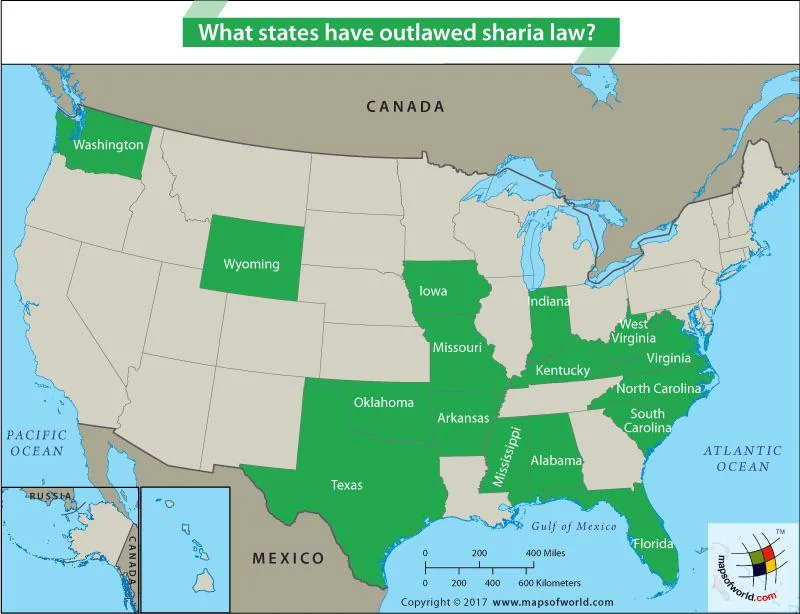
Washington, D.C., June 19, 2025—Six U.S. states—Alabama, Arizona, Kansas, Louisiana, North Carolina, and Tennessee—have passed laws prohibiting the use of Sharia law in state courts, a move supporters hail as a defense of American values and critics condemn as discriminatory. The legislation, often framed as “American Laws for American Courts” (ALAC), bans foreign or religious laws that conflict with state or federal constitutions, with Sharia, the Islamic legal framework, frequently cited as a target. As President Donald Trump’s policies fuel immigration debates, these bans have reignited tensions over religious freedom and cultural identity.
The laws, enacted between 2011 and 2014, respond to fears that Sharia could influence U.S. courts, particularly in family law cases like divorce or custody. Alabama’s 2014 constitutional amendment, passed with 72% voter support, explicitly prohibits courts from applying foreign or religious law if it violates constitutional rights. Proponents argue this ensures legal uniformity, citing a 2009 New Jersey case where a judge briefly considered Islamic practices before denying a restraining order; the decision was overturned on appeal. “These laws protect our Constitution,” said a Kansas legislator. A Rasmussen Reports poll shows 59% of Republicans support such bans.
Critics, including the American Civil Liberties Union (ACLU), argue the laws are redundant and discriminatory, as the U.S. Constitution already supersedes foreign or religious law. The 1878 Supreme Court case Reynolds v. United States affirmed secular law’s precedence over religious practices, rendering Sharia bans unnecessary, per the American Bar Association. In Oklahoma, a similar 2010 ban was struck down by a federal judge for violating the First Amendment by targeting Islam, a ruling upheld in 2012. “These laws stigmatize Muslims,” said an ACLU spokesperson. A Pew Research poll finds 46% of Americans view the bans as anti-Muslim.
Supporters counter that the laws address a growing threat, pointing to Sharia’s use in private arbitration among Muslims, permitted under the 1925 Federal Arbitration Act, which also allows Jewish and Christian tribunals. A 2013 Brennan Center for Justice report warns that banning Sharia could disrupt Jewish Beth Din courts or Christian mediation, affecting prenuptial agreements or religious divorces. Despite this, advocates like the Center for Security Policy argue Sharia’s principles, applied in some Muslim-majority countries, clash with American values like gender equality. The bans, they claim, prevent “creeping Sharia.”
The debate dovetails with Trump’s immigration policies, including the deportation of 150,000 undocumented immigrants and 850,000 self-deportations, per DHS data. The “No Kings Day” protests, drawing 4-6 million on June 14, highlighted fears of authoritarianism, while California’s lawsuit against ICE tactics and 1,800 planned protests signal ongoing unrest. Critics argue Sharia bans fuel Islamophobia, alienating Muslim Americans, who number 3.45 million, per a 2017 Pew estimate. Economic concerns, like $3 billion in agricultural losses from deportations, per USDA data, further complicate the narrative.
The six states’ bans, while symbolic for some, have had limited practical impact, as no U.S. court has applied Sharia over civil law. Yet, their passage reflects broader cultural anxieties, amplified by Trump’s rhetoric. As legal challenges persist and public opinion remains split—52% of independents in a Gallup poll see the bans as unnecessary—the Sharia debate underscores America’s struggle to balance religious freedom with national identity in a polarized era.