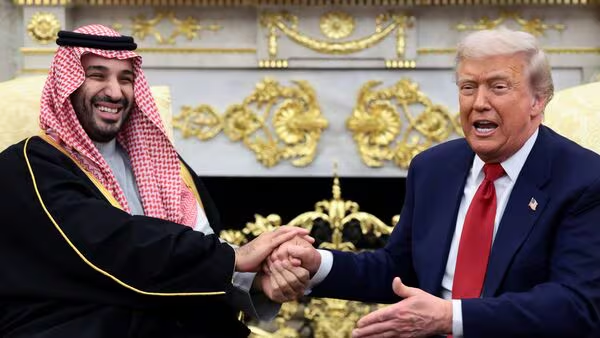
Washington, D.C. – In a diplomatic coup that electrified Wall Street and deepened U.S.-Saudi ties, Crown Prince Mohammed bin Salman announced Tuesday, November 18, 2025, that his kingdom would nearly double its committed investments in the American economy—from $600 billion to almost $1 trillion. The bombshell, dropped during an Oval Office meeting with President Donald Trump, signals Riyadh’s aggressive pivot toward U.S. innovation amid global energy shifts, promising a flood of capital into tech, AI, and infrastructure.
Flanked by U.S. flags and a phalanx of advisors, the 40-year-old de facto Saudi ruler—known as MBS—wasted no time upping the ante. “I believe, Mr. President, today and tomorrow we can announce that we are going to increase that $600 billion to almost $1 trillion for real investment,” MBS declared to reporters, his tone blending confidence and camaraderie. Trump, beaming beside him, interjected with a grin: “Now you’re saying to me now that the $600 billion will be $1 trillion?” The exchange, laced with Trump’s trademark banter, underscored a bromance reborn after Biden-era frictions.
The pledge, channeled through Saudi Arabia’s $925 billion sovereign wealth fund, targets “real opportunities” in semiconductors ($50 billion short-term alone), rare earth magnets for EVs, and AI computing power—sectors where Riyadh craves diversification from oil’s volatility. “We’re not creating fake opportunities to please America or please Trump,” MBS insisted, citing Saudi’s “huge demand” for U.S. tech. Trump hailed it as a job juggernaut: “That means investments in plants, in companies… A lot of jobs. We have a lot of jobs.”
Yet, skeptics abound. Economists question the feasibility amid subdued oil prices and MBS’s lavish Vision 2030 megaprojects, like NEOM’s $500 billion desert metropolis. The New York Times flagged the $1 trillion as rivaling the kingdom’s entire fund, potentially straining fiscal belts. Human rights watchdogs, still haunted by Jamal Khashoggi’s 2018 murder, decried the embrace as “blood money diplomacy,” urging congressional scrutiny on arms deals floated in tandem.
As Trump’s second term dawns, this trillion-dollar torrent could turbocharge his “America First” narrative, luring factories to red states and easing trade tensions. For MBS, it’s a masterstroke: Securing U.S. alliances while hedging against Iran’s shadow. In the Oval’s gilded glow, one handshake reshapes horizons—promising prosperity, but at what geopolitical price?