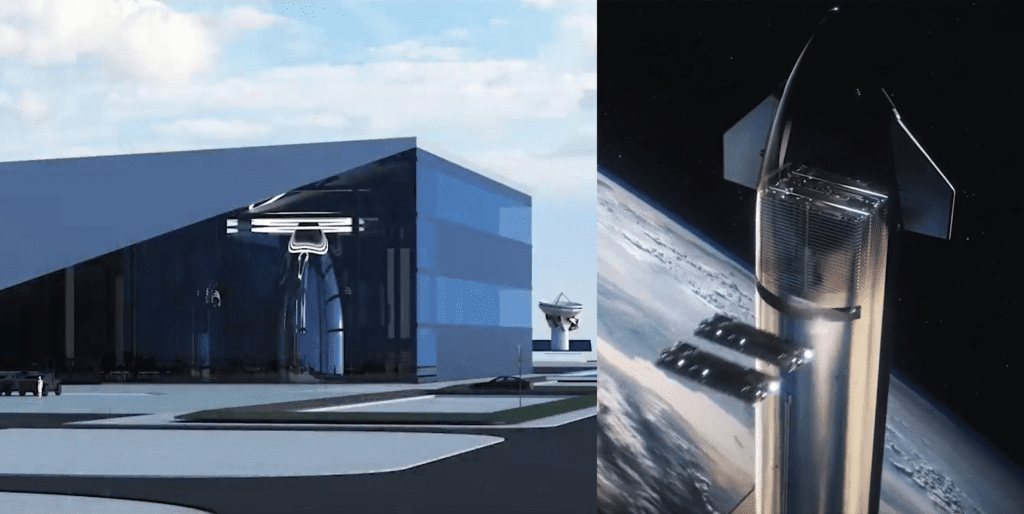
Elon Musk, the polarizing billionaire and SpaceX CEO, unveiled plans on May 29, 2025, to construct two massive “Gigabay” facilities—one in Starbase, Texas, and another at Kennedy Space Center, Florida—designed to produce 1,000 Starship rockets annually, each larger than a Boeing 747. Touted as among the world’s largest structures, these 380-foot-tall, 815,000-square-foot behemoths aim to revolutionize space travel, supporting NASA’s 2027 Artemis III moon landing and Musk’s dream of Mars colonization by 2026. Yet, the announcement, reported by Reuters, raises questions about Musk’s growing influence and the environmental and political implications of his space empire.
The Gigabays, set for completion by August 2026, will stack and finalize 232-foot Super Heavy boosters with Starship spacecraft, enabling launches from Texas and Florida’s Pad 39A by late 2025, pending environmental reviews, per Florida Today. SpaceX’s $1.8 billion investment in Florida alone will create 600 jobs by 2030, a boon hailed by Gov. Ron DeSantis, who called Florida “the future of the space industry,” per a March 2025 statement. The facilities, dwarfing NASA’s 525-foot Vehicle Assembly Building in capacity, could produce three Starships daily, aligning with SpaceX President Gwynne Shotwell’s goal of 400 launches in four years, per Benzinga.
Musk’s vision is audacious: Starship, at 400 feet with 16 million pounds of thrust, outstrips the Saturn V’s 363 feet and 7.6 million pounds, positioning it as humanity’s ticket to interplanetary life. NASA relies on Starship for lunar missions, while Musk eyes an uncrewed Mars trip by 2026, backed by President Donald Trump’s inauguration pledge to plant the U.S. flag on Mars. However, Starship’s ninth test flight on May 27 failed due to a fuel leak, tumbling over the Indian Ocean, per NPR, highlighting technical hurdles.
Critics see the Gigabays as emblematic of Musk’s unchecked power. Environmentalists decry Starship’s impact in Texas, where launches threaten the endangered Kemp’s ridley sea turtle and federal wildlife refuges, per Wikipedia. In Florida, competitors like United Launch Alliance and Blue Origin warn of explosion risks from Starship’s methane-oxygen propellants, potentially disrupting Cape Canaveral’s shared launch infrastructure, per Reuters. Politico reported local pushback in Texas, where Starbase’s incorporation as a city grants SpaceX control over land use, raising fears of a “company town” dominated by Musk.
Politically, Musk’s influence is divisive. His $200 million 2024 election spending and X platform ownership amplified Trump’s campaign, drawing accusations of buying electoral outcomes, per The Washington Post. His DOGE tenure, ending May 28 after clashing with Trump over a $4 trillion tax bill, left a legacy of disrupted services, with calls for probes into alleged fraud and conflicts of interest, per NPR. A 2025 Pew poll shows 54% of Americans view billionaire political sway as excessive, fueling skepticism of Musk’s motives.
The Gigabays could redefine space exploration or exacerbate concerns about billionaire overreach. While supporters see Musk’s vision as America’s path to the stars, critics demand accountability for environmental and democratic costs. As SpaceX races toward Mars, the Gigabays stand as both a technological marvel and a test of Musk’s legacy.