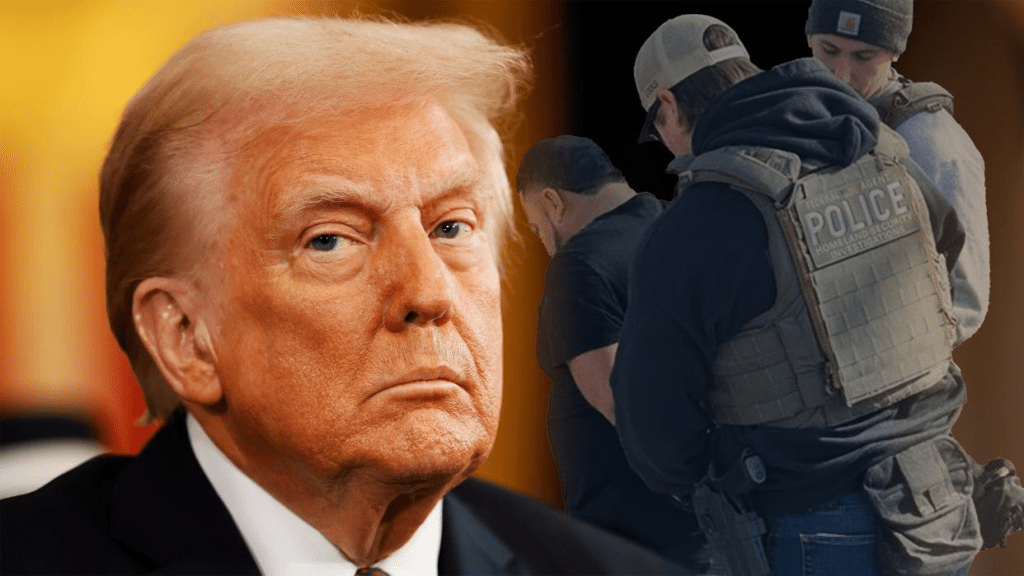
As President Donald Trump’s Immigration and Customs Enforcement (ICE) raids ramp up, targeting 3,000 daily arrests across major U.S. cities, a growing chorus in California is questioning why the operations aren’t focused on the red states that voted for him. States like Texas, Florida, Missouri, Oklahoma, Tennessee, Arizona, Iowa, and Ohio overwhelmingly backed Trump’s 2024 campaign, yet blue states like California are bearing the brunt of the immigration round-ups. Critics argue the administration’s strategy unfairly punishes political opponents while sparing its base, raising questions about fairness and intent.
The raids, launched in January 2025, have hit sanctuary cities like Los Angeles, Chicago, and New York hardest, with 32,809 arrests, including 1,155 gang members, reported in the first 50 days. Los Angeles, where riots over the raids caused $5.2 million in damages and injured 47 officers, has become a flashpoint. California, which voted 59% for Trump’s opponent, feels targeted, especially as its sanctuary laws under Governor Gavin Newsom limit cooperation with ICE. Protesters argue that red states, where Trump won by double digits, should face the same scrutiny if the goal is truly national security.
Critics point out that red states have significant undocumented populations. Texas, with an estimated 1.6 million undocumented immigrants, ranks second only to California’s 2 million. Florida follows with 900,000, and Arizona, a border state, has 300,000. Yet, ICE’s focus on blue state urban centers—where arrests are high-profile and spark resistance—suggests political motives. California’s critics argue that Trump is punishing sanctuary policies while avoiding backlash in states like Missouri or Ohio, where local law enforcement often cooperates with ICE, streamlining deportations without fanfare.
The administration defends its strategy, claiming it prioritizes areas with the highest concentrations of criminal offenders and non-compliant local governments. ICE data shows Los Angeles and Chicago yield more arrests per operation than smaller red state cities, with 118 and 95 detainees last week, respectively. Homeland Security Secretary Kristi Noem emphasized that sanctuary cities “harbor fugitives,” justifying the focus. Trump’s deployment of 700 Marines to LA underscores the need to quell unrest, absent in red states where protests are smaller. Supporters, with 48% of Americans backing the raids, argue efficiency, not politics, drives the targeting.
Economically, red states may dodge disruption. Construction, a key industry in Texas and Florida, relies on undocumented labor—15% of workers nationwide. Raids in Phoenix cleared a worksite, halting a $50 million project, a scenario red state leaders like Texas Governor Greg Abbott may wish to avoid. Blue states, with denser urban economies, face greater fallout, as seen in California’s labor shortages post-raids. Critics argue this selective enforcement protects Trump’s base while destabilizing Democratic strongholds.
Democrats, like Los Angeles Mayor Karen Bass, call the strategy vindictive, noting California’s $692 billion in federal taxes dwarfs contributions from red states like Oklahoma. They argue Trump is flexing power where resistance is loudest, not where the problem is largest. Red states, with 52% support for Trump’s policies in battleground areas, face less political risk from raids, making them less urgent targets.
As ICE expands, the question persists: why not start in Trump country? The answer may lie in politics—sparing allies while making an example of foes. California didn’t vote for this, but it’s living it, while red states watch from the sidelines.