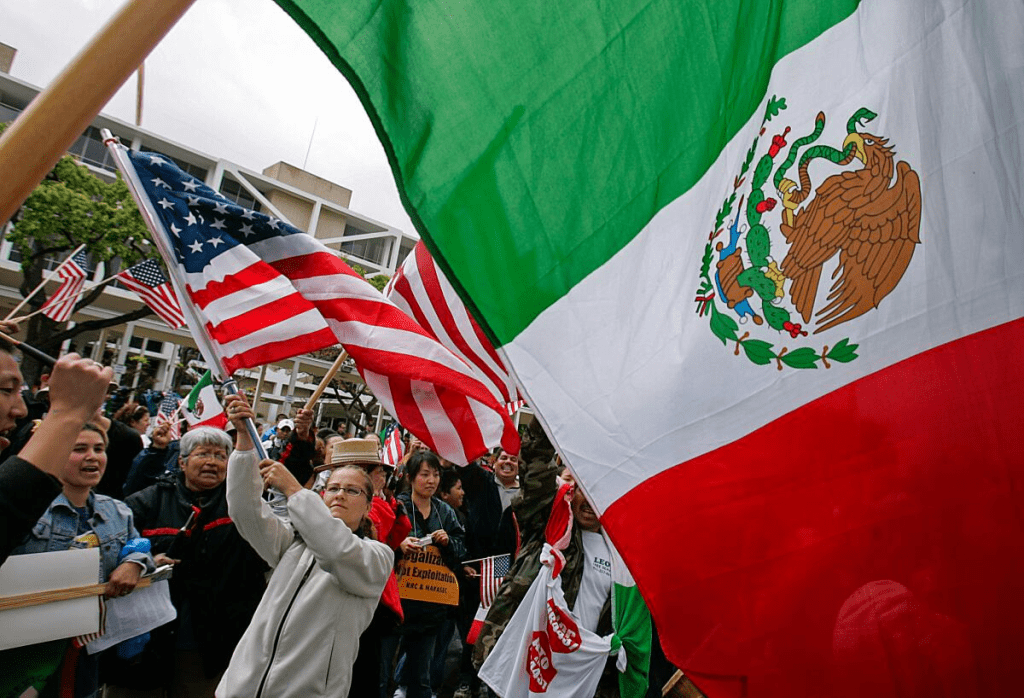
A provocative sentiment has gained traction in June 2025: individuals waving a Mexican flag in the U.S. should be deported to Mexico. Fueled by President Donald Trump’s aggressive immigration policies and echoed by his fervent base, this view has surfaced amid escalating tensions, particularly during Los Angeles protests where some demonstrators displayed Mexican flags while opposing ICE raids. As Trump’s second term pushes for mass deportations and stringent border security, the statement ignites a fierce debate over patriotism, free speech, and national identity in a deeply divided America.
The sentiment aligns with Trump’s “America First” agenda, which has seen 142,000 deportations and ICE’s arrest of 32,809 migrants in 2025’s first 50 days, a 627% surge from Biden’s final year. Supporters argue that waving a foreign flag, especially during protests against U.S. policies like the Safeguard American Voter Eligibility Act, signals disloyalty. A 2025 Gallup poll shows 90% of 2016 Trump voters approve his performance, with 62% of Americans favoring stricter immigration enforcement, per a 2024 Pew survey. Recent raids, like the Tallahassee construction site operation where workers fled, and the deployment of 2,000 National Guard troops to Los Angeles, underscore the administration’s hardline stance.
Critics, however, argue the statement violates constitutional protections. The Supreme Court’s 1989 Texas v. Johnson ruling safeguards flag displays as free speech, applicable to citizens and noncitizens alike. The ACLU, citing 35 wrongful detentions in 2025 immigration sweeps, warns that targeting expressive acts risks chilling dissent, as seen in visa revocations for pro-Palestinian activism. Los Angeles Mayor Karen Bass condemned the rhetoric as “divisive,” noting that 7.6% of U.S. adults identify as non-heterosexual or non-citizen, contributing $79.7 billion annually to the economy, per a 2024 Center for American Progress study. Deporting based on flag-waving lacks legal grounding, with no precedent in immigration law.
The controversy ties to broader cultural battles. Trump’s push to defund sanctuary cities and his call to charge Biden officials with treason for lax border policies amplify perceptions of foreign flags as provocative. Incidents like the Indiana teacher’s “8647” shirt, seen as a coded threat against Trump, and Wyoming’s proof-of-citizenship voting law reflect a charged climate. Yet, weak history education—only 13% of eighth graders proficient per a 2023 NAEP report—limits awareness of past overreaches, like 1954’s Operation Wetback, which caused widespread hardship.
Economic and social impacts loom large. Undocumented workers, many from Mexico, comprise 34% of construction labor, per a 2022 Kaiser study, and deportations could cost $315 billion, per a 2024 American Immigration Council estimate. Protests, like those in Los Angeles where tear gas was deployed, highlight community resistance, with 55% of Americans in a 2025 Pew poll viewing Trump’s policies as excessive. Legal challenges, including suits against protester arrests, underscore the tension between enforcement and rights.
As the 2026 midterms approach, the Mexican flag controversy galvanizes Trump’s base but risks alienating moderates. Tariffs, raising household costs by $1,300 annually per a 2025 Brookings study, and incidents like wrongful detentions test public support. The call to deport flag-wavers reflects a broader struggle over what it means to be American, pitting expressions of heritage against demands for loyalty in a nation at a crossroads.