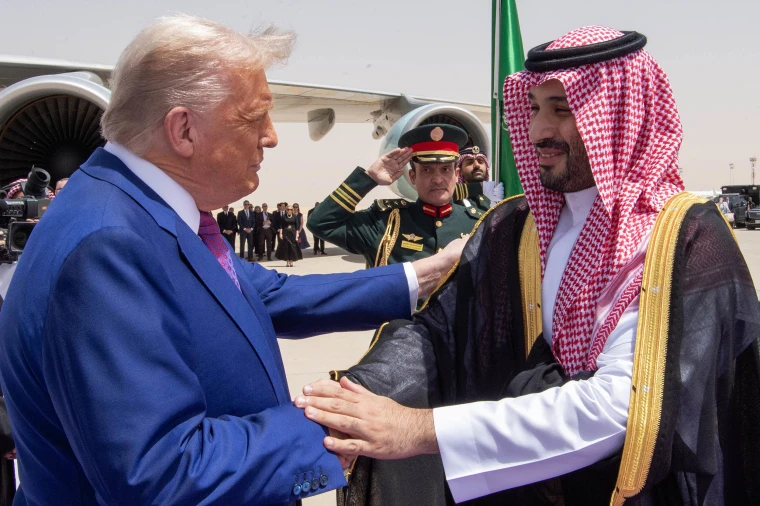
Riyadh, Saudi Arabia – President Donald Trump touched down at King Khalid International Airport in Riyadh on May 13, 2025, kicking off his first major overseas trip of his second term. Greeted with a lavish ceremony by Crown Prince Mohammed bin Salman, Trump’s visit signals a renewed focus on deepening U.S.-Saudi economic ties, with significant implications for the American people. Accompanied by tech titan Elon Musk, who joined Trump for a lunch with the crown prince, the president is also set to speak at the Saudi-U.S. Investment Forum later today, aiming to secure massive investments and trade deals.
The centerpiece of Trump’s agenda is a $600 billion investment commitment from Saudi Arabia, finalized today, which the White House hailed as a “historic” achievement. This deal, covering energy, infrastructure, defense, and AI, is designed to create jobs and bolster U.S. industries. Treasury Secretary Scott Bessent, speaking at the forum, emphasized that the funds will flow into American infrastructure and frontier technologies, positioning the U.S. as a global leader in innovation while stimulating economic growth. Posts on X from users like
@Ceo_Branding echoed this, noting the potential for job creation in sectors like energy and AI, though some expressed skepticism about the long-term benefits given Saudi Arabia’s own economic constraints.
Trump’s visit also aims to advance a civil nuclear agreement with Saudi Arabia, a move that could see American firms win lucrative contracts to support the kingdom’s Vision 2030 diversification plan. A controlled enrichment deal, as discussed by U.S. Energy Secretary Chris Wright in April, could enhance U.S. energy security while ensuring Saudi Arabia’s nuclear ambitions remain peaceful. However, this proposal has sparked concerns, with some analysts warning that Saudi domestic uranium enrichment could lead to proliferation risks, especially given the kingdom’s insistence on this condition, as reported by CNN.
Beyond economics, Trump’s trip addresses strategic priorities. The White House is pushing for Saudi Arabia to maintain low oil prices, a move Trump has long championed to curb inflation and benefit American consumers. With oil comprising 62% of Saudi government revenue last year, as noted by Reuters, this could strain the kingdom’s budget, but Trump’s transactional approach—evident when he conditioned the visit on a $1 trillion pledge—prioritizes U.S. economic relief. Additionally, a $142 billion defense sales agreement, the largest between the allies, will bolster U.S. defense industries while reinforcing Saudi Arabia as a counterweight to Iran, aligning with Trump’s goal of regional stability.
The visit isn’t without controversy. Trump’s decision to bypass Israel, amid tensions with Prime Minister Benjamin Netanyahu over Gaza, has raised eyebrows. Saudi Arabia’s refusal to normalize ties with Israel without a clear path to Palestinian statehood, as reported by Reuters, complicates Trump’s hope to expand the Abraham Accords. Meanwhile, the presence of Musk and other U.S. business leaders—like Amazon and NVIDIA CEOs—at the royal lunch highlights the blurring lines between Trump’s foreign policy and personal business interests, especially given the Trump Organization’s recent real estate deals in the Gulf, as noted by The Washington Post.
Human rights concerns also loom large. The crown prince’s implication in the 2018 murder of journalist Jamal Khashoggi, documented by Human Rights Watch, casts a shadow over the visit, yet Trump has consistently downplayed such issues, calling bin Salman a “fantastic guy” in January. This pragmatic stance may secure economic wins but risks undermining U.S. moral credibility.
For the American people, Trump’s Riyadh visit promises tangible benefits—jobs, lower energy costs, and strengthened industries—through the $600 billion investment and defense deals. However, the long-term impact of these agreements, coupled with the ethical trade-offs of aligning closely with Saudi Arabia, remains uncertain. As Trump navigates this delicate balance, his focus on economic gains over geopolitical ideals underscores a presidency driven by dealmaking, for better or worse.