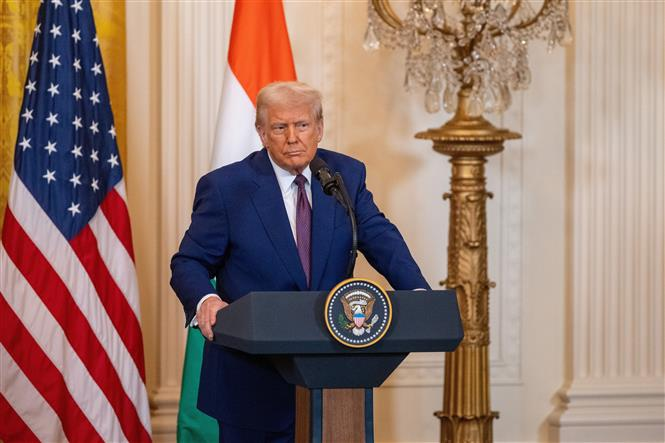
President Donald Trump’s latest wave of pardons, announced this week on May 28, 2025, has unleashed a torrent of criticism, with detractors arguing that the Republican Party’s longstanding claims to champion “law and order,” family values, and morality have been irreparably tarnished. The pardons, which include reality TV stars Todd and Julie Chrisley, convicted of fraud and tax evasion, and former Rep. Michael Grimm, who pleaded guilty to tax evasion, have fueled accusations that Trump rewards loyalty over justice, eroding the GOP’s moral authority and exposing a hypocrisy that critics say will haunt the party for years.
The Chrisleys, sentenced in 2022 to 12 and seven years for defrauding banks of $30 million, were pardoned after their daughter Savannah’s public advocacy, including appearances with Trump’s daughter-in-law Lara Trump. Grimm, a former Staten Island congressman, served seven months for concealing $900,000 in restaurant revenue. Other pardons included Virginia Sheriff Scott Jenkins, convicted in a “cash-for-badges” bribery scheme, and Paul Walczak, a nursing home executive whose mother, a GOP donor, attended a $1 million Mar-a-Lago fundraiser. Critics argue these acts prioritize political allegiance, with NBC News reporting Trump’s pattern of favoring allies convicted of financial crimes.
Democrats and independents have seized on the pardons to challenge the GOP’s “law and order” mantra. Rep. Zoe Lofgren (D-CA) told CNN, “This isn’t justice; it’s a loyalty racket.” The GOP, long branding itself as the party of moral rectitude, faces accusations of abandoning principles like accountability and family values, especially after pardoning figures like Jenkins, who profited from public trust. A 2025 Pew poll shows only 31% of Americans trust the GOP on ethical governance, down from 45% in 2020, reflecting the damage.
Trump’s defenders, including White House spokesperson Harrison Fields, argue the pardons correct a “weaponized” justice system, citing Walczak’s claim of being targeted for his family’s conservative politics. Supporters point to Trump’s 52% “right track” rating in a Rasmussen poll, suggesting public backing for his clemency decisions. They frame the Chrisleys’ pardon as mercy for a family unfairly targeted, though court records show their fraud spanned years, undermining claims of innocence.
The broader context of Trump’s clemency—over 1,600 pardons, including 1,500 January 6 rioters—intensifies the backlash. NPR reported that dozens of those pardoned had prior convictions for serious crimes like rape and manslaughter, clashing with the GOP’s “back the blue” rhetoric, given 140 officers were injured on January 6. Legal scholars like Liz Oyer, a former DOJ pardon attorney, told PBS that Trump’s actions signal a “two-tiered justice system” favoring the connected, contradicting traditional pardon criteria of remorse and rehabilitation.
The outrage reflects a deeper disillusionment. Critics argue that by pardoning loyalists while preaching morality, Republicans have lost credibility. The Los Angeles Times noted that candidates campaigning under Trump’s banner must now reconcile this with their law-and-order stance, a challenge as midterms loom. For many, the pardons symbolize a GOP unmoored from its values, leaving voters to question whether “family values” and “morality” are now mere political slogans.