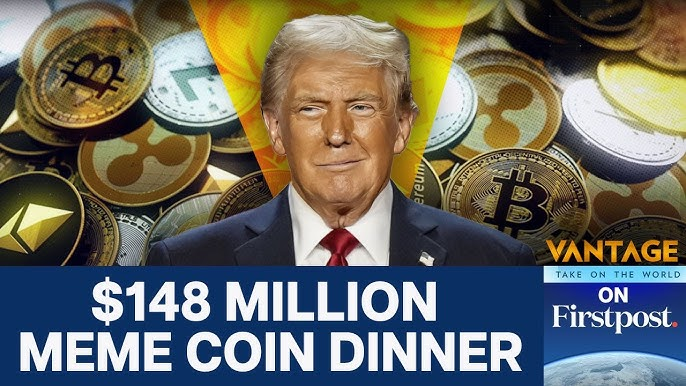
Washington, D.C. – President Donald Trump’s exclusive May 22, 2025, gala for top $TRUMP memecoin holders at Trump National Golf Club has sparked accusations that he’s not just promoting a cryptocurrency but selling political influence. Critics, echoing sentiments like those on X from
@CalltoActivism, argue the event, attended largely by foreign crypto investors like Chinese billionaire Justin Sun, represents a “pay-to-play” scheme, leveraging Trump’s presidency for personal gain. As legal and ethical concerns mount, the memecoin controversy is fueling debates over the commodification of political access.
The $TRUMP memecoin, launched in January 2025, soared 50% after Trump announced the dinner, offering top 220 holders a seat and the top 25 a VIP White House tour. CNBC reported that 18 of the top 25 holders used foreign exchanges like Binance, banned for U.S. users, with Sun, who holds $18 million in tokens, leading the pack. Sun’s $75 million investment in Trump’s World Liberty Financial (WLF) project, which nets Trump’s family 75% of revenues, coincided with the Securities and Exchange Commission (SEC) pausing fraud charges against him in February, prompting allegations of favoritism.
Democratic lawmakers, including Sen. Elizabeth Warren, have seized on the gala as evidence of corruption, calling it a “marketplace for political favors.” A Center for American Progress report warned that the pseudonymous nature of crypto wallets allows foreign actors to buy access without scrutiny, potentially violating Federal Election Commission (FEC) rules. The timing of Sun’s dropped charges, alongside Trump’s SEC appointee Paul Atkins’ deregulatory stance, has fueled claims of a quid pro quo, with
@MuellerSheWrote on X labeling it “blatant influence peddling.”
Trump’s team insists the event promotes “freedom of speech” through blockchain innovation, with WLF claiming it disbursed “tens of millions” to investors. However, a Philadelphia class action lawsuit filed May 8 alleges America PAC, linked to Musk’s voter payment schemes, failed to deliver promised $100 petition-signing rewards, drawing parallels to $TRUMP’s unfulfilled promises. The suit, per Reuters, estimates unpaid sums exceed $5 million, with potential damages topping $100 million if election law violations are proven.
Ethics watchdogs, like Accountable.US, call the memecoin a “self-enrichment scam,” noting Trump’s 80% control of $TRUMP’s supply and his family’s WLF stake. The coin’s volatility—peaking at $75 and crashing to $12—has led to $3.9 billion in investor losses, per The New Republic. Republicans, wary of backlash, have largely avoided defending Trump, with Sen. Cynthia Lummis urging clearer crypto regulations. Meanwhile, civil rights groups warn that such schemes erode democratic trust, especially after Musk’s voter payment controversies.
As Trump’s influence grows, the memecoin gala underscores a troubling convergence of politics and profit. The nation watches whether legal challenges will expose a deeper web of favors or fade as political noise.