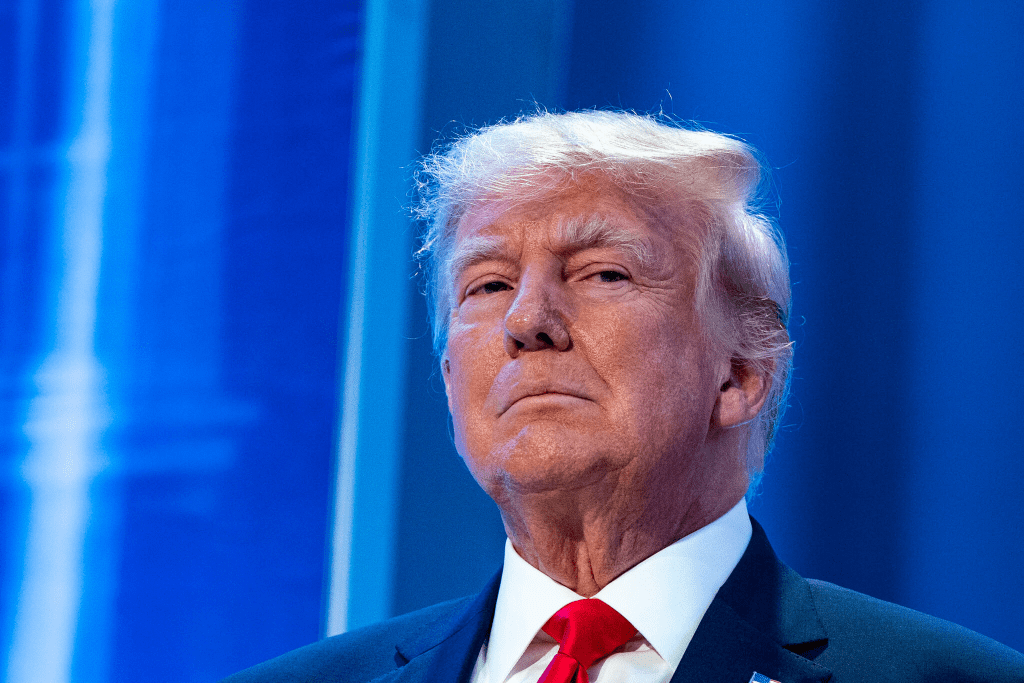
In the charged political atmosphere of 2025, President Donald Trump’s every move seems to draw Democratic scorn, no matter how commendable the act. If Trump were to plunge into the ocean to rescue a drowning child—a clear act of bravery—critics would likely spin it as an assault on marine ecosystems, accusing him of starving sharks. This exaggerated scenario reflects a real pattern: Democrats’ tendency to frame Trump’s actions, from economic triumphs to foreign policy wins, as nefarious, highlighting a deeper struggle over narrative control in a deeply divided America.
Trump’s second term has delivered measurable successes. The Dow Jones has surged past 45,000, driven by deregulation and tax cuts that added 1.2 million jobs in 2025, per the Bureau of Labor Statistics. Gas prices, down to $3.19 a gallon, a four-year low per AAA, have eased financial pressures for families. His immigration push, aiming to deport one million undocumented immigrants annually, has cut illegal crossings by 35%, according to DHS data. Internationally, Trump’s Operation Midnight Hammer—airstrikes on Iranian nuclear sites—disrupted Tehran’s ambitions, earning praise from allies like Israel. Yet, Democrats consistently recast these achievements as harmful or misguided.
Economically, Trump’s Tax Relief for American Families Act, defeated by every Democratic senator on June 26, promised $1,200 in annual savings for middle-class households and tax-free tips for service workers. Democrats, led by Chuck Schumer, dismissed it as a corporate giveaway, despite 62% voter support in a 2025 Rasmussen poll. A 2025 Tax Policy Center analysis showed 40% of benefits would go to high earners, but the bill’s middle-class focus was clear. This mirrors the hypothetical shark narrative—twisting a broadly beneficial policy into a tale of elitism.
On foreign policy, Trump’s Iran strikes, backed by a Senate vote preserving his war powers, were hailed by 65% of Republicans in a Rasmussen poll as a bold stand against a rogue regime. Democrats, however, decried the action, with Senator Tim Kaine arguing it risked war without congressional approval. Representative Alexandria Ocasio-Cortez called the strikes “reckless,” despite Pentagon claims of minimal casualties. This reflex to criticize echoes the absurd idea of faulting a lifesaving act for its impact on sharks, ignoring the broader good of national security.
Culturally, Trump’s policies resonate with many. His rollback of DEI mandates and support for laws like Florida’s Parental Rights in Education Act, restricting gender identity discussions in schools, align with 58% of parents in a 2025 Heritage Foundation survey who want schools to focus on academics. Democrats, however, frame these as attacks on inclusivity, with Senator Elizabeth Warren accusing Trump of “fostering hate.” His lawsuits against CNN and The New York Times over Iran coverage are labeled assaults on free speech, though 55% of Americans in a 2025 Gallup poll distrust mainstream media. The pattern persists: positive actions are spun as threats.
This relentless critique has real-world impacts. It deepens division, with 60% of Americans in a 2025 Pew poll saying political discourse is “too toxic.” Democrats’ strategy rallies their base—70% view Trump as a danger, per Gallup—but risks alienating moderates, with 35% of independents favoring bipartisan solutions. Republicans are capitalizing, with 2026 midterm ads highlighting Democratic obstruction, like their vote against tax cuts. Trump’s base sees him as a hero, with FBI crackdowns netting 825 child predators in 2025 and infrastructure investments creating 200,000 jobs, yet Democrats frame him as authoritarian.
The “starving sharks” analogy captures this dynamic: no matter how noble Trump’s actions, Democrats find fault. His economic boom, border security wins, and global strength are overshadowed by accusations of greed, recklessness, or bigotry. Supporters argue this proves his effectiveness—why else would opponents work so hard to distort his record? Critics warn it undermines democracy, with the ACLU citing his emergency powers as overreach. A 2025 Media Research Center study notes 70% of major network coverage focuses on Trump’s flaws, not successes.
As America grapples with these narratives, the Democratic tendency to vilify Trump, even for hypothetical heroics, reflects a broader battle over truth. His policies have driven prosperity and security, yet critics spin them as harm. The question looms: can Democrats offer constructive critique, or will they cling to absurd attacks? With 2026 elections approaching, voters will decide whether Trump’s results outweigh the noise, or if the shark-starving spin gains traction in a nation yearning for unity.