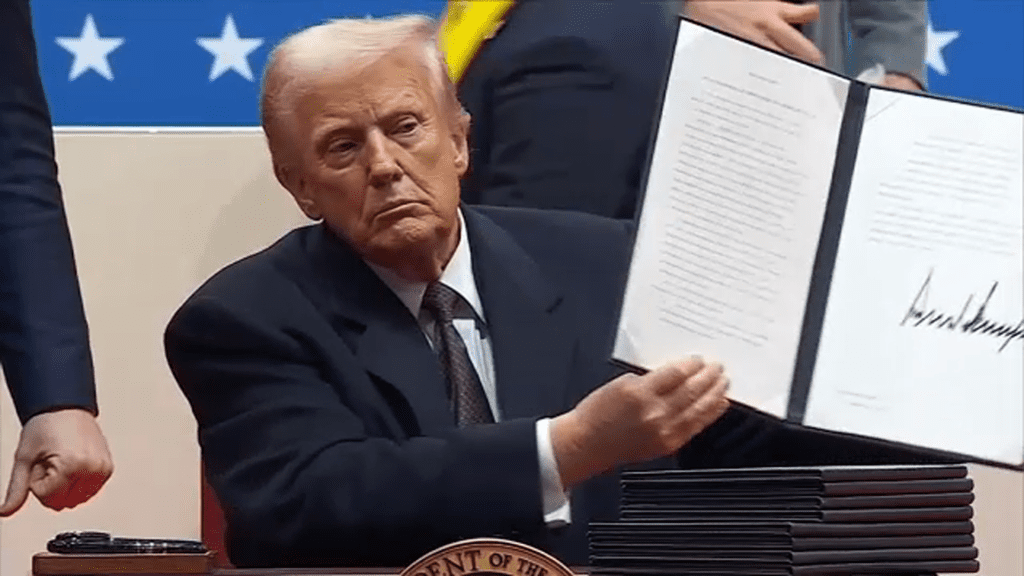
WASHINGTON – President Donald Trump ignited a fresh battle over election integrity Saturday night, announcing on Truth Social his intent to issue an executive order mandating voter identification for every ballot cast in U.S. elections. “Voter I.D. Must Be Part of Every Single Vote. NO EXCEPTIONS! I Will Be Doing An Executive Order To That End!!!” Trump declared, framing the proposal as essential to “bring HONESTY” ahead of the 2026 midterms. The move extends his earlier efforts, including a March executive order requiring proof of citizenship for voter registration, and signals an aggressive federal push into a domain traditionally reserved for states.
Currently, 36 states enforce some form of ID requirement at polling places, ranging from photo IDs in 23 states to non-photo documents like utility bills in others. The remaining 14 states and Washington, D.C., rely on alternative verifications, such as signature matches. Trump’s order, if enacted, would impose a uniform national standard, potentially overriding these variations and affecting millions, particularly in Democratic-leaning areas. It also pairs with his call to sharply restrict mail-in voting, limiting it to the severely ill or military personnel—a stance rooted in his persistent, unsubstantiated claims of 2020 fraud, despite his 2024 victory.
Legal experts swiftly condemned the plan as unconstitutional. The U.S. Constitution delegates election regulation to states, with Congress holding override authority—not the executive branch. “This would be an unprecedented power grab,” said UCLA law professor Rick Hasen, noting prior Trump initiatives, like citizenship proof mandates, were blocked by federal judges in Massachusetts and Washington, D.C. A June ruling deemed such measures risked disenfranchising up to 21 million citizens lacking easy access to documents like passports or birth certificates.
Voting rights advocates, including the Brennan Center for Justice and League of Women Voters, decried the proposal as a veiled assault on marginalized groups. Studies show strict ID laws disproportionately burden minorities, seniors, low-income voters, students, and people with disabilities—communities where up to 11% lack compliant IDs. “Voter fraud is vanishingly rare, yet these barriers silence the very voices democracy needs,” argued Wendy Weiser of the Brennan Center. Groups vowed immediate lawsuits, predicting the order’s demise in court.
Republicans hailed the announcement as a safeguard against “election chaos.” House Speaker Mike Johnson praised it as “common-sense reform,” while Senate Minority Leader Mitch McConnell urged swift congressional backing via bills like the SAVE Act. Democrats, led by Senate Majority Leader Chuck Schumer, branded it “voter suppression theater,” warning of eroded turnout in battleground states.
As White House lawyers draft the order, expected within weeks, the nation braces for litigation that could redefine federal overreach. With midterms looming, Trump’s gambit underscores a polarized electorate: one side demanding ironclad security, the other fearing silenced ballots. Whether this mandate endures or crumbles, it has already supercharged the fight for America’s vote.