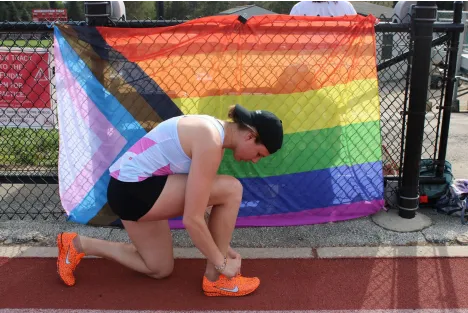
Philadelphia – Evie Parts, a 22-year-old transgender distance runner, has opened up about the harrowing toll of her legal crusade against Swarthmore College and the NCAA, blasting the battle as profoundly “not fair” after revealing it plunged her into suicidal thoughts and panic attacks. The senior, who graduated in May after a reinstated stint on the women’s track team, filed suit in August alleging discrimination that shattered her athletic dreams and mental health.
Parts, a four-time honor roll student who once clinched the 10,000 meters at the Bill Butler Invitational, was sidelined in February when the NCAA’s “Trans Ban” policy—barring transgender women from women’s competitions—took effect. Swarthmore officials, including athletics director Brad Koch and coach Peter Carroll, allegedly pressured her to join the men’s team or compete unattached, denying medical support unless she complied. “They told me I’d only get treatment if I ran with the guys,” Parts recounted, her voice breaking in a Teen Vogue interview. The ordeal, she claims, sparked a “dangerous depressive state” of self-harm and despair, where pre-race anxiety morphed into fears of disqualification at the starting line.
“This is not fair that I’m having to think about this,” Parts told the magazine, contrasting her torment with peers plotting race tactics. “Everybody else is thinking about strategy, and I’m wondering if I’ll even be allowed to race.” Her lawsuit seeks damages for emotional distress and civil conspiracy, arguing the NCAA—a private entity—oversteps Title IX and Pennsylvania law. Reinstated in April after advocacy, Parts raced until graduation but carries scars: “When I finished that 10K, I started crying—exhausted, not just physically.”
Swarthmore insists it balanced support for Parts with NCAA compliance amid “rapidly evolving guidance,” valuing its transgender community. The NCAA, silent on the suit, faces a parallel challenge from Rochester Institute of Technology’s Sadie Schreiner, who sued Princeton over a similar ouster. Parts’ attorney, Susie Cirilli, decries the policy as “bigoted,” vowing to shield trans athletes’ futures.
As Title IX debates rage under Trump’s scrutiny, Parts’ saga spotlights the human cost: A runner’s stride halted not by injury, but by identity. “I just want to run,” she pleads—hoping courts clear the track for those chasing the same.