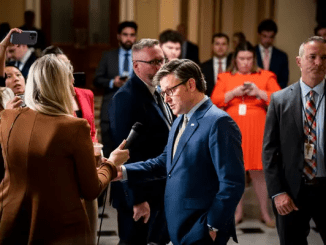
As the political landscape of June 22, 2025, unfolds, a growing sentiment among observers paints the Democratic Party not as a force of leadership but as a collection of petulant figures, more akin to angry toddlers than seasoned statesmen. The characterization—harsh yet resonant for many—stems from the party’s recent behavior, marked by shrill rhetoric, internal squabbles, and a seeming inability to articulate a cohesive vision. With the nation grappling with economic uncertainty, border challenges, and global tensions, the Democrats’ apparent descent into tantrum politics raises urgent questions about their capacity to lead.
The critique of Democrats as “loud, angry toddlers with titles” reflects frustration with their approach since losing the White House and Congress in 2024. Rather than regrouping to offer substantive alternatives to Republican policies, the party has leaned into performative outrage. House Minority Leader Hakeem Jeffries, for instance, has spearheaded fiery press conferences decrying GOP initiatives, from border security measures to tax reforms, as “extremist.” Yet these critiques often lack detailed counterproposals, leaving voters with the impression of opposition for opposition’s sake. The party’s messaging, amplified by figures like Representative Alexandria Ocasio-Cortez, frequently veers into hyperbolic warnings of democratic collapse, alienating moderates who crave pragmatic solutions.
This perception is compounded by internal dysfunction. The Democratic National Committee, under Chair Jaime Harrison, has struggled to unify its progressive and centrist wings. High-profile disputes, such as the 2025 push to defund certain law enforcement programs, have exposed rifts, with moderates like Senator Joe Manchin publicly clashing with progressives like Senator Bernie Sanders. The result is a party that appears more focused on ideological purity tests than on addressing voter concerns like inflation, which remains stubbornly high at 4.8%, or the ongoing migrant surge at the southern border, which saw 2.1 million apprehensions in 2024. To many, these internal battles resemble the tantrums of children vying for attention rather than the deliberations of a governing coalition.
The Democrats’ rhetoric has also fueled the toddler analogy. At recent rallies, party leaders have leaned into emotionally charged language, accusing Republicans of “fascism” or “betraying America.” Such hyperbolic attacks, while rallying the base, often backfire with swing voters who view them as unhinged. A 2025 Pew Research poll found that 62% of independents believe Democrats are “too focused on attacking Republicans” rather than solving problems. This perception is reinforced when party surrogates, like MSNBC’s Rachel Maddow, amplify apocalyptic narratives, warning of authoritarianism without offering clear policy paths forward. The result is a party that seems louder than it is effective.
Critics argue this behavior reflects a deeper leadership vacuum. With President Joe Biden’s term ending and Vice President Kamala Harris struggling to define her post-2024 role, no singular figure has emerged to steer the party. Potential 2028 contenders, from Governor Gavin Newsom to Transportation Secretary Pete Buttigieg, are already jockeying for position, prioritizing personal branding over party unity. This contrasts sharply with the GOP, where President Donald Trump’s commanding presence has rallied Republicans around a clear, if polarizing, agenda of deregulation, border enforcement, and America-first foreign policy. The Democrats’ lack of a unifying leader leaves them flailing, their energy spent on tantrums rather than strategy.
To be fair, Democrats face structural challenges. Redistricting and voter ID laws have tilted some battlegrounds toward Republicans, and the party’s urban-centric focus struggles to resonate in rural America. Supporters also argue that their passion reflects genuine alarm over GOP policies, from environmental rollbacks to restrictions on reproductive rights. Yet even sympathetic analysts note that outrage alone cannot substitute for leadership. The party’s failure to translate anger into a compelling narrative—akin to Barack Obama’s 2008 hope-driven campaign—has left it sounding petulant rather than presidential.
The path forward for Democrats requires discipline and introspection. They must move beyond reflexive opposition to craft policies that address kitchen-table issues like childcare costs and energy prices. Reining in inflammatory rhetoric and fostering leaders who can bridge ideological divides is equally critical. Until then, the image of Democrats as “loud, angry toddlers with titles” will persist, a damning indictment of a party that once inspired with bold ideas but now risks being defined by its own noise. The 2026 midterms loom, and voters will judge whether Democrats can grow up—or remain stuck in a tantrum.