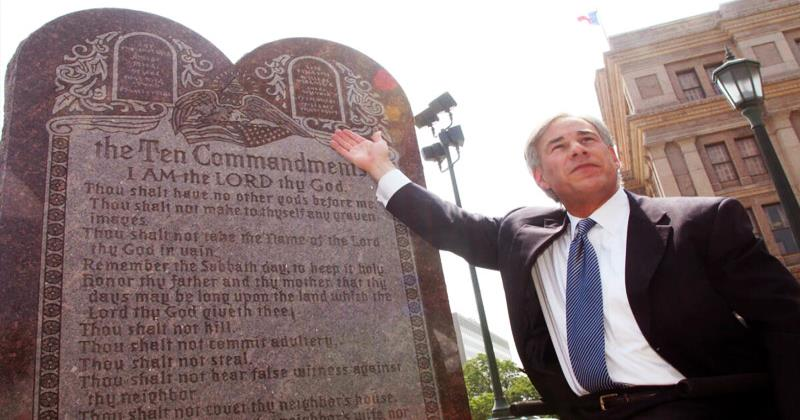
On June 21, 2025, Texas Governor Greg Abbott signed Senate Bill 10 into law, mandating that every public school classroom display the Ten Commandments starting in the 2025-2026 school year. The move, hailed by supporters as a return to America’s moral roots, has sparked fervent celebration among conservatives and sharp criticism from those who see it as a breach of church-state separation. With nearly 6 million students across 9,100 schools affected, Texas now leads a conservative push to reintroduce religious elements into public education, raising questions about legality, inclusion, and the future of American classrooms.
The law requires each classroom to display a 16-by-20-inch poster or framed copy of the Ten Commandments, using the King James Bible’s Protestant version, legible from anywhere in the room. Schools must accept privately donated displays meeting these standards but can use district funds if needed. Sponsored by Senator Phil King and Representative Candy Noble, the bill passed the Texas Senate 20-11 on March 19 and the House 82-46 on May 25, with final Senate approval on May 28. Noble argued the commandments are “historically important to our nation educationally and judicially,” echoing supporters who see them as foundational to American values.
Abbott, who as attorney general in 2005 defended a Ten Commandments monument at the Texas Capitol before the Supreme Court, framed the law as a defense of the “American dream.” His signing of Senate Bill 11, allowing voluntary prayer and religious text reading in schools, complements this agenda. Supporters, including groups like Texas Values, celebrate the law as a counter to moral decline, citing a 2022 Supreme Court ruling in Kennedy v. Bremerton that upheld a coach’s right to pray on school grounds. They argue the commandments, revered by Christians, Jews, and Muslims, provide a universal moral framework for students.
Critics, however, see a constitutional violation. The First Amendment’s Establishment Clause prohibits government endorsement of religion, and a 1980 Supreme Court ruling in Stone v. Graham struck down a similar Kentucky law. Louisiana’s parallel mandate, passed in 2024, was deemed unconstitutional by the Fifth Circuit Court of Appeals on June 20, 2025, a ruling binding in Texas. Opponents, including the ACLU and Texas Freedom Network, warn the law excludes non-Christians—Texas is 42% Protestant, 22% Catholic, and less than 1% Jewish, with thousands of Hindu, Muslim, and atheist students. A letter from Christian and Jewish leaders noted the Protestant-specific text could alienate students whose faiths interpret the commandments differently.
The law’s legal safeguards reveal anticipation of challenges. An amendment ensures the state, not school districts, covers legal fees and judgments, with Attorney General Liz Murrell prepared to defend it, potentially to the Supreme Court. Critics like Representative James Talarico, a Democrat and seminary student, argue the mandate could push students away from religion by imposing it. The Texas Freedom Network’s Emily Witt called it a “coordinated strategy” to favor one faith, sending a message that “other religions don’t matter.” Teachers’ unions, like the Texas State Teachers Association, oppose it, citing educators’ discomfort with enforcing religious displays in secular settings.
The broader context shows Texas leading a conservative wave. Arkansas passed a similar law, also under legal scrutiny, while Oklahoma mandated Bible instruction in 2024. Texas’s 2023 chaplain program and “In God We Trust” display law reflect this trend. Supporters argue these measures counter cultural shifts—66% of Texans in a 2024 University of Texas poll support more religion in schools. Yet opponents fear coercion, noting the commandments’ references to adultery or idolatry may spark age-inappropriate questions in math or science classes.
As September 1, 2025, approaches, Texas braces for legal battles. The Fifth Circuit’s Louisiana ruling suggests courts may strike down SB 10, but a conservative-leaning Supreme Court could shift precedent. For now, Abbott’s base cheers a governor aligning schools with their vision of America’s Judeo-Christian heritage. Critics, meanwhile, see a dangerous precedent, threatening the diverse fabric of Texas’s 5.4 million students. As one supporter put it, “Thank you, Governor Abbott, for standing for our values.” Whether this law endures or falls, it marks a pivotal moment in the fight over religion, education, and America’s identity, with implications far beyond the Lone Star State.