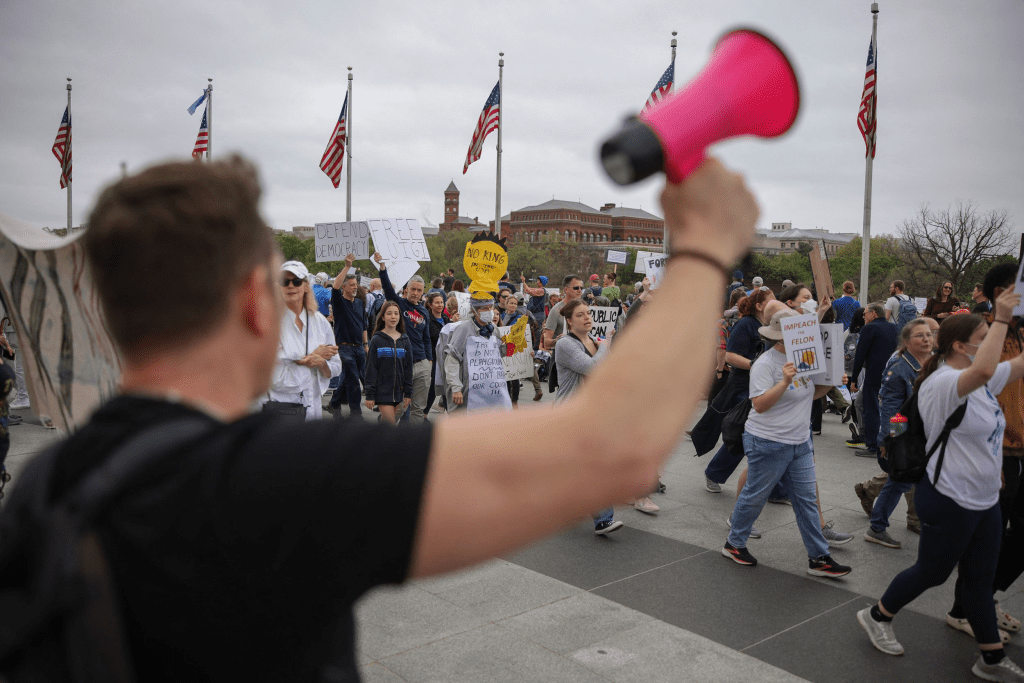
A planned “No Kings” protest in Hollywood, Florida, set for June 15, 2025, has been abruptly canceled due to insufficient anticipated attendance, marking a rare setback for the nationwide anti-Trump movement. The rally, part of nearly 2,000 demonstrations organized to oppose President Donald Trump’s policies and his $45 million military parade in Washington, D.C., was expected to draw crowds across the state. The cancellation highlights challenges facing organizers in Florida, where strong law enforcement warnings and political dynamics may be dampening turnout.
The “No Kings” protests, led by groups like Indivisible and the 50501 Movement, aim to reject what organizers call Trump’s authoritarianism, particularly his immigration raids targeting 3,000 daily arrests. In Florida, over 75 rallies were scheduled, from Miami to Port St. Lucie, to counter Trump’s parade celebrating the U.S. Army’s 250th anniversary, Flag Day, and his 79th birthday. The Hollywood event, slated for a public park, was meant to echo the movement’s chant of “no thrones, no crowns, no kings.” Instead, organizers pulled the plug, citing too few confirmed participants to justify the effort.
Florida’s cancellation stands out against the backdrop of robust protest plans elsewhere. In Los Angeles, where ICE raids sparked riots causing $5.2 million in damages and 47 officer injuries, demonstrations remain fierce. Philadelphia’s flagship “No Kings” march expects thousands. Yet, in Hollywood, the lack of enthusiasm could signal local fatigue or fear. Governor Ron DeSantis and state officials have taken a hardline stance, warning that any violence—such as throwing bricks or blocking roads—could lead to arrests or worse. Brevard County Sheriff Wayne Ivey’s blunt threat to “kill you graveyard dead” for attacking deputies may have chilled participation.
The state’s 2021 anti-riot law, which imposes harsh penalties for violent protests, adds another layer of caution. DeSantis has also stirred controversy by claiming drivers can hit protesters blocking roads if they feel threatened, though legal experts warn such actions risk felony charges. With 48% of Americans supporting Trump’s immigration crackdown, Florida’s conservative lean—evident in its 2024 vote for Trump—may further explain the tepid response. Organizers’ commitment to nonviolence and de-escalation, while principled, faces a tough sell in a state primed for confrontation.
Critics of the cancellation argue it hands Trump a symbolic win, especially as his parade, featuring 6,600 soldiers and 60-ton tanks, dominates headlines. Supporters of the president, buoyed by 52% approval in battleground states, see the low turnout as proof of weak opposition. Meanwhile, “No Kings” advocates insist the movement remains strong, pointing to successful rallies elsewhere and their focus on high-visibility sites like city halls. The Hollywood cancellation, they say, reflects strategic reallocation, not defeat.
The broader context is stark. Trump’s raids, netting 32,809 arrests since January, and his deployment of 700 Marines to Los Angeles have galvanized resistance but also exposed its limits. In Florida, where the economy relies on immigrant labor, protests face competing pressures: fear of escalation and economic disruption. The cancellation in Hollywood, while minor in scale, underscores a truth: even a national movement struggles to rally where local realities—legal, political, and cultural—push back.
As the “No Kings” protests unfold nationwide, Florida’s stumble may be a blip or a warning. For now, the Sunshine State’s streets will stay quiet, leaving the fight to other cities and the question of momentum unanswered.