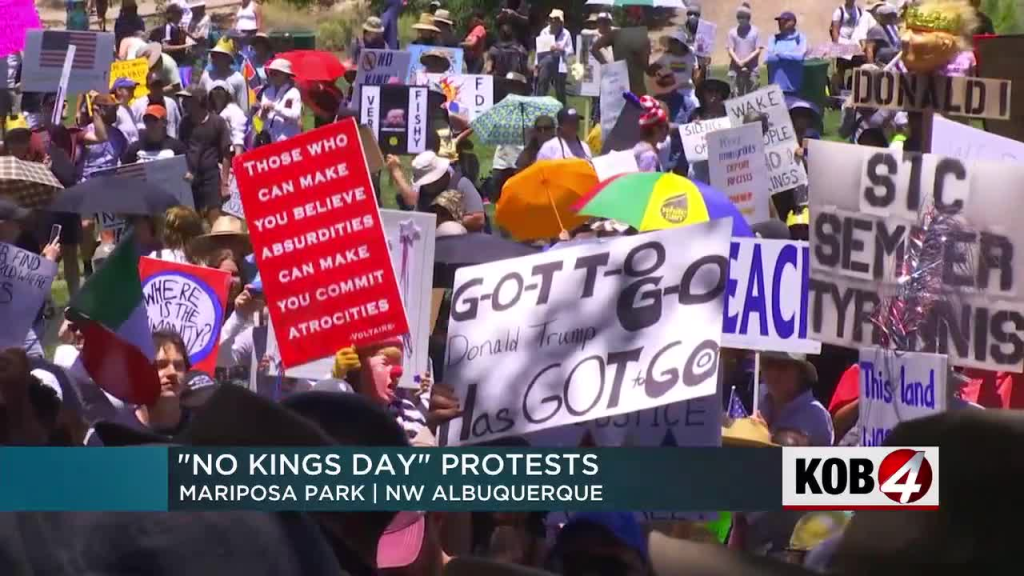
Washington, D.C., June 18, 2025—The “No Kings Day” protests on June 14, which mobilized 4-6 million Americans across 2,100 events, aimed to challenge President Donald Trump’s mass deportation policies and perceived authoritarianism. Organized by groups like the ACLU and Indivisible, the demonstrations denounced the detention of 150,000 undocumented immigrants and the deployment of 700 Marines in Los Angeles. Yet, as critics mock the protests as a “massive fail,” with “no kings” toppled and no policy reversals, questions linger: did the marches achieve anything beyond symbolic defiance?
Protesters sought to halt Trump’s immigration crackdown, which has ramped up since January 2025, with ICE arresting 2,200 people on June 3 alone, a record high. Rallies in cities like Los Angeles, New York, and Chicago demanded an end to raids, family separations, and military involvement, with chants of “No more deportations!” echoing through Manhattan. Organizers hailed the turnout—over 100,000 in Philadelphia—as a show of solidarity, claiming it pressured Democratic leaders to act. California’s lawsuit against ICE tactics, filed June 10, was cited as a direct response, per the ACLU.
Tangible outcomes, however, remain elusive. Trump’s administration, undeterred, vowed to continue deportations, with White House Press Secretary Karoline Leavitt declaring the “largest mass deportation operation in history” underway. ICE’s daily arrests, now at 2,000, aim for 3,000, per Deputy Chief of Staff Stephen Miller, far from slowing down. The deployment of 4,000 National Guard troops in Los Angeles, federalized against Governor Gavin Newsom’s wishes, proceeded despite protests. A Pew Research poll shows 52% of Americans support the deportations, suggesting limited public sway.
Some argue the protests amplified marginalized voices. In San Diego, over 1,000 marched to the “Coming Together” sculpture, symbolizing unity, while Chicago’s 400 volunteers saw a 300% surge in anti-deportation efforts. Legal advocates, like the Immigrant Legal Resource Center, distributed resources on immigrants’ rights, and the ACLU filed 50 lawsuits challenging Trump’s policies, including a temporary block on the Alien Enemies Act’s use. These steps, activists claim, bolstered community resilience and slowed enforcement in court, though no major policy was overturned.
Critics, however, see the protests as impotent. Violence in Los Angeles, where ten sheriff’s deputies were injured and $50 million in damages reported, undermined the message, with 1,200 arrests diluting the focus on peaceful dissent. Trump’s base, energized by his 2024 landslide (312 electoral votes, 50.2% popular vote), dismissed the protests as “insurrection,” with 59% of Republicans in a Rasmussen Reports poll viewing them as orchestrated chaos. The lack of concrete policy changes—deportations rose 24% in April—has led some to call the effort a “symbolic tantrum.”
The protests’ broader impact may lie in galvanizing opposition. Senator Alex Padilla (D-CA) warned that Trump’s policies “create chaos” for businesses and families, spurring state resistance like California’s sanctuary laws. Yet, with 1,800 more protests planned and no sign of Trump retreating, the movement faces an uphill battle. Political scientist Rachel Blum notes that without unified Democratic strategy or broader public support, the protests risk fading into noise, failing to shift the needle on deportations or perceptions of Trump’s power.
For now, “No Kings Day” stands as a defiant cry against Trump’s agenda, amplifying fears of authoritarianism but struggling to translate passion into policy wins. As deportations continue and courts remain the primary battleground, the protests’ legacy may be their scale, not their success, leaving America still grappling with its divisions.