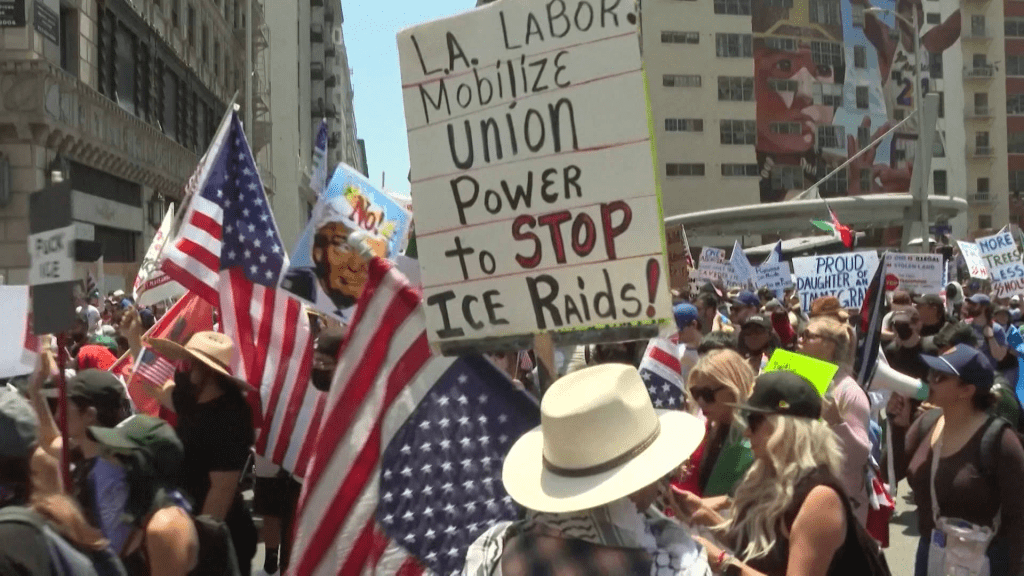
Los Angeles, June 17, 2025—The “No Kings Day” protests, which drew an estimated 4-6 million Americans on June 14 to oppose President Donald Trump’s policies, have taken a troubling turn as some participants misinterpret the movement’s goals, with isolated calls to loot stores circulating online. Framed as a stand against Trump’s perceived authoritarianism, particularly his mass deportation program and military deployments, the protests have largely been peaceful. However, confusion among some activists—evident in questions like which stores to target to “stop America from having a king”—has raised alarms about the movement’s coherence and risks derailing its message.
The protests, organized by groups like the 50501 Movement and Indivisible, targeted Trump’s immigration crackdowns, which have detained 150,000 undocumented immigrants since January, and the deployment of 700 Marines in Los Angeles to secure federal assets. Demonstrators in cities like Philadelphia and Seattle rallied under the “No Kings” banner, rejecting what they see as Trump’s unchecked power, especially after his 2024 landslide victory (312 electoral votes, 50.2% popular vote). Yet, scattered online posts and flyers, particularly in Los Angeles, have urged looting retail stores as a form of resistance, prompting swift condemnation from organizers.
Protest leaders have disavowed such tactics, emphasizing nonviolence and civic engagement. “Looting isn’t activism; it’s chaos that hurts our cause,” said Maria Torres of the 50501 Movement at a Los Angeles press conference. Authorities report that looting incidents—targeting stores like Target and Walmart in South LA—were limited, with 1,200 arrests tied to vandalism and theft during the protests, per LAPD data. A Rasmussen Reports poll shows 68% of Americans, including 55% of Democrats, oppose property destruction as protest, highlighting broad disapproval of such acts.
The confusion stems partly from misinformation and the movement’s decentralized nature. Some younger protesters, new to activism, have latched onto hyperbolic rhetoric, misinterpreting calls to “disrupt the system” as endorsements of criminal acts. Political scientist Rachel Blum noted that fragmented messaging can lead to “misguided actions that alienate allies.” In Seattle, a viral flyer listing “stores to hit” was traced to a fringe group unaffiliated with major organizers, yet it fueled perceptions of disarray. The Los Angeles Times reported that such flyers contributed to $50 million in damages citywide.
Trump supporters have seized on the looting calls to discredit the protests entirely. At a Mar-a-Lago rally, Trump labeled demonstrators “thugs paid to riot,” echoing claims that Democratic groups fund unrest—allegations lacking evidence of widespread payments, per FactCheck.org. The narrative has resonated with his base, with 59% of Republicans in a Pew Research poll viewing the protests as illegitimate. Meanwhile, Democratic leaders like California Senator Alex Padilla have urged protesters to focus on legal challenges, like a pending lawsuit against ICE tactics, rather than destructive acts.
The “No Kings Day” movement faces a critical moment. While its scale reflects genuine anger over Trump’s policies, including military involvement in domestic unrest, the specter of looting risks overshadowing its goals. Organizers are now emphasizing voter mobilization and legal advocacy to counter Trump’s agenda, with 1,800 more protests planned this month. For activists confused about the movement’s aims, the message is clear: resistance lies in ballots and courtrooms, not broken storefronts. As the nation grapples with its democratic identity, the protests’ success hinges on clarity and discipline to avoid fueling the very authoritarian narrative they seek to dismantle.