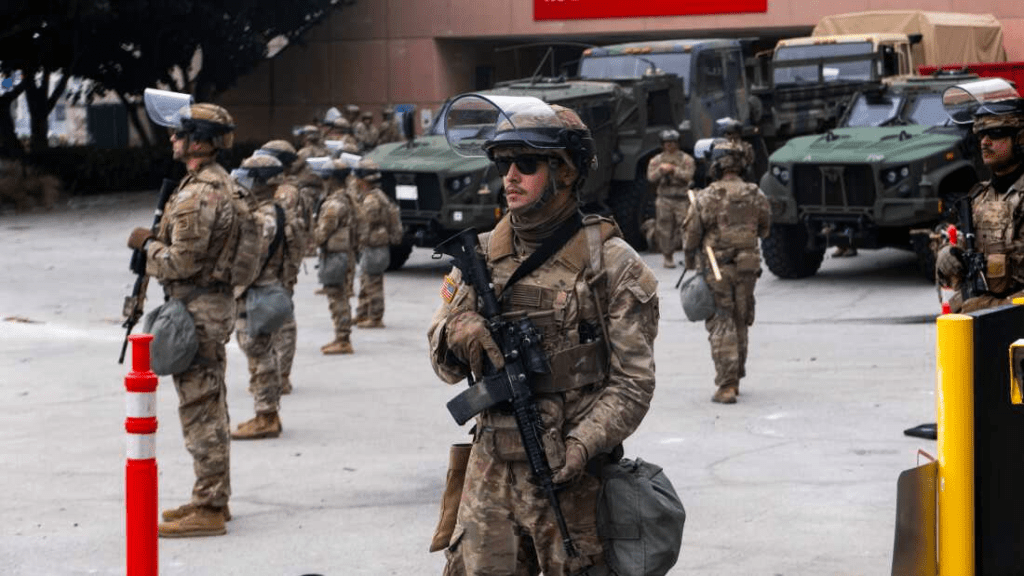
Los Angeles is bracing for a new chapter in its ongoing unrest as U.S. Marines, deployed by President Donald Trump to quell violent anti-ICE protests, hit the streets with a mission described as “mostly peaceful” by federal officials. The irony isn’t lost on critics, who note the phrase mirrors how some have downplayed the riots that have left the city reeling with looted businesses, burned vehicles, and injured officers. As tensions escalate, the arrival of heavily armed Marines signals a dramatic escalation in the battle to restore order.
The protests, sparked by Trump’s expanded ICE operations targeting 3,000 daily arrests, have gripped Los Angeles for weeks. What began as rallies against deportations has spiraled into chaos, with 338 arrests, 18 looted stores, and $5.2 million in damages reported in the past week alone. Five Waymo robotaxis were set ablaze, and 47 police officers were hospitalized after clashes involving projectiles and Molotov cocktails. City leaders, including Mayor Karen Bass, have struggled to contain the violence, prompting Trump to send in 1,500 Marines alongside National Guard units to “secure the streets.”
The administration’s description of the Marines’ mission as “mostly peaceful” has raised eyebrows, echoing the language used by some Democrats to describe the protests themselves. Federal officials insist the Marines are there to de-escalate, focusing on protecting critical infrastructure and assisting local law enforcement. But their presence—marked by armored vehicles and tactical gear—has intensified fears among protesters and residents alike. Community organizers warn that military intervention risks inflaming an already volatile situation, pointing to historical flashpoints like the 1992 LA riots.
For Trump’s supporters, the deployment is a long-overdue response to lawlessness. They argue that the Marines, trained for precision and discipline, are exactly what’s needed to stop rioters who’ve exploited “peaceful” protests to wreak havoc. Small business owners, like a Koreatown shopkeeper whose store was looted twice, cheered the move, saying, “Someone has to protect us.” Polls show 48% of Americans back Trump’s immigration crackdown, with many in LA’s suburbs echoing the call for stronger measures to curb the violence.
Critics, however, see the Marines’ arrival as a dangerous overreach. Protest leaders argue that militarizing the response to what they view as legitimate dissent only deepens community mistrust. Reports of “collateral arrests” during ICE raids, including U.S. citizens detained by mistake, have fueled accusations of heavy-handed tactics. A viral incident involving a Marine patrol detaining a protester for “suspicious behavior” later revealed to be a legal resident has added to the outcry. Civil rights groups are now threatening lawsuits, citing violations of free speech and assembly.
The stakes are high for Los Angeles, a city already scarred by economic strain and social division. The protests have disrupted daily life, with public transit halted and entire neighborhoods boarded up. The Marines’ presence, while intended to restore calm, risks becoming a flashpoint itself. If their operations are as “mostly peaceful” as the protests they’re meant to control, the city could face more destruction before peace is achieved.
As the Marines patrol LA’s streets, the nation watches a city at a crossroads. For some, they’re a symbol of order; for others, a threat to freedom. The irony of their “peaceful” label cuts deep in a city where the line between protest and riot has blurred beyond recognition.