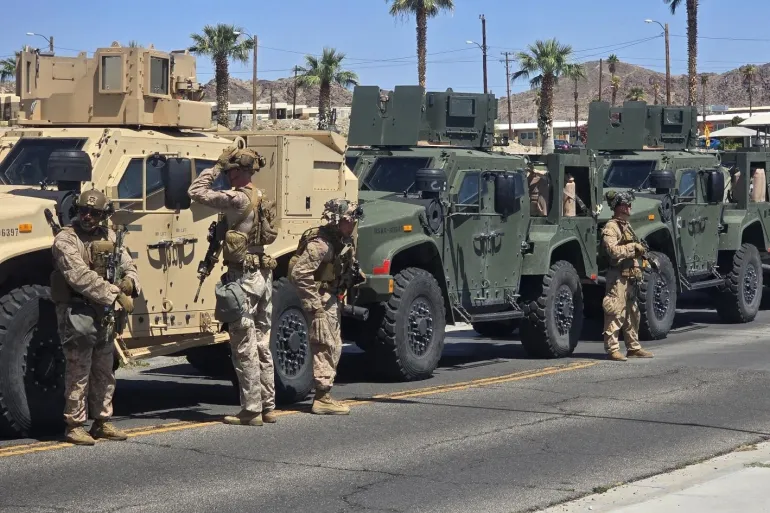
Los Angeles, June 16, 2025—In a significant escalation of federal response to ongoing protests, approximately 700 U.S. Marines have been deployed to Los Angeles to safeguard federal properties and personnel. The move, ordered by President Donald Trump, follows days of demonstrations sparked by aggressive immigration enforcement operations in the city. While supporters of the deployment view it as a necessary step to restore order, critics argue it risks militarizing civilian spaces and inflaming tensions.
The protests began on June 6, triggered by Immigration and Customs Enforcement (ICE) raids targeting workplaces and communities across Los Angeles. Demonstrations, largely concentrated in downtown areas, have been mostly peaceful but occasionally marred by violence, including arson and vandalism. Over the weekend, President federalized 2,000 California National Guard troops, a decision that drew sharp criticism from Governor Gavin Newsom, who called it an unlawful overreach. The addition of Marines from the 2nd Battalion, 7th Marines, based in Twentynine Palms, marks a rare use of active-duty military on U.S. soil.
Pentagon officials, including Major General Scott Sherman, have emphasized that the Marines’ role is strictly limited to protecting federal buildings, such as the Wilshire Federal Building, and supporting ICE agents by securing perimeters during raids. “Our soldiers will not engage in law enforcement activities,” Sherman stated, noting that the Marines are equipped with riot shields, batons, and non-lethal gear, though they carry live ammunition. The deployment has already seen its first reported action, with detaining a civilian—identified as a U.S. Army veteran—who crossed a restricted area, before being handed over to federal authorities.
The Trump administration justifies the deployment under Title 10 of the U.S. Code, citing a “danger of rebellion” against federal authority. White House press secretary Karoline Leavitt stated, “President Trump promised to protect our cities and enforce the law, and that’s what we’re doing.” Supporters argue the military presence is critical to prevent further chaos, pointing to incidents of property damage and clashes with police. They see the operation as a fulfillment of Trump’s campaign pledge to prioritize national security and immigration enforcement.
However, the deployment has met fierce opposition. Governor Newsom, alongside California Attorney General Rob Bonta, has filed a federal lawsuit challenging the use of both the National Guard and Marines, arguing it violates the Posse Comitatus Act, which restricts active-duty military from domestic law enforcement unless the Insurrection Act is invoked—an action Trump has not taken. Newsom called the deployment “a provocation, not a solution,” warning it could escalate tensions. Los Angeles Police Chief Jim McDonnell echoed concerns, noting the lack of coordination with local law enforcement poses “significant logistical challenges.”
Critics, including legal experts, warn that the Marines’ presence risks blurring the line between military and civilian roles. A recent court ruling by U.S. District Judge Charles Breyer deemed the National Guard’s federalization illegal, though an appeals court temporarily paused the order, allowing troops to remain. The ongoing legal battle underscores deep divisions over the use of military force in domestic protests. Some service members, speaking anonymously to advocacy groups, have expressed unease, describing the assignment as a “political game” that undermines morale.
As Los Angeles braces for more protests, with 1,800 demonstrations planned nationwide, the city remains under a nighttime curfew. Mayor Karen Bass has urged calm, emphasizing that local police are equipped to handle unrest without federal intervention. Yet, with 4,700 troops now in the city, including 200 Marines actively guarding federal sites, the situation remains tense. The deployment, hailed by some as a bold defense of federal authority, continues to spark debate over the balance between security and civil liberties in America’s second-largest city.