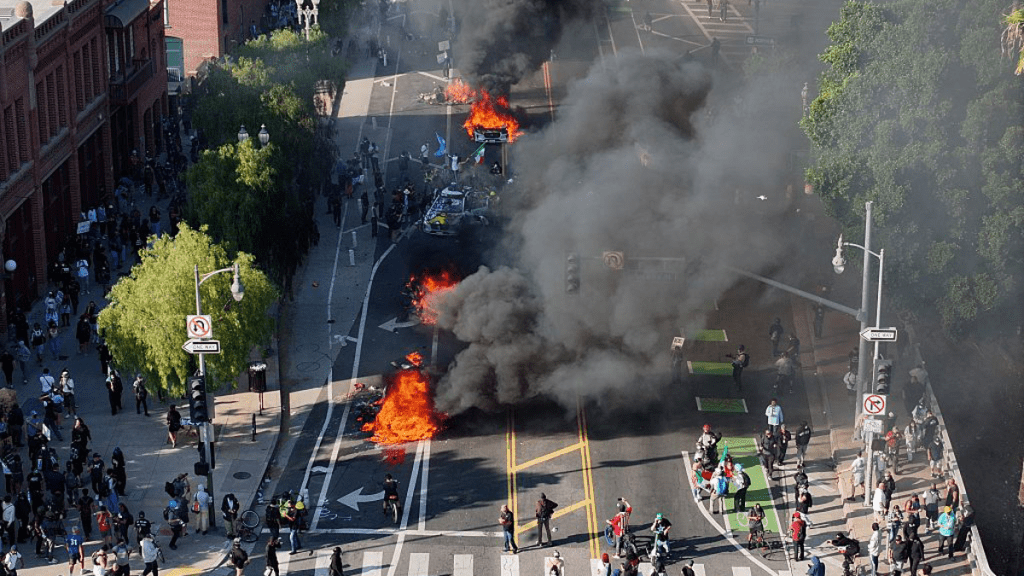
The recent riots in Los Angeles, initially sparked by President Donald Trump’s aggressive ICE raids, are increasingly being viewed as far from organic outbursts of anger. Mounting evidence and official statements point to coordinated efforts by organized groups, raising questions about the true forces behind the chaos that has gripped the city. With $5.2 million in damages, 338 arrests, and 47 injured officers, the unrest reveals a calculated push rather than a grassroots uprising.
The violence erupted on June 6, 2025, following ICE operations targeting 3,000 daily arrests nationwide, including 118 undocumented immigrants in LA, five of whom were alleged gang members. Protests, centered in downtown and Paramount, quickly escalated into riots, with demonstrators torching five Waymo cars, looting 18 businesses, and hurling Molotov cocktails. While some rallies remained peaceful, the presence of sophisticated tactics—gas masks, coordinated blockades, and even battery-operated leaf blowers used to redirect tear gas—suggests premeditation. Los Angeles County Sheriff Robert Luna is now investigating whether outside groups orchestrated the violence, noting that many arrested rioters were not local residents.
Federal officials, including the Department of Homeland Security, have condemned the riots as orchestrated attacks on law enforcement, citing over 1,000 rioters surrounding a federal building, slashing tires, and defacing property. The White House has claimed that “professional agitators” are exploiting immigration tensions, pointing to the uniformity of tactics and symbols, like keffiyehs worn by many rioters, as evidence of planning. Trump’s deployment of 700 Marines and 4,000 National Guard troops underscores the administration’s belief that the unrest is a deliberate challenge to federal authority.
Critics of the “organic” narrative argue that the riots serve a broader anti-government agenda. The presence of well-equipped protesters, some with prior protest-related arrests in other states, suggests a network of trained activists. In LA, 20% of arrestees had out-of-state records, fueling speculation of external funding and coordination. The FBI is now probing potential financial backers, with some pointing to large nonprofits or foreign entities as possible culprits, though no concrete evidence has yet emerged.
Defenders of the protests, including Mayor Karen Bass and Governor Gavin Newsom, insist the unrest stems from genuine fear and anger over ICE’s tactics, particularly “collateral arrests” of non-criminal immigrants. They argue that labeling the riots as organized oversimplifies the issue, dismissing the real grievances of LA’s immigrant communities, where over one-third of residents are foreign-born. Bass has called the federal response, including military deployment, an overreach that escalates tensions rather than addressing root causes like economic disparity and distrust in law enforcement.
The truth likely lies in a messy middle. While some protesters are local residents voicing legitimate concerns, the scale and sophistication of the violence—graffiti on federal buildings, targeted attacks on police—point to a core of organized actors. The riots’ economic toll, including $50 million in damages nationwide, and their spread to cities like San Francisco and New York suggest a broader strategy. As investigations deepen, the question remains: who stands to gain from turning LA’s streets into a battleground?
For now, the narrative of spontaneous protest is unraveling. The deployment of drones by Homeland Security to monitor the unrest and reports of journalists being targeted—35 incidents, including rubber bullet injuries—further underscore the riots’ intensity. Whether driven by ideology or external agendas, LA’s chaos is proving to be anything but random, leaving a city and a nation grappling with its implications.