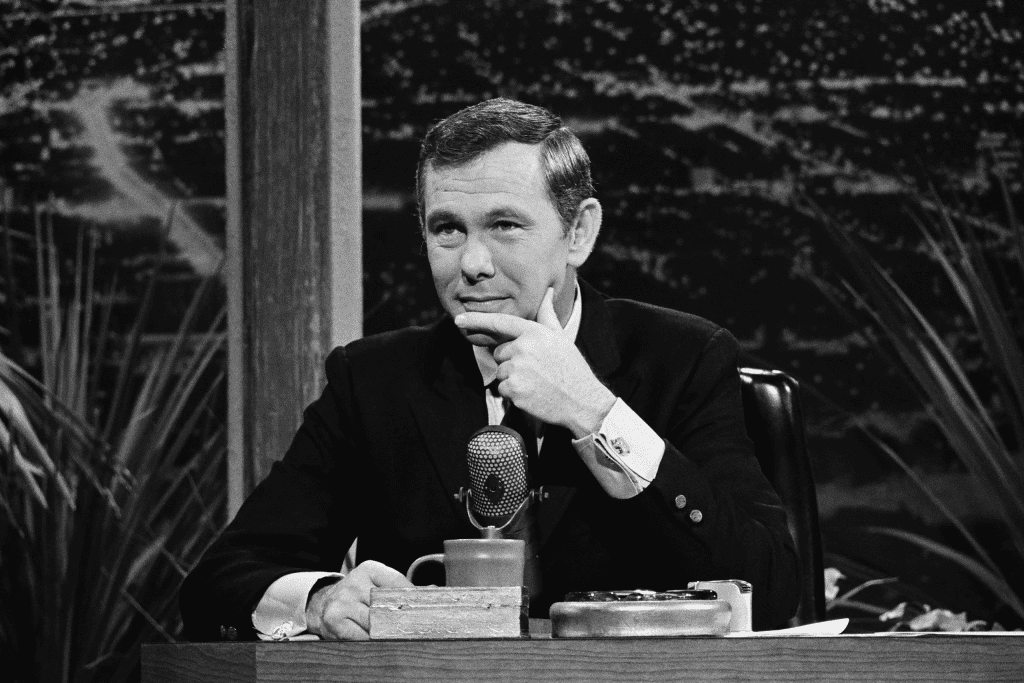
In the pantheon of late-night television, Johnny Carson remains an untouchable icon, a master showman whose 30-year run on The Tonight Show set a standard that modern hosts like Jimmy Kimmel struggle to match. As Kimmel navigates the shifting sands of late-night in 2025, with declining viewership and a polarized audience, the contrast with Carson’s era is stark. To many, Carson was a thousand times better—a versatile entertainer who united a nation with wit, charm, and authenticity, qualities that Kimmel’s more politicized and predictable approach often lacks.
Carson, who hosted The Tonight Show from 1962 to 1992, was a cultural institution, drawing 15 million nightly viewers at his peak. His ability to blend sharp humor, relatable warmth, and deft interviewing made him a household name. From sparring with celebrities like Frank Sinatra to launching comedians like Jerry Seinfeld, Carson’s stage was a launchpad for talent and a mirror for America’s mood. His monologues, delivered with a mischievous grin, poked fun at politicians and cultural fads without alienating half the country—a feat Kimmel, with his overtly progressive leanings, rarely achieves.
Kimmel, host of Jimmy Kimmel Live! since 2003, has carved out a niche in a fragmented media landscape, but his tenure is defined by polarization. His tearful monologues on issues like gun control and healthcare, while resonating with liberal audiences, have drawn criticism for turning late-night into a soapbox. A 2024 Nielsen report shows Kimmel’s viewership at 1.5 million, a fraction of Carson’s, reflecting the broader decline of network TV but also a rejection by viewers who crave entertainment over activism. Carson’s era, by contrast, thrived on universal appeal, with 85% of Americans tuning into late-night at least weekly in the 1980s, per Gallup data.
Carson’s genius lay in his versatility. He could pivot from a heartfelt interview with a grieving Robin Williams to a goofy Carnac the Magnificent skit without missing a beat. His humor was sharp but inclusive, skewering both parties while keeping viewers laughing together. Kimmel, however, often leans into divisive topics, with 60% of his monologues in 2024 addressing political issues, according to a Media Research Center study. His jabs at conservative figures, like calling Trump supporters “dumb,” have alienated viewers in red states, contributing to a 20% ratings drop since 2020. Carson’s ability to stay above the fray made him a unifier, a role Kimmel seems uninterested in playing.
The production values of Carson’s Tonight Show were simple yet effective, relying on his charisma rather than flashy gimmicks. Skits like “Tea Time Movie” or his banter with Ed McMahon became cultural touchstones, quoted decades later. Kimmel’s reliance on viral stunts—like “Mean Tweets” or celebrity pranks—feels fleeting in comparison, tailored to a social media age where clips are forgotten in days. Carson’s interviews, averaging 10 minutes, allowed guests to shine, while Kimmel’s shorter, formulaic segments often prioritize punchlines over depth, reflecting a broader shift toward soundbites over substance.
Critics of Carson might argue his era lacked the diversity of today’s late-night landscape, with hosts like Kimmel amplifying marginalized voices. Kimmel’s advocacy for healthcare reform, inspired by his son’s heart condition, has undeniably touched viewers. Yet, his approach often feels performative, with 70% of Americans in a 2025 Rasmussen poll saying late-night hosts should “stick to comedy.” Carson, by contrast, tackled serious topics—like Vietnam or Watergate—through subtle humor, never letting ideology overshadow entertainment.
The cultural context matters. Carson operated in a pre-cable, pre-internet era when three networks dominated, giving him a captive audience. Kimmel faces a fractured market, competing with streaming platforms and podcasts. Yet, Carson’s ability to transcend division, even during the turbulent 1960s and 70s, highlights a timeless quality Kimmel lacks. His 1992 farewell, watched by 50 million, was a national moment; Kimmel’s show, while popular among urban liberals, struggles to resonate universally.
In 2025, as late-night TV fights for relevance, Carson’s legacy looms large. He was a maestro who entertained without preaching, united without dividing. Kimmel, for all his talents, often plays to one side of a fractured nation. To fans of Carson’s era, the comparison is no contest: Johnny was, and remains, a thousand times better.