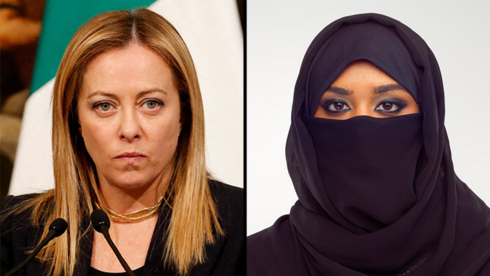
ROME – Italy’s right-wing Brothers of Italy party, spearheading Prime Minister Giorgia Meloni’s government, introduced a controversial bill Wednesday to ban face-covering garments like the burqa and niqab in all public spaces, framing it as a bulwark against “cultural separatism” linked to Islamic fundamentalism. If passed, violators could face fines ranging from €300 to €3,000 ($350 to $3,500), marking a significant escalation in Europe’s ongoing debate over religious expression and national cohesion.
The legislation, tabled in the Chamber of Deputies by party members Sara Kelany, Galeazzo Bignami, and Francesco Filini, prohibits the full-body burqa—complete with a mesh screen over the eyes—and the face-veiling niqab in schools, universities, shops, offices, and other public areas. It also targets mosque funding from foreign sources deemed incompatible with Italian values, aiming to curb “enclaves” where Sharia law allegedly supplants national norms. “Religious freedom is sacred, but it must be exercised openly, respecting our Constitution,” said Andrea Delmastro, a key proponent, in a Facebook post echoing the party’s stance on integration.
This proposal revives a 1975 law vaguely prohibiting face coverings for security reasons, but the new bill explicitly names Islamic attire, inspired by France’s 2011 burqa ban upheld by the European Court of Human Rights. Over 20 countries, including Austria, Belgium, and Switzerland, have similar restrictions, often justified as promoting “living together” in diverse societies. Italy’s measure aligns with Meloni’s hardline immigration policies, including naval blockades and asylum caps, amid a 15% rise in anti-Muslim incidents since 2023.
Critics, including the Italian Islamic Religious Community and human rights groups like Amnesty International, decried it as Islamophobic overreach. “This isn’t security—it’s stigmatizing Muslim women and eroding freedoms,” said Imam Yahya Pallavicini, a prominent moderate voice. Legal challenges loom, with opponents arguing it violates Article 8 of the European Convention on Human Rights. The bill heads to committee debate, likely passing in the right-dominated Parliament by year’s end.
As Europe grapples with migration and cultural tensions, Italy’s bid tests the balance between security and pluralism. For proponents, it’s a stand for Western values; for detractors, a step toward exclusion. With elections looming in 2027, Meloni’s gamble could solidify her base—or alienate moderates.