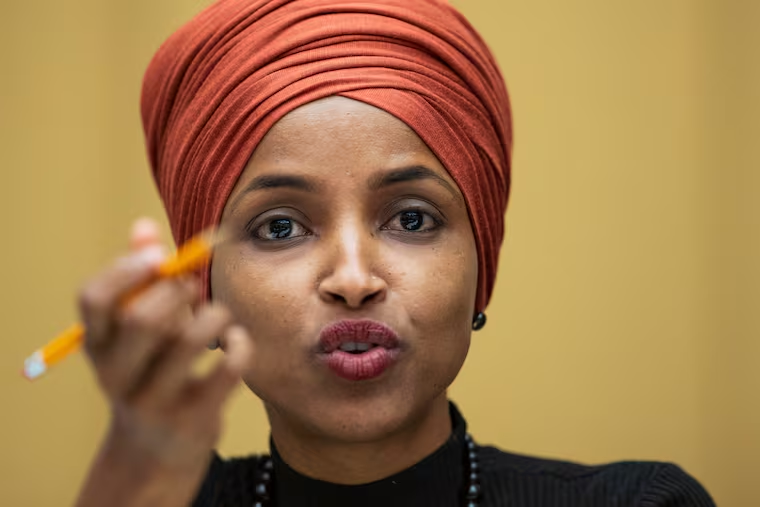
Washington, D.C., June 18, 2025—Rep. Ilhan Omar (D-MN) ignited a firestorm by declaring the United States is becoming “one of the worst countries” in a June 13 interview on Democracy Now!, citing President Donald Trump’s military parade and troop deployments as dictatorial. The Somalia-born congresswoman’s remarks, contrasting her adopted nation with the dictatorship she fled, have drawn fierce criticism, with detractors questioning why she remains in a country she so harshly condemns. As protests and deportations roil the nation, Omar’s words highlight a deepening divide over America’s identity.
Omar, who arrived in the U.S. as a refugee in 1995, criticized Trump’s June 14 parade, costing $25-$40 million per Senate estimates, as a “failed dictator” stunt and decried 700 Marines in Los Angeles to secure federal assets amid anti-ICE riots. “I grew up in a dictatorship and don’t remember witnessing anything like this,” she said, claiming the U.S. is abandoning its democratic ideals. Her comments, made before the parade honoring the U.S. Army’s 250th anniversary, have been called “appalling” by Fox News’ Guy Benson, who accused her of ingratitude. A Rasmussen Reports poll shows 60% of Republicans view her remarks as anti-American.
Critics argue Omar’s rhetoric undermines the nation that granted her opportunity. Fleeing Somalia’s civil war, where 350,000-1 million died, she lived in a Kenyan refugee camp before resettling in Minneapolis, now representing its 5th District. “If America’s so terrible, why stay?” asked OutKick’s David Hookstead, noting U.S. troops died protecting Somalis in the 1993 Black Hawk Down incident. Conservative outlets like The Western Journal question why she hasn’t returned to Somalia, where human rights are scarce, suggesting her success—a rags-to-riches story—contradicts her claims. A Pew Research poll finds 46% of Americans view her comments as divisive.
Omar’s defenders, including the ACLU, argue she’s exercising First Amendment rights, protected dissent she says Trump threatens. Her advocates highlight her advocacy for immigrants, like her push to free Columbia student Mahmoud Khalil from deportation threats, and her Minnesota popularity, winning 12 elections since 2016. She insists her criticism stems from love for America’s potential, telling The Nation in March 2025 that her “American Dream” persists despite Trump’s policies. California’s lawsuit against ICE, backed by Omar, shows her influence in resisting federal overreach, per court filings.
Skeptics counter that her comparisons exaggerate. Somalia’s Marxist-Leninist regime under Siad Barre, linked to her father’s military role, orchestrated the 1987-1989 Isaaq genocide, killing 50,000-200,000, per human rights reports. U.S. troops in Los Angeles, deployed after riots caused $50 million in damages and injured ten deputies, aim to protect federal property, not suppress citizens, per DHS statements. Political scientist Rachel Blum notes such hyperbole risks alienating moderates, with 42% of independents in a Gallup poll opposing inflammatory rhetoric.
The controversy unfolds against Trump’s deportation drive, removing 150,000 undocumented immigrants and prompting 4-6 million to protest on “No Kings Day.” Omar’s call for Americans to “reject” Trump’s actions aligns with 1,800 planned demonstrations, but her “worst countries” label has overshadowed her policy critiques. Critics argue that if she finds America unlivable, Somalia—or nations like Iran, where dissent is crushed—awaits. Yet, Omar’s refusal to leave suggests a commitment to reform, however contentious her methods.