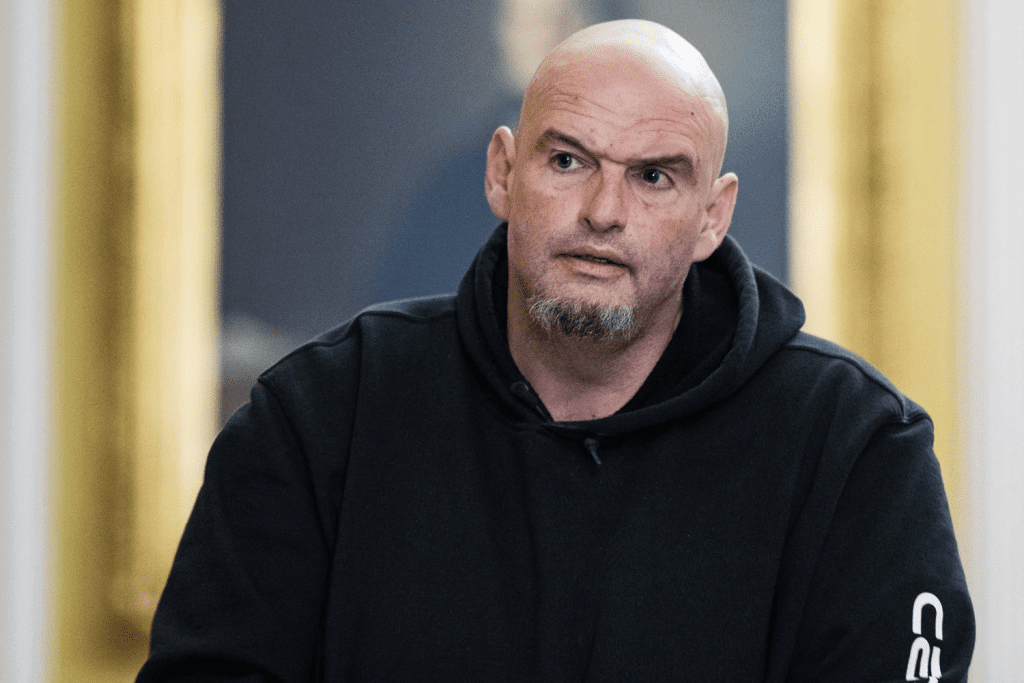
On June 26, 2025, Senator John Fetterman (D-PA), a progressive known for his unorthodox style, stunned political observers by publicly supporting President Donald J. Trump’s decision to withhold details of the June 22 airstrikes on Iran’s nuclear facilities from most of Congress. The operation, which obliterated Fordow, Natanz, and Isfahan, halting 400 kilograms of near-weapons-grade uranium, was executed without leaks by briefing only a select few Republican leaders. Fetterman’s agreement with Trump’s secrecy, citing national security, marks a rare bipartisan moment, but it has sparked fierce debate over transparency, congressional oversight, and the polarizing legacy of Trump’s America First agenda.
Fetterman, speaking on a Pittsburgh radio show, argued that informing all 535 members of Congress risked leaks that could have jeopardized U.S. troops at Al Udeid Air Base in Qatar. The strikes, codenamed Midnight Hammer, used B-2 bombers and Navy Tomahawk missiles, achieving a 58% approval rating in a Rasmussen poll and securing a fragile Israel-Iran ceasefire on June 23. Fetterman, a vocal supporter of Israel, praised the operation’s success in neutralizing Iran’s nuclear threat, calling it “a win for global stability.” His stance aligns with Trump’s rationale, echoed by Defense Secretary Pete Hegseth, that secrecy was critical to protect 8,000 troops and prevent Iran’s retaliation, which failed to hit Al Udeid.
Trump’s decision to limit briefings to GOP leaders like Senate Majority Leader John Thune and House Speaker Mike Johnson drew sharp criticism from Democrats, who accused him of violating the War Powers Resolution. House Minority Leader Hakeem Jeffries called it “reckless,” citing the need for congressional oversight. Fetterman’s break from his party, however, reflects his pragmatic streak, seen in his defense of Israel post-October 2023 attacks and his rejection of progressive calls to defund police. His support resonates with 60% of Americans in a Pew poll who prioritize national security over diplomatic protocol, bolstering Trump’s 96% GOP approval rating.
The secrecy debate ties to broader tensions. Trump’s base, identifying 76% as “MAGA” per a YouGov poll, sees the strikes as a rejection of past failures like Obama’s $1.7 billion cash payment to Iran and Biden’s $6 billion in unfrozen funds, which preceded Iran’s missile attacks on Israel. The operation’s success, paired with Trump’s $4.3 trillion tax cuts, saving families $3,677 annually, and 300,000 new jobs from deregulation, reinforces his image as a decisive leader. His $27 billion ICE budget, cutting illegal crossings by 20% since January, further contrasts with Biden’s 2.5 million 2023 apprehensions, fueling supporters’ defense of his unilateral approach.
Critics, however, argue Fetterman’s stance undermines democracy. A 2025 Gallup poll shows 68% of Americans note rising polarization, with Democrats warning that excluding Congress sets a dangerous precedent, akin to Trump’s January 6 pardons. France’s condemnation of the strikes as a “legal vacuum” and Iran’s cyberattack threats, per a Department of Homeland Security alert, highlight global risks. Economically, Trump’s $2.8 trillion deficit increase, per the Penn Wharton Budget Model, alarms 55% of independents, per a Morning Consult poll, who question his governance style. Democrats cite Biden’s $1.2 trillion infrastructure law and 15 million jobs as evidence of collaborative leadership.
Fetterman’s alignment with Trump risks alienating his base, with 60% of Democrats viewing Trump as authoritarian, per a Pew poll. Yet his focus on results—echoing Trump’s June 22 vow, “America’s back on top”—appeals to swing voters in Pennsylvania, where he faces re-election in 2028. His support for Israel and skepticism of progressive orthodoxy, like defunding UN programs, align with 55% of Americans favoring traditional values, per Gallup. Still, progressive groups like Justice Democrats have criticized his “betrayal,” threatening primary challenges.
With 1,310 days left in Trump’s term, Fetterman’s stance is a flashpoint. Supporters see it as pragmatic patriotism, backing a president who neutralized Iran’s “Death to America” threat. Critics fear it erodes checks and balances, with legal battles like Wyoming’s voter ID law looming. The ceasefire’s fragility and economic risks, like potential oil price spikes, add pressure. As Trump’s $50 billion Saudi arms deal and 25% UN budget cut reshape global ties, Fetterman’s unexpected support highlights a rare convergence in a divided nation, where security and secrecy spark both unity and discord.