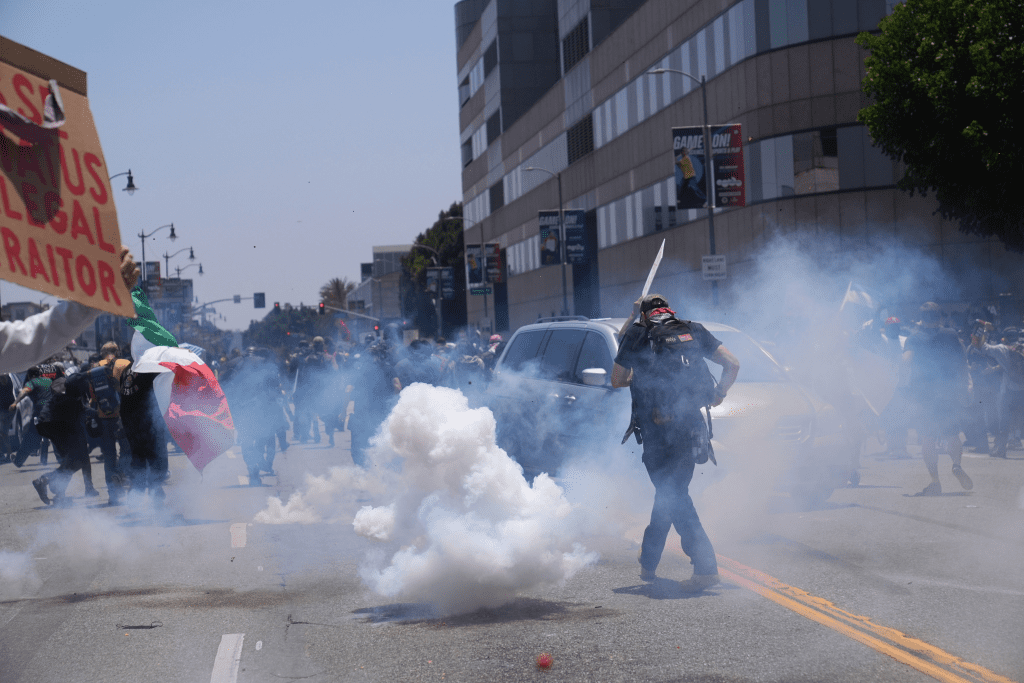
Los Angeles, June 17, 2025—A wave of violence targeting Los Angeles County Sheriff’s deputies has left ten injured in a single week, as protests against President Donald Trump’s immigration policies spiral into chaos. Fueled by far-left agitators hurling rocks, Molotov cocktails, and high-grade pyrotechnics, the unrest has prompted urgent calls to restore order amid nationwide demonstrations. The injuries, reported during anti-ICE raids, highlight a volatile clash between law enforcement and protesters, raising fears of further escalation as tensions grip the city.
The violence erupted on June 6, following Immigration and Customs Enforcement (ICE) raids detaining 150,000 undocumented immigrants across Southern California. Protests, initially peaceful, turned volatile, with Los Angeles County Sheriff Robert G. Luna reporting that deputies faced “interesting weapons” like explosives and concrete chunks. The ten injuries, sustained between June 7 and June 13, included burns and concussions, with one deputy hospitalized after a Molotov cocktail attack in Compton, per sheriff’s department reports. Luna emphasized a “big difference” between peaceful protesters and those attacking officers, urging lawful demonstrations.
The unrest, part of the broader “No Kings Day” protests on June 14, saw 200,000 march in Los Angeles alone, decrying Trump’s deployment of 2,000 National Guard troops and 700 Marines to secure federal assets. While most protests remained nonviolent, far-left groups have been blamed for inciting chaos, with some glorifying violence against police, according to the Network Contagion Research Institute. Los Angeles Police Chief Jim McDonnell reported 1,200 arrests citywide, with charges ranging from arson to assault, as rioters set Waymo vehicles ablaze and graffitied federal buildings.
Conservative leaders, including Trump, have condemned the violence, framing it as an attack on law and order. “These are not protests—they’re insurrections,” Trump said at a Mar-a-Lago rally, pointing to his 2024 landslide victory (312 electoral votes, 50.2% popular vote) as a mandate to crack down. Supporters argue the deputies’ injuries justify stronger measures, with 59% of Republicans in a Rasmussen Reports poll viewing the protests as orchestrated by “paid agitators.” Calls for invoking the Insurrection Act are growing, though no action has been taken.
Critics, including California Governor Gavin Newsom, argue Trump’s militarized response is inflaming tensions. “This violence is a reaction to federal overreach,” Newsom said, noting the state’s sanctuary laws and suing over the National Guard’s federalization. Protesters like Robert Meraz, a public defender struck by an LAPD bean-bag munition, insist police aggression escalates conflicts, with 600 rounds of less-lethal munitions used, per LAPD data. A Pew Research poll shows 46% of Americans worry about excessive force, though 52% support the deportations driving the unrest.
The injured deputies, part of a department already strained by 444 resignations in 2024, underscore the toll of ongoing clashes. Sheriff Luna, speaking at a June 13 press conference, called the attacks “unacceptable,” vowing to prosecute violent actors. Los Angeles County District Attorney Nathan Hochman echoed this, warning that those hurling cinder blocks or setting fires face severe consequences. With 1,800 protests planned nationwide and a curfew in effect, the city braces for more unrest, testing the balance between free expression and public safety.
As Los Angeles grapples with this violence, the nation watches a deepening divide. For some, the injured deputies symbolize a system under siege, demanding stronger enforcement. For others, the unrest reflects resistance to federal policies seen as oppressive. With no end in sight, the call to stop the violence grows louder, but solutions remain elusive in a city—and country—torn by competing visions of justice.