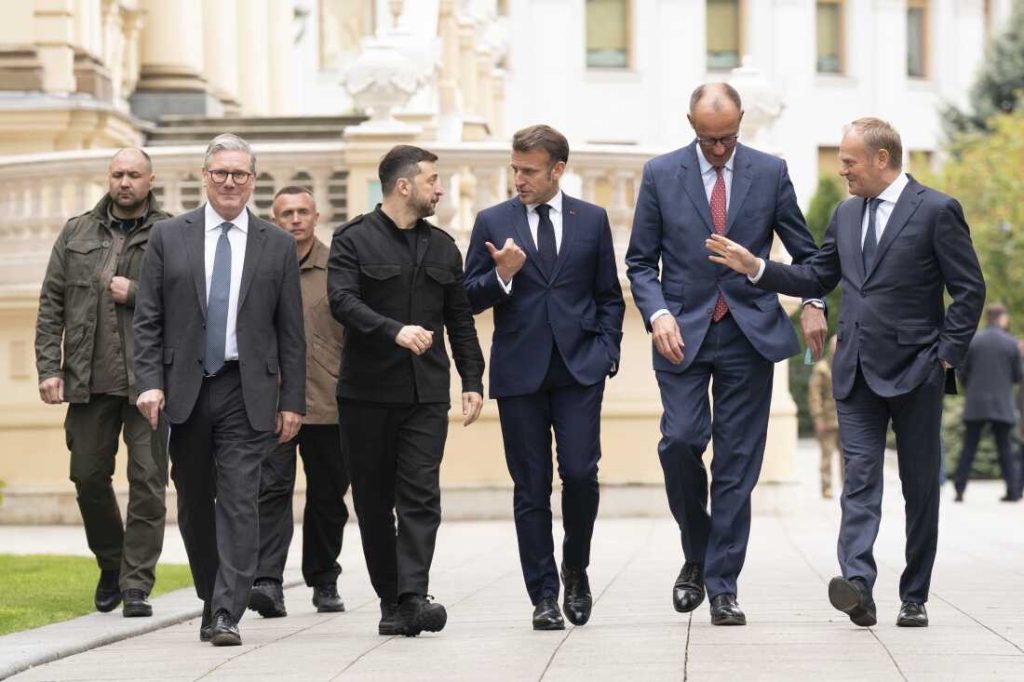
Kyiv, Ukraine, May 12, 2025 — European leaders have delivered a stark ultimatum to Russian President Vladimir Putin: agree to a 30-day unconditional ceasefire by the end of Monday, or face “massive” new sanctions and increased weapons transfers to Ukraine. The announcement, made during a historic joint visit to Kyiv on Saturday, marks a significant escalation in Western pressure on Moscow as the war in Ukraine, now in its third year, shows no signs of abating.
The leaders of Britain, France, Germany, and Poland—Prime Minister Keir Starmer, President Emmanuel Macron, Chancellor Friedrich Merz, and Prime Minister Donald Tusk—stood alongside Ukrainian President Volodymyr Zelenskyy to issue the demand. Backed by U.S. President Donald Trump after a joint phone call, the coalition set a deadline of May 12 for Russia to comply, leaving Putin with less than 24 hours to respond as of early Monday. “All of us here, together with the U.S., are calling Putin out. If he’s serious about peace, then he has a chance to show it now,” Starmer declared at a press conference in Kyiv’s Maidan Square.
The proposed ceasefire would halt all fighting on land, air, and sea for 30 days, creating space for diplomacy to address the conflict that has killed tens of thousands and displaced millions since Russia’s 2022 invasion. Zelenskyy emphasized the need for an unconditional truce, stating, “Attempts to put forward any conditions would be evidence of an intention to prolong the war.” If Russia refuses, European leaders vowed to impose severe sanctions targeting its energy and banking sectors—already strained by years of Western measures—and to supply Ukraine with advanced weaponry to bolster its defense.
Putin, however, has already rejected the proposal. In a late-night Kremlin briefing on Sunday, he dismissed the ultimatum as “anti-Russian rhetoric” and instead suggested direct talks with Ukraine in Istanbul on Thursday, without preconditions. “We don’t exclude that during these negotiations we will be able to agree on new ceasefires,” Putin said, a statement Macron called “a first step, but not enough.” The French president stressed that an unconditional ceasefire cannot be preceded by negotiations, accusing Putin of trying to “buy time” while continuing military operations.
The ultimatum follows a symbolic three-day ceasefire declared by Russia from May 8 to 10, coinciding with its Victory Day celebrations marking 80 years since the Soviet victory in World War II. Ukraine reported numerous violations, with fighting continuing along frontlines and Russian shelling killing three in Sumy on Saturday. Zelenskyy called the ceasefire a “farce,” a sentiment echoed by Ukrainian soldiers on the ground who told Reuters that nothing had changed during the supposed truce.
European unity was on full display in Kyiv, with leaders joined remotely by figures like NATO Secretary General Mark Rutte and European Commission President Ursula von der Leyen, who endorsed the ceasefire and warned of “biting” sanctions if Russia breaches it. The U.S. has signaled support, with Trump noting on Truth Social that a 30-day ceasefire could be a step toward peace, though he has privately expressed frustration with both Putin and Zelenskyy for stalling negotiations. Critics, however, argue that Trump’s reluctance to take a firmer stance—despite his campaign promise to end the war in 24 hours—has emboldened Putin, leaving Europe to take the lead.
The move has drawn mixed reactions. On X, some users praised Europe’s resolve, with one calling it a “big success” for showing “leadership and courage Trump refused to show.” Others, like a post questioning Europe’s military backbone, dismissed the ultimatum as “hollow,” arguing that Western sanctions have failed to stop Russia’s war machine. Meanwhile, Kremlin spokesperson Dmitry Peskov accused Europe of “confrontational” statements, and former Russian President Dmitry Medvedev derided the proposal on X, telling European leaders to “shove these peace plans up your pangender arses.”
As the deadline looms, the stakes are high. A ceasefire could pave the way for meaningful peace talks, but Putin’s rejection and ongoing attacks—like a Sunday drone strike on Kyiv that injured one—suggest he’s unlikely to comply. If Russia refuses, Europe’s promised sanctions and weapons support could shift the conflict’s dynamics, though at the risk of further escalation. For now, the world watches as Ukraine braces for what comes next.