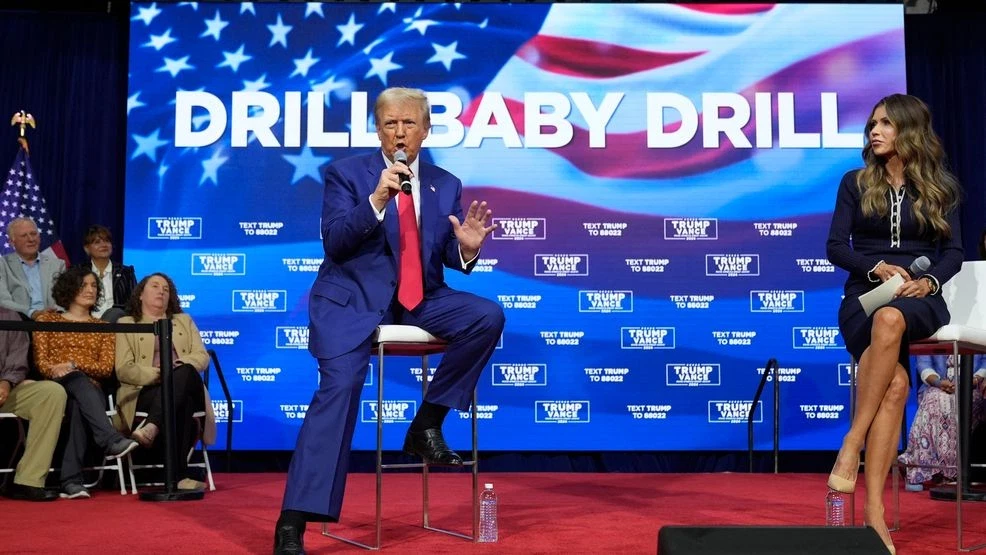
Washington, D.C., June 16, 2025—President Donald Trump’s rallying cry of “Drill Baby Drill” is once again shaping U.S. energy policy, with the administration announcing plans to open new oil fields in Alaska, the Gulf of Mexico, and federal lands in the West. Aimed at achieving energy dominance and lowering fuel prices, the move has energized supporters who see it as a bold step toward economic growth. Critics, however, warn of environmental devastation and a step backward in the fight against climate change, setting the stage for a fierce national debate.
The initiative, detailed in a June 15 executive order, reverses Biden-era restrictions on drilling, targeting 13 million acres in Alaska’s Arctic National Wildlife Refuge (ANWR) and 28 million acres offshore in the Gulf. The Department of the Interior also plans to lease 73 million acres in Wyoming, Utah, and New Mexico for oil and gas exploration. Trump, speaking at a Houston energy conference, framed the policy as a return to American self-reliance. “We’re unleashing our energy wealth to create jobs and crush prices at the pump,” he declared, citing average gas prices of $3.85 per gallon, up 10% from last year.
Supporters argue the expansion will boost the economy and reduce dependence on foreign oil. The American Petroleum Institute estimates the new fields could create 500,000 jobs and add $1 trillion to GDP over a decade. In Alaska, where unemployment hovers at 6.5%, local leaders like Governor Mike Dunleavy welcomed the move, projecting $2 billion in state revenue from ANWR drilling. Advocates also point to geopolitical benefits, noting that increased U.S. production could counter OPEC’s influence and support allies facing energy shortages amid Russia’s ongoing war in Ukraine.
Environmentalists and Democrats are sounding alarms, warning of irreversible ecological harm. The ANWR, home to polar bears and caribou, is a pristine ecosystem, and drilling risks oil spills and habitat destruction, according to the Sierra Club. Offshore expansion in the Gulf raises concerns about marine life and coastal communities still recovering from the 2010 Deepwater Horizon disaster. Senator Elizabeth Warren (D-MA) called the policy “a giveaway to Big Oil,” accusing Trump of ignoring climate commitments. A 2025 NOAA report projects rising sea levels and extreme weather if fossil fuel use isn’t curbed.
The economic argument is also contentious. While drilling could lower gas prices temporarily—by an estimated 15-20 cents per gallon, per the Energy Information Administration—critics argue it locks the U.S. into fossil fuels when renewables like solar and wind are cheaper and growing. The Inflation Reduction Act’s clean energy incentives, partially repealed by Trump, had spurred $200 billion in green investments since 2022. Opponents warn that diverting focus to oil undermines long-term energy security and global competitiveness, as China leads in clean tech.
Legal and political battles are already brewing. Environmental groups, including Earthjustice, have filed lawsuits to block ANWR leases, citing violations of the National Environmental Policy Act. In Congress, House Democrats are pushing a bill to reinstate drilling bans, though it faces a Republican-controlled Senate. Meanwhile, public opinion is split: a Pew Research poll shows 49% of Americans support expanded drilling, with 44% opposed, reflecting sharp partisan divides. Protests are planned in Anchorage and New Orleans, signaling grassroots resistance.
As Trump doubles down on fossil fuels, the “Drill Baby Drill” mantra encapsulates a broader vision of energy independence and economic revival. Yet, it also reignites a decades-old clash over America’s environmental and economic future. With oil fields set to open as early as 2026, the consequences—jobs, lower prices, or ecological harm—will shape the nation’s trajectory for years to come.