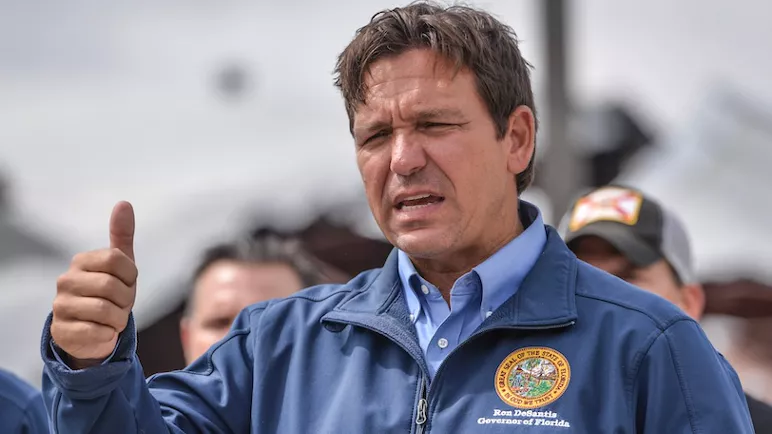
Florida Governor Ron DeSantis has ignited a firestorm by stating that drivers in his state can legally hit protesters blocking roads if they fear for their lives, a policy he framed as self-defense during a recent podcast appearance. The remark, tied to Florida’s 2021 Combating Public Disorder Act, has thrilled supporters who see it as a bold stand for law and order, while critics warn it could embolden violence and trample First Amendment rights. As protests against Trump’s ICE raids intensify, DeSantis’ words are adding fuel to a national debate.
Speaking on The Rubin Report, DeSantis addressed the chaos of recent anti-ICE protests in Los Angeles, where riots left $5.2 million in damages and 47 officers injured. He argued that drivers surrounded by a “mob” shouldn’t be “sitting ducks.” If a driver feels threatened and hits a protester while fleeing, DeSantis claimed, “that’s their fault for impinging on you.” The statement builds on Florida’s law granting civil immunity to drivers who injure protesters blocking roads, provided they claim self-defense. Supporters, particularly in Florida’s conservative strongholds, hailed the policy as a necessary protection against violent demonstrations, with 48% of Americans backing Trump’s immigration crackdown.
The context is critical. Florida’s law, signed in 2021, was a response to nationwide protests following George Floyd’s death. It defines a “riot” as three or more people causing injury or property damage and includes measures like felony charges for blocking traffic. DeSantis emphasized Florida’s “zero-tolerance” stance, contrasting it with blue states like California, where he claims lax enforcement fuels chaos. In Florida, where protests have been smaller but tensions are rising ahead of planned “No Kings” demonstrations, the governor’s rhetoric resonates with those frustrated by disruptions like road blockades.
Critics, however, see a dangerous precedent. Civil liberties groups argue the law chills free speech by intimidating protesters, pointing to the 2017 Charlottesville attack, where a driver killed Heather Heyer during a protest. A federal judge blocked parts of Florida’s law in 2021, citing First Amendment violations, though DeSantis vowed to appeal. Opponents warn that his latest comments could encourage vigilante violence, especially after a Jacksonville man was arrested for threatening to “plow” through protesters. Democrats, including Miami’s Mayor Daniella Levine Cava, called the remarks “reckless,” arguing they inflame tensions rather than resolve them.
The legal reality is murky. While Florida’s law offers civil immunity, criminal charges could still apply if intent to harm is proven, as in the Charlottesville case. Data from 2020 shows 66 vehicle-ramming incidents at protests nationwide, with few drivers charged, highlighting the complexity of balancing self-defense and protest rights. In Florida, pedestrian deaths are already a crisis—U.S. Highway 19 alone saw 34 deaths per 100 miles from 2017 to 2022—raising fears that DeSantis’ rhetoric could worsen an already deadly situation.
For DeSantis’ base, the policy is a win, aligning with Florida’s tough-on-crime ethos and Trump’s immigration agenda. But as protests loom, the governor’s words risk escalating confrontations. With 52% of battleground state voters supporting ICE raids, the divide is clear: some see DeSantis as a defender of safety, others as a provocateur endangering free expression. As Florida braces for more demonstrations, the line between self-defense and aggression grows perilously thin.