In a move that has ignited fierce political debate, every Democratic senator voted against what Republicans are calling the largest middle-class tax cut in American history, a cornerstone of President Donald Trump’s 2025 economic agenda. The Tax Relief for American Families Act, defeated in a 53-47 Senate vote on June 26, 2025, aimed to slash income taxes for households earning under $150,000, expand the child tax credit, and eliminate taxes on tips for service workers. As the midterm elections loom, Republicans are seizing on the vote to paint Democrats as out of touch with struggling families, urging voters to remember this rejection at the ballot box.
The bill, championed by Trump and Senate Majority Leader John Thune, promised to deliver $1,200 in average annual savings for middle-class families, according to the Congressional Budget Office. It included a 15% tax rate reduction for individuals earning $75,000 or less, a $2,000 increase in the child tax credit, and permanent deductions for small businesses. With inflation still pinching at 3.2% and gas prices at a four-year low of $3.19, per AAA, Republicans argued the cuts would boost consumer spending and fuel the economy’s 4% GDP growth, as reported by the Commerce Department. The Dow Jones, soaring past 45,000, underscored the optimism surrounding Trump’s economic policies.
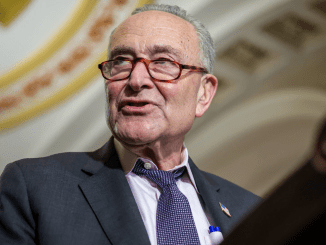
Democrats, led by Senate Minority Leader Chuck Schumer, unanimously opposed the bill, arguing it disproportionately benefits corporations and high earners despite its middle-class branding. A 2025 Tax Policy Center analysis estimated that 40% of the bill’s benefits would flow to the top 20% of earners, with corporations gaining $500 billion in deductions over a decade. Schumer called it a “Trojan horse for the wealthy,” warning that the $1.5 trillion cost could balloon the deficit, forcing cuts to Medicare and Social Security. Democrats also criticized the lack of offsets, with Senator Elizabeth Warren proposing a wealth tax to fund social programs instead.
The vote has handed Republicans a potent campaign weapon. At a recent Ohio rally, Trump blasted Democrats for “turning their backs on hardworking Americans,” vowing to reintroduce the bill if the GOP gains a larger Senate majority in 2026. A 2025 Rasmussen poll shows 62% of voters support the tax cuts, with 70% of independents favoring relief for the middle class. The tip tax elimination, inspired by Trump’s campaign pledge, resonated with service workers, who number 4 million nationwide, per the Bureau of Labor Statistics. GOP strategists are already airing ads in swing states, reminding voters that “every Democrat voted no” on relief for families and waitresses.
Democrats counter that their opposition reflects fiscal responsibility and fairness. Senator Bernie Sanders argued that the bill fails to address income inequality, with 60% of wealth concentrated among the top 10%, per Federal Reserve data. They point to Trump’s first-term tax cuts, which a 2024 Urban Institute study found added $2 trillion to the deficit while primarily benefiting corporations. Progressives like Representative Alexandria Ocasio-Cortez advocate for investments in housing and healthcare, citing the 187,000 homeless in California as a more pressing concern. Democrats also note that 55% of Americans in a 2025 Gallup poll worry about rising deficits, complicating their messaging.
The vote’s fallout is already shaping the political landscape. In battleground states like Pennsylvania and Nevada, GOP candidates are hammering Democratic incumbents, with ads featuring tipped workers decrying the vote. The National Restaurant Association, representing 500,000 businesses, has endorsed Republican efforts to revive the bill, amplifying pressure. Meanwhile, Democratic strongholds like California face internal strife, with Governor Gavin Newsom distancing himself from the Senate vote amid a DOJ probe into his state’s homelessness funds.
The Tax Relief for American Families Act’s defeat underscores America’s deep economic divide. Republicans frame it as a betrayal of the middle class, with 1.2 million jobs created in 2025 and a thriving market proving the efficacy of Trump’s policies. Democrats warn of fiscal recklessness and inequity, appealing to voters skeptical of trickle-down economics. As voters head to the polls in 2026, the memory of this vote—every Democrat against a historic tax cut—could sway swing districts. With both sides doubling down, the battle over America’s economic future is set to dominate the midterm narrative, leaving voters to decide who truly represents their interests.