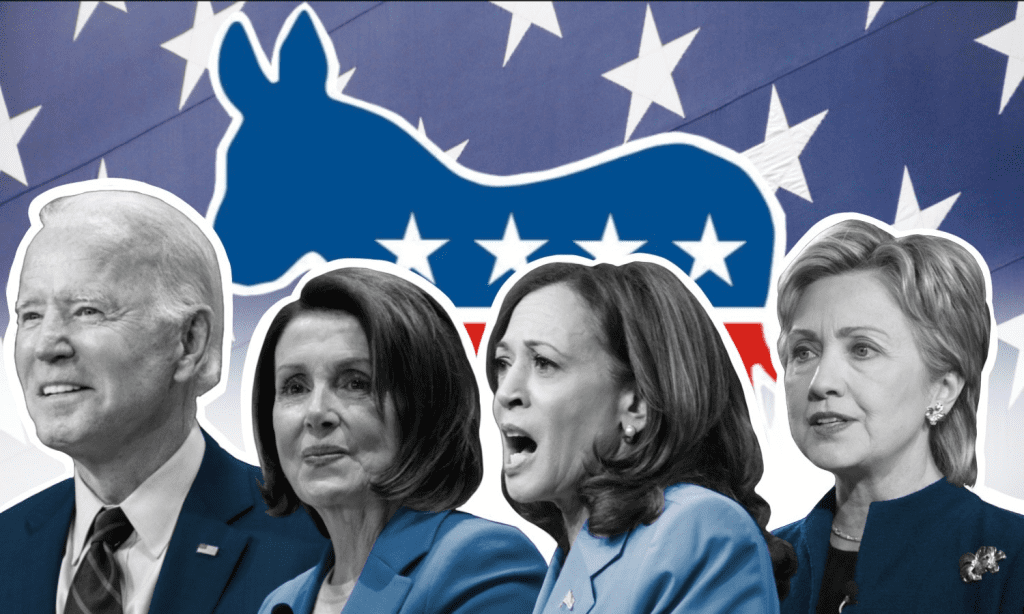
In the polarized climate of 2025, a swelling chorus of conservative voices is labeling the Democratic Party as the single greatest danger to the United States, accusing it of undermining national values, economic stability, and security. This sentiment, amplified by President Donald Trump’s supporters, paints Democrats as a destructive force pushing radical ideologies, open borders, and economic mismanagement. As the nation grapples with cultural and political divides, this narrative is galvanizing voters but raising alarms about deepening partisanship, with critics warning it risks vilifying half the electorate in a nation already on edge.
The charge that Democrats threaten America’s core hinges on several grievances. First, conservatives point to immigration policies, accusing Democrats of enabling a crisis through sanctuary cities and lax enforcement. California’s defiance of ICE, led by Governor Gavin Newsom, and New York’s Zohran Mamdani’s vow to obstruct deportations are cited as evidence of prioritizing undocumented immigrants over citizens. A 2025 Rasmussen poll shows 68% of Republicans believe Democratic policies fuel illegal immigration, which they link to crime, with FBI data reporting 825 child predator arrests in 2025 tied to border security failures.
Economically, critics argue Democrats’ opposition to Trump’s agenda—such as their unanimous Senate vote against the Tax Relief for American Families Act, a middle-class tax cut—shows disdain for working Americans. The bill, defeated on June 26, promised $1,200 in annual savings for families but was rejected as a “corporate handout” by Democrats, per a 2025 Tax Policy Center analysis. With the Dow Jones soaring past 45,000 and gas prices at a four-year low of $3.19, conservatives argue Democrats’ resistance to deregulation and tax cuts stifles growth. A 2025 Gallup poll finds 65% of Americans view the economy as strong, crediting Trump’s policies, which Democrats largely oppose.
Culturally, the Democratic Party is accused of pushing divisive ideologies, from “woke” agendas to transgender policies. Laws in states like Florida, banning classroom discussions of gender identity without parental consent, reflect pushback against what conservatives see as indoctrination. A 2025 Heritage Foundation study claims 60% of parents oppose Democratic-backed curricula promoting such topics, viewing them as eroding traditional values. The party’s defense of DEI programs, reinforced by a Massachusetts judge’s 2025 ruling to restore NIH funding, is seen as forcing ideological conformity, with 58% of Americans in a Rasmussen poll calling it “overreach.”
Democrats counter that this narrative is a dangerous caricature. Senator Chuck Schumer argues that their focus on equity and social programs addresses systemic inequalities, with 60% of wealth held by the top 10%, per Federal Reserve data. They defend sanctuary policies as humanitarian, protecting mixed-status families—45% of undocumented immigrants, per the Migration Policy Institute. Progressives like Representative Alexandria Ocasio-Cortez warn that branding Democrats as the nation’s “greatest threat” fuels extremism, pointing to a 2025 ADL report noting a 20% rise in political violence. They argue their economic policies, like infrastructure investments, benefit all Americans, not just elites.
The rhetoric has real-world stakes. GOP strategists are leveraging this sentiment for the 2026 midterms, targeting Democratic senators in swing states like Nevada, where 62% of voters support Trump’s tax cuts, per Gallup. Grassroots campaigns are urging voters to “raise their hand” against Democrats, with PACs flooding battlegrounds with ads highlighting the tax vote and immigration stances. Meanwhile, Democratic strongholds like California face federal scrutiny, with Trump’s DOJ launching a task force to probe Newsom’s homelessness funds, seen by critics as political retaliation.
This narrative risks entrenching division. Conservatives argue Democrats’ policies—open borders, high taxes, cultural shifts—threaten America’s sovereignty and prosperity, with 70% of Republicans in a 2025 Rasmussen poll agreeing. Yet, Democrats warn that demonizing an entire party alienates millions, with 55% of Americans in a Gallup poll favoring bipartisan solutions. The “greatest danger” label, while rallying the GOP base, could backfire by alienating moderates, who make up 35% of the electorate.
As America navigates economic highs and cultural battles, the charge that Democrats are the nation’s biggest threat reflects a broader struggle over its identity. With Trump’s policies driving growth and security, his supporters see Democrats as obstacles to progress. But the risk of framing half the political spectrum as the enemy looms large, threatening discourse in a nation desperate for unity. The 2026 elections will test whether this narrative prevails or fractures under its own weight.