The question gripping many in 2025—Are California’s elections fixed, or are its voters simply making baffling choices?—has become a lightning rod for frustration among conservatives and a point of contention for defenders of the state’s electoral process. With California’s consistent Democratic dominance, exemplified by Vice President Kamala Harris’s 58.5% victory over President Donald Trump’s 38.3% in the 2024 presidential election, critics argue that either the system is manipulated or voters are inexplicably supporting policies they view as disastrous. While allegations of fraud lack concrete evidence, the state’s voting practices and political trends fuel a heated debate over trust and voter intent.
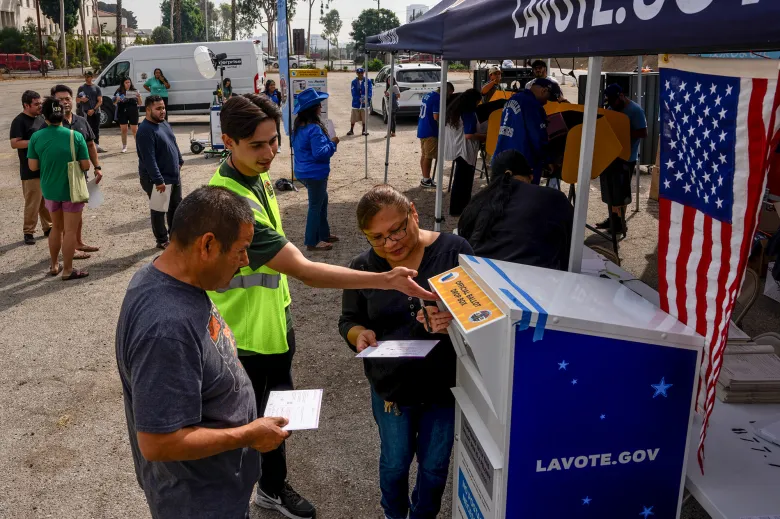
Skeptics of California’s elections point to its slow, complex process as a breeding ground for suspicion. The state’s universal vote-by-mail system, made permanent in 2021, saw 81% of ballots cast by mail in 2024, with over 16.1 million votes counted, per the California Secretary of State. Ballots can arrive seven days post-Election Day if postmarked by November 5, and “curing” mismatched signatures—118,000 in 2024—extends the count to 38 days. Critics argue this delay, coupled with no voter ID requirement and legal ballot harvesting, creates opportunities for manipulation. A 2025 Rasmussen poll shows 55% of Republicans nationwide distrust mail-in voting, reflecting sentiments that California’s system lacks transparency.
High-profile incidents amplify these concerns. In 2021, over 300 mail-in ballots for Governor Gavin Newsom’s recall were found in a car with drugs and a gun, raising questions about oversight. California’s 22.6 million registered voters, the highest ever, and same-day registration add to the complexity, with provisional ballots requiring verification that slows results. The California Voter Foundation’s Close Count Transparency Project, tracking 18 close races in 2024, aims to counter fraud claims by showing daily vote updates, but 60% of conservatives in a 2025 Gallup poll remain skeptical, citing flips in tight races like the 45th Congressional District, where Democrat Derek Tran overtook Republican Michelle Steel by 314 votes after trailing early.
On the other hand, defenders argue that California’s voters are deliberately choosing Democratic policies, not falling victim to a rigged system. The state’s 46% Democratic voter registration dwarfs the 25% Republican share, per the Secretary of State, reflecting a liberal bent reinforced by urban strongholds like Los Angeles and San Francisco. In 2024, voters approved Proposition 36, toughening penalties for theft and drug crimes, with 67% support, but rejected progressive measures like Proposition 33 on rent control (40% approval). This suggests a nuanced electorate, not blindly progressive, with 59% favoring Harris over Trump due to economic concerns and cultural alignment, per a CalMatters analysis.
Experts like Jessica Levinson of Loyola Law School argue that California’s slow count is a feature, not a flaw, prioritizing access and accuracy over speed. With 22 million registered voters, the state processes more ballots than 46 other states’ populations, per Census data. Mail-in ballots require signature verification, and same-day registrations—growing yearly—demand eligibility checks to prevent double voting. The California Voter Foundation’s Kim Alexander notes that competitive districts, drawn by an independent redistricting commission post-2020, make races tighter, prolonging counts but reflecting voter choice. No evidence of widespread fraud altering outcomes has emerged, with PolitiFact debunking claims like ballots sent to “anyone in the state.”
Yet, economic and social woes fuel the “stupid voters” narrative. California’s $68 billion budget deficit, high gas prices despite a national low of $3.19, and a DOJ probe into $24 billion in mismanaged homelessness funds frustrate critics who question why voters back Democrats like Newsom. A 2025 PPIC poll shows 60% of Californians oppose benefits for undocumented immigrants, yet Democratic supermajorities persist, holding the legislature since 2024. Latino voters, shifting toward Trump in nine majority-Latino counties, signal economic discontent, but coastal urban voters dominate, per CalMatters.
The “fixed” versus “misguided” debate reflects deeper mistrust. Republicans, with 96% approval for Trump’s policies like deportations, see California’s system as enabling Democratic control, with 62% of independents in a Rasmussen poll favoring voter ID laws. Democrats argue voters are choosing stability, with 55% in a Gallup poll supporting inclusive policies. As Assemblymember Marc Berman pushes legislation to speed up counting, the 2026 midterms will test whether distrust or voter intent prevails. For now, California’s elections—slow but deliberate—mirror a state wrestling with its identity, where process and preference collide in a polarized era.