In a dramatic win for President Donald Trump’s economic agenda, the U.S. Court of Appeals for the Federal Circuit temporarily reinstated his sweeping “Liberation Day” tariffs on May 29, 2025, just a day after a lower court struck them down as illegal. The decision, reported by Reuters, grants an administrative stay, allowing the 10% global tariffs and higher levies on Canada, Mexico, and China to resume while the court reviews the administration’s appeal. The ruling breathes new life into Trump’s trade war, though critics warn of economic fallout and legal uncertainty as the battle heads toward the Supreme Court.
The tariffs, unveiled on April 2, 2025, as “Liberation Day,” imposed a 10% baseline duty on nearly all imports, with 25% levies on Canadian and Mexican goods and 20% on Chinese products, justified by Trump as addressing drug trafficking and trade deficits. The U.S. Court of International Trade had ruled on May 28 that Trump exceeded his authority under the International Emergency Economic Powers Act (IEEPA), declaring the tariffs unconstitutional for bypassing Congress’s tariff powers. The Federal Circuit’s stay, however, pauses this block, with plaintiffs—12 Democratic-led states and five small businesses—ordered to respond by June 5, per CBS News.
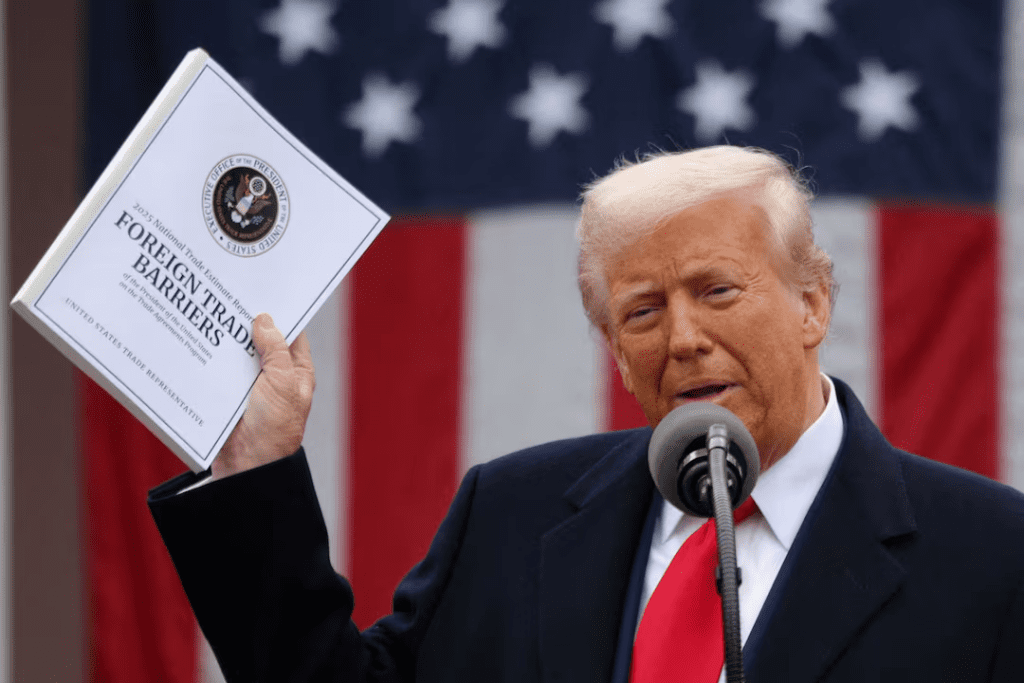
Trump hailed the decision, calling it a victory against “activist judges” in a May 29 Truth Social post, while White House Press Secretary Karoline Leavitt denounced the initial ruling as “judicial overreach.” Trade advisor Peter Navarro told reporters, “Even if we lose, we’ll do it another way,” hinting at alternative laws like Section 122 of the Trade Act of 1974, which allows 15% tariffs for 150 days, per TIME. The administration’s appeal argues that halting the tariffs risks “irreparable national-security and economic harms,” a claim bolstered by Trump’s 52% “right track” Rasmussen poll rating.
Markets reacted with volatility. S&P 500 futures rose after the initial tariff block, per Reuters, but dipped slightly post-reinstatement as uncertainty loomed. Critics, including Nevada Attorney General Aaron Ford, called the tariffs “economically destructive,” citing potential price hikes for consumers, with Goldman Sachs estimating a 0.5% GDP hit. Small businesses, represented by the Liberty Justice Center, warned of supply chain disruptions and lost customers, arguing the tariffs threaten their survival. A separate May 29 ruling by U.S. District Judge Rudolph Contreras, blocking tariffs for a toy company, remains unaffected by the stay, per NBC News.
The reinstatement strengthens Trump’s leverage in trade talks with over 60 countries, though analysts like Wendy Cutler of the Asia Society told ABC News that ongoing legal battles could deter concessions from partners like the EU and China. The case, expected to reach the Supreme Court, tests the limits of presidential power, with legal experts like Tim Meyer noting the Constitution’s clear allocation of tariff authority to Congress. Yet, Trump’s 6-3 Supreme Court majority may tilt in his favor, per The Washington Post.
As the Federal Circuit weighs a longer stay, the tariffs’ fate remains uncertain. For now, Trump’s trade war is back on, but the cost to consumers and businesses hangs in the balance.