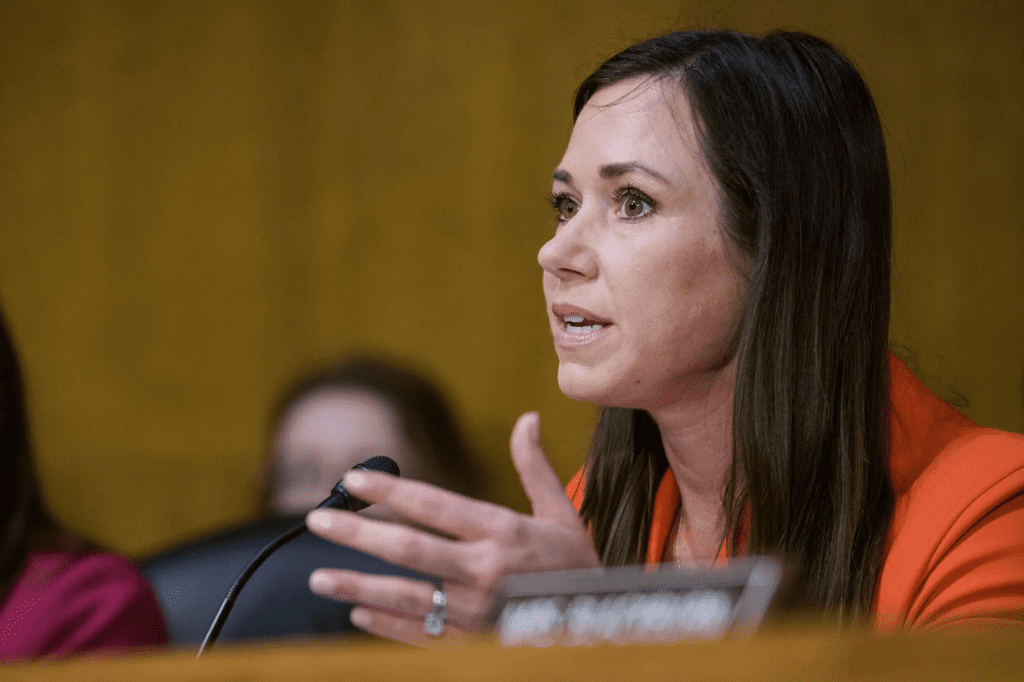
Washington, D.C. – As midterm anxieties grip the nation, Alabama Republican Sen. Katie Britt reignited her push for the Citizen Ballot Protection Act on Thursday, a measure designed to fortify federal elections by mandating proof of U.S. citizenship for mail-in voter registrations. The bill, first introduced in December 2023 as a Senate companion to Rep. Gary Palmer’s H.R. 4316, arrives amid a surge in border crossings and fresh DOJ scrutiny over noncitizen voting allegations.
Britt, a rising star in Trump’s orbit and Senate Rules Committee member, framed the legislation as a bulwark against “election subversion” during a Capitol briefing. “Voting is a sacred right for American citizens only,” she declared, flanked by co-sponsors including Sens. Mitch McConnell, Ted Cruz, and Cindy Hyde-Smith. The two-page proposal amends the National Voter Registration Act (NVRA), explicitly allowing states to demand documentary proof – like passports or birth certificates – on federal mail forms, overriding a 2013 Supreme Court ruling that curtailed Arizona’s similar effort.
Proponents cite escalating threats: Recent Texas arrests of noncitizens on voter rolls and D.C.’s 2022 local voting law for undocumented residents fuel GOP alarms. Britt highlighted Alabama Secretary of State Wes Allen’s testimony that states lack tools to verify citizenship, warning, “We can’t let illegal migrants or foreign adversaries dilute our democracy.” With over 10 million encounters at the southern border since 2021, allies like Rep. Palmer argue the bill restores “impeccable integrity” eroded by lax enforcement.
Democrats and voting rights groups pounced, branding it redundant fearmongering. Noncitizen voting in federal races is already a felony, punishable by prison and deportation, with studies like a 2017 Brennan Center report finding just 30 suspected cases nationwide from 1986-2017. The ACLU decried it as a “voter suppression Trojan horse,” potentially disenfranchising millions of eligible citizens without easy access to documents – especially minorities and the elderly. “This solves a phantom problem while creating real barriers,” said Rep. Terri Sewell, Britt’s Alabama counterpart.
As the 2026 midterms loom, the bill’s fate hinges on a divided Senate. Trump, fresh from Oval Office vows on immigration crackdowns, endorsed it online: “Katie’s fighting the steal – pass it now!” Yet, with lawsuits from the ACLU pending and public trust in elections at historic lows, the measure underscores America’s polarized ballot box: safeguard or straitjacket?