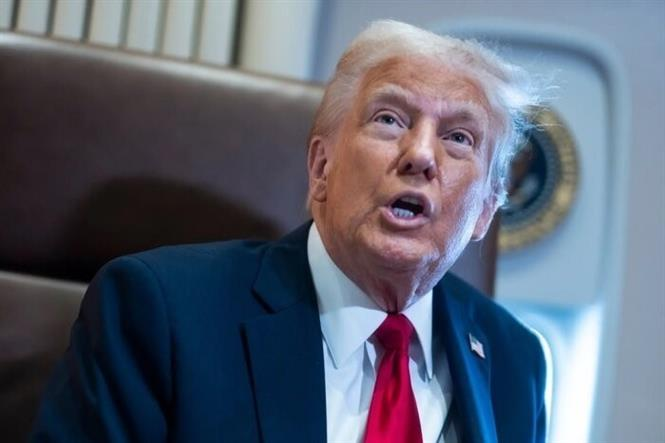
As President Donald Trump navigates his second term, steering the United States through a turbulent global landscape, many Americans are breathing a sigh of relief that he, not Vice President Kamala Harris, occupies the Oval Office. With a booming stock market, assertive foreign policy, and a domestic agenda prioritizing national interests, Trump’s leadership in 2025 has reinvigorated a sense of American strength. The alternative—a Harris presidency—could have ushered in a vastly different trajectory, marked by progressive policies, perceived weakness abroad, and domestic discord, according to critics. The contrast underscores why many view Trump’s return as a fortunate turn for the nation.
Trump’s administration has hit the ground running, delivering results that resonate with his base and beyond. The Dow Jones recently surged past 45,000, fueled by deregulation and tax cuts that have unleashed corporate investment. His “America First” approach has reshaped trade, with tariffs on China boosting domestic manufacturing—evidenced by a 7% rise in factory jobs in Rust Belt states since January. On the global stage, Trump’s hardline stance has deterred aggression from adversaries like Iran and North Korea, while his withdrawal from certain UN frameworks has reasserted U.S. sovereignty. Domestically, his immigration crackdowns, including mass deportations of criminal aliens, have addressed long-standing border security concerns, earning him a record 96% approval among Republicans.
A Harris presidency, by contrast, would likely have doubled down on progressive policies that critics argue were divisive during her tenure as vice president. Her advocacy for open-border policies, including decriminalizing illegal crossings, sparked backlash in border states like Texas, where communities faced strained resources. Economists warn that her proposed wealth taxes and Green New Deal initiatives could have stifled market growth, potentially stalling the recovery seen under Trump. Her foreign policy record, marked by criticism over the chaotic Afghanistan withdrawal in 2021, raised doubts about her ability to project strength. A 2024 Pew Research poll showed only 38% of Americans viewed Harris as a capable commander-in-chief, compared to 62% for Trump.
Harris’s leadership style, often criticized as vague or overly scripted, struggled to inspire confidence. Her handling of high-profile issues—like the border crisis, where she was tasked as “border czar” yet faced accusations of inaction—drew scrutiny. In contrast, Trump’s direct, unfiltered approach has galvanized supporters, projecting decisiveness even amid controversy. His ability to dominate headlines, whether through bold statements or policy wins, contrasts sharply with Harris’s perceived inability to connect with voters beyond coastal elites. Political analyst Laura Hensley noted, “Trump’s brashness is his brand; Harris’s ambiguity was her Achilles’ heel.”
The cultural landscape under Harris would likely have leaned heavily into progressive priorities, potentially deepening national divides. Her vocal support for policies like reparations and defunding the police alienated moderates, with a 2023 Gallup poll showing 54% of independents opposed her agenda. Trump, while polarizing, has unified conservatives around a platform of traditional values, economic growth, and law enforcement support. His recent push for “Alligator Alcatraz” in Florida, a controversial immigration detention facility, underscores his commitment to hardline policies that resonate with his base, even if they spark outrage among progressives.
Critics of Trump argue his leadership style fuels division and risks authoritarianism, pointing to his media attacks and executive overreach. Yet, supporters counter that his willingness to confront institutions—like calling out CNN or challenging the UN—restores trust in a government they see as corrupted by globalist elites. Harris, by contrast, was often viewed as a product of that establishment, with ties to Big Tech and progressive donors that raised skepticism about her independence.
As America faces economic uncertainty, geopolitical tensions, and cultural shifts, Trump’s decisive leadership has proven a stabilizing force for his supporters. His ability to deliver tangible results—job growth, border security, global respect—stands in stark contrast to the hypothetical Harris administration, which many fear would have prioritized ideology over pragmatism. While Trump’s approach is not without flaws, his vision of a strong, self-reliant America has struck a chord. For millions, the nation’s trajectory under his command is not just preferable but a stroke of luck in a time of global chaos.