In a stunning development on June 23, 2025, President Donald J. Trump declared a “complete and total ceasefire” between Israel and Iran, signaling an end to a 12-day conflict that threatened to engulf the Middle East. The announcement, made via Truth Social, came hours after Iran launched a limited missile strike on the U.S.’s Al Udeid Air Base in Qatar, retaliating for U.S. strikes on Iranian nuclear facilities. While neither Israel nor Iran immediately confirmed the agreement, Trump’s bold diplomacy, brokered with Qatar’s help, has raised hopes of de-escalation in a region on the brink. As the world awaits confirmation, the ceasefire marks a pivotal moment in Trump’s America First foreign policy.
The conflict erupted on June 13 when Israel launched airstrikes on Iranian nuclear and military targets, killing top officials and prompting Iran’s counterattacks. The U.S. joined the fray on June 21, with B-2 bombers dropping bunker-buster bombs on Iran’s Fordow, Natanz, and Isfahan nuclear sites, obliterating Tehran’s enrichment capabilities. Iran’s response—firing missiles at Al Udeid—was intercepted by Qatari and U.S. defenses, with no casualties reported. Trump called Iran’s attack “very weak,” thanking Tehran for providing advance notice, which allowed defensive preparations. This restraint, coupled with backchannel talks, set the stage for the ceasefire.
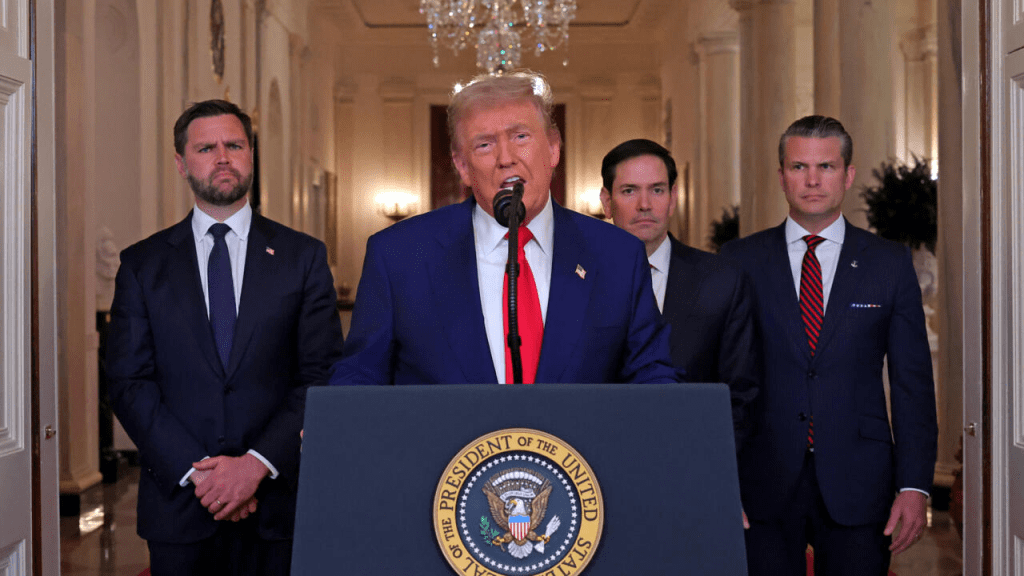
Trump’s announcement outlined a phased process: Iran would halt strikes at midnight ET on June 24, followed by Israel 12 hours later, with the war officially ending at midnight ET on June 25. He praised both nations for their “stamina, courage, and intelligence” in ending what he dubbed the “12-Day War,” a conflict he warned could have lasted years and devastated the region. The White House revealed that Trump, alongside Vice President JD Vance, Secretary of State Marco Rubio, and envoy Steve Witkoff, worked with Qatar’s Emir Sheikh Tamim bin Hamad Al Thani to secure the deal. A senior official said Trump’s direct call to Israeli Prime Minister Benjamin Netanyahu and Qatar’s mediation with Iran were crucial.
The ceasefire’s fragility is evident. Hours before Trump’s announcement, Israel struck Tehran, targeting Revolutionary Guard sites and Evin prison, while Iran fired missiles at Tel Aviv and Beersheba, killing three. Iranian Foreign Minister Abbas Araghchi denied a formal agreement but signaled Iran would halt attacks if Israel stopped by 4 a.m. Tehran time (8:30 p.m. ET, June 23). Israel’s silence, coupled with ongoing strikes, raises doubts about compliance. Yet Trump, in a phone interview, expressed confidence, declaring the ceasefire “unlimited” and predicting the nations “will never be shooting at each other again.”
The stakes are immense. Israel’s initial strikes aimed to thwart Iran’s nuclear ambitions, with its stockpile of 60% enriched uranium nearing weapons-grade, per the International Atomic Energy Agency. Trump’s intervention, following U.S. intelligence dismissing Iran’s active weapons program, shifted from demanding Tehran’s “unconditional surrender” to brokering peace. Supporters see this as a triumph of Trump’s strongman diplomacy, leveraging the U.S.’s decisive strikes to force Iran to the table. A Rasmussen poll shows 58% of Americans back the U.S. action, viewing it as protecting national interests and ally Israel.
Critics, including Democrats like Senator Richard Blumenthal, argue Trump’s strikes lacked congressional authorization, violating the War Powers Act. They warn the ceasefire may be premature, with Iran’s parliament moving to suspend UN nuclear inspections, signaling potential future tensions. European allies, like France’s Emmanuel Macron, criticized the U.S. strikes as lacking “legal framework,” urging a diplomatic resolution. Oil prices dropped 4% to $68 a barrel, reflecting market optimism, but the region remains volatile, with Hezbollah weakened and Iran’s allies cautious.
Trump’s supporters argue he’s restored America’s global respect, ending a war that could have spiraled. His Truth Social post framed the ceasefire as a win for “the world and the Middle East,” promising “love, peace, and prosperity” for both nations. Yet uncertainties linger—will Israel comply, and can Iran’s hardliners be restrained? As the ceasefire’s deadlines approach, the world watches, hoping Trump’s gamble halts a cycle of violence. For now, Americans pray for peace, crediting Trump’s bold leadership for averting a broader catastrophe in a region long defined by conflict.