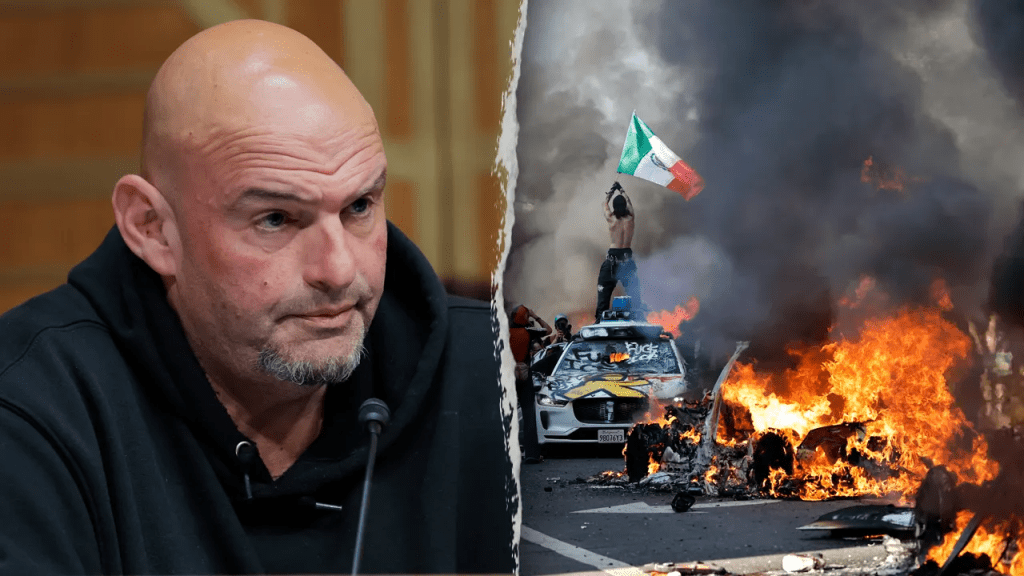
Washington, D.C., June 17, 2025—Senator John Fetterman (D-PA) has once again distanced himself from progressive Democrats, lauding President Donald Trump’s military parade celebrating the U.S. Army’s 250th anniversary as a fitting tribute to “the very best of us.” The June 14 event in Washington, D.C., featuring 6,000 soldiers, tanks, and flyovers, drew cheers from Trump supporters but condemnation from Democrats who decried it as authoritarian posturing. Fetterman’s stance, emphasizing “America before party,” has deepened rifts within the Democratic Party, with critics accusing him of cozying up to Trump.
Fetterman’s praise came amid the “No Kings Day” protests, which saw 4-6 million march nationwide against Trump’s policies, including mass deportations detaining 150,000 undocumented immigrants. At a Philadelphia rally, Fetterman was booed for refusing to join the protests, instead calling the parade “appropriate” for honoring 250 years of military sacrifice. “This parade is comprised of our sons, daughters, mothers, and fathers,” he said, urging unity regardless of politics. His remarks followed a January meeting with Trump at Mar-a-Lago, where the president called him a “commonsense person.” A Rasmussen Reports poll shows 55% of Pennsylvanians approve of Fetterman’s bipartisan approach.
Once a progressive darling who endorsed Bernie Sanders in 2016, Fetterman has shifted rightward, clashing with Democrats over issues like Israel and immigration. His support for Trump’s parade, which cost $25-$40 million per Senate estimates, contrasts with progressive leaders like Rep. Yassamin Ansari, who likened it to “North Korea.” Fetterman’s rejection of the “fascist” label for Trump, used by Kamala Harris in 2024, has further alienated him from the party’s left wing. A Pew Research poll finds 62% of Democrats view his actions as a betrayal of party values.
Fetterman defends his stance as pragmatic, representing a purple state Trump won in 2024 with 312 electoral votes and 50.2% of the popular vote. “I’m the senator for all Pennsylvanians, not just Democrats,” he told KDKA radio, arguing that constant outrage over Trump’s moves—like the parade or his cabinet picks—weakens the party. He has met with nominees like Pete Hegseth and backed Elise Stefanik for U.N. ambassador, drawing ire from colleagues. Political analyst Mustafa Rashed called Fetterman’s approach a calculated bid to appeal to Pennsylvania’s working-class voters, who backed Trump overwhelmingly.
Critics, however, see Fetterman as undermining Democratic resistance. A New York Magazine profile detailed his erratic behavior post-stroke, fueling speculation about his motives. Progressives like Tracy Baton, who protested Fetterman in Pittsburgh, feel betrayed by his shift from a Sanders-style populist to a Trump-friendly maverick. “He’s broken the social contract,” Baton said. Some compare him to former Senators Joe Manchin and Kyrsten Sinema, who clashed with Democrats before leaving the party. A Gallup poll shows 46% of Democrats want stronger opposition to Trump, not collaboration.
The parade, with its Golden Knights parachute jumps and WWII Jeeps, was a spectacle Trump hailed as a “great day for America.” Yet, it sparked protests chanting “86 47” and decrying militarization, especially after 700 Marines were deployed in Los Angeles. Fetterman’s call to “chill out” and focus on country over party has positioned him as an outlier, praised by conservatives but scorned by his base. As Democrats navigate their 2024 loss and plan for 2028, Fetterman’s gambit—putting America before party—may reshape his role or further isolate him in a fractured party.