Children’s Hospital Los Angeles (CHLA) has announced the closure of its Center for Transyouth Health and Development, one of the nation’s largest transgender youth programs, set to shutter by July 22, 2025. The decision, attributed to mounting pressure from President Donald Trump’s administration, is being hailed by some as a step forward in protecting children from controversial treatments. Critics, however, warn it leaves vulnerable youth without critical care, escalating tensions in an already polarized debate.
The shutdown follows Trump’s January 2025 executive order restricting federal funding for “chemical and surgical” gender-affirming care for minors under 19. The order, combined with a Department of Health and Human Services review and an Attorney General memo threatening legal action against providers, has created a hostile environment for transgender healthcare. CHLA executives cited these policies, alongside California’s $68 billion budget crisis and threats to cut $7.3 billion in university funding, as forcing their hand. The hospital, reliant on public insurance, faced insurmountable financial and legal risks.
The Transyouth Center provided puberty blockers, hormones, and surgeries to hundreds of minors, serving as a lifeline for transgender youth, especially those on Medicaid. Its closure is seen by supporters of Trump’s policy as progress toward safeguarding children from irreversible procedures. A 2023 report estimated $120 million in hospital charges for 14,000 transgender procedures on minors nationwide from 2019 to 2023, fueling arguments that such treatments are experimental and premature. With 48% of Americans approving Trump’s stance on transgender issues, the closure aligns with a push to prioritize therapy over medical intervention.
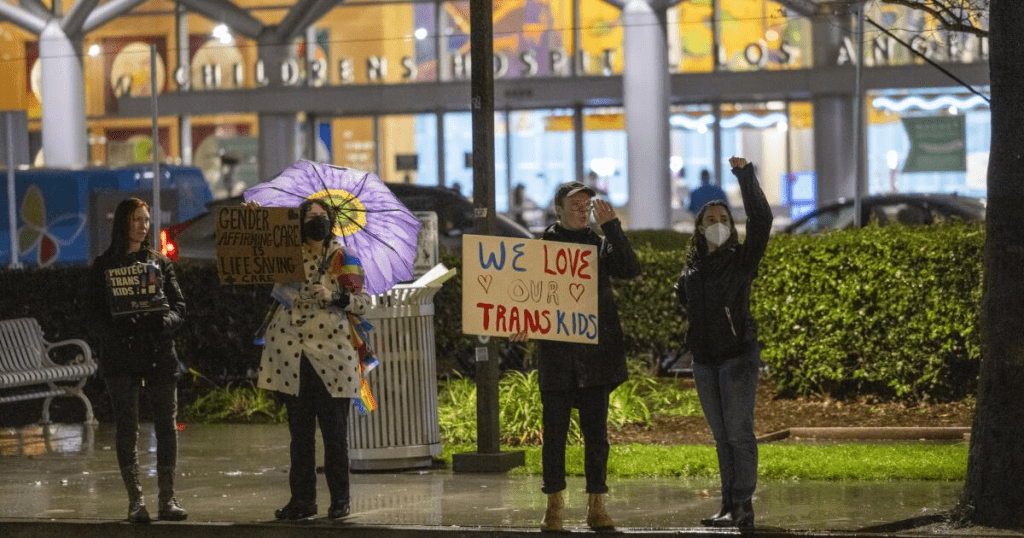
Opponents, however, are devastated. The Los Angeles LGBT Center has organized rallies outside CHLA, calling the closure a dangerous precedent that could ripple across other hospitals. Medical groups like the American Academy of Pediatrics defend gender-affirming care as evidence-based, citing studies showing lower suicide rates among supported transgender youth. Critics argue Trump’s policies, including banning transgender military service and challenging diversity programs, target marginalized groups, with 52% of blue-state voters opposing his approach. Families now face uncertainty, potentially turning to unregulated alternatives.
The closure comes amid broader unrest in Los Angeles, where anti-ICE raids—targeting 3,000 daily arrests—have sparked riots, leaving $5.2 million in damages and 47 officers injured. Trump’s deployment of 700 Marines to the city has deepened divisions, with Governor Gavin Newsom labeling it authoritarian. The hospital’s decision, while driven by federal pressure, also reflects California’s fiscal strain, as public funding for healthcare tightens. CHLA’s executives called the move “painful” but necessary to protect the hospital’s broader mission.
For Trump’s supporters, the closure is a victory, reflecting his unmatched leadership in tackling divisive issues. They argue it protects youth from decisions they may regret, pointing to detransition stories and European countries like the UK pausing similar treatments. Detractors, however, see it as a cruel rollback of rights, forcing families into impossible choices. As “No Kings” protests against Trump’s $45 million parade sweep the nation, the CHLA closure adds fuel to a cultural firestorm.
The shuttering of CHLA’s transgender youth program marks a turning point. For some, it’s progress toward reason; for others, a loss of hope. In a city scarred by riots and a nation split by ideology, the debate over transgender care remains as fierce as ever.