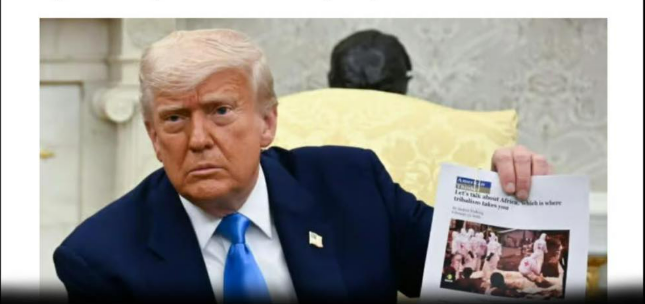
Washington, D.C. – President Donald Trump ignited global controversy on May 20, 2025, during a White House meeting with South African President Cyril Ramaphosa, where he presented photos of a mass burial site of Black women raped and burned alive in the Democratic Republic of Congo, falsely claiming they depicted the “burial site” of white farmers in South Africa. The incident, first reported by News24 and amplified across X, has drawn widespread condemnation for promoting a discredited “white genocide” narrative and misrepresenting the Congolese atrocities, raising questions about Trump’s diplomatic conduct and accuracy.
The meeting, intended to address U.S.-South Africa trade relations, took a contentious turn when Trump, citing concerns about South African land reforms, displayed the images to argue that white farmers face systemic violence. Posts on X, including from
@HafedAlGhwell and
@ShehunGwandu, clarified the photos’ true origin: a 2023 mass grave in eastern Congo, where over 50 women were killed amid escalating militia violence, as documented by the United Nations. South Africa’s government swiftly denounced the claim, with Ramaphosa’s office calling it “deeply offensive” and a distortion of their nation’s challenges.
South Africa’s land reform policies, aimed at redistributing land to address apartheid-era inequities, have long been a flashpoint. A 2018 AgriSA report noted 47 farm murders that year, predominantly of white farmers, but experts like the Institute for Security Studies reject the “genocide” label, citing broader crime trends affecting all South Africans. Trump’s claim, echoing a narrative pushed by far-right groups, was further debunked by Africa Check, which found no evidence of targeted killings of white farmers on the scale he suggested.
The White House has not retracted the statement, with Press Secretary Karoline Leavitt defending Trump, saying he was “highlighting global violence against farmers.” Critics, however, see the incident as part of a pattern of inflammatory rhetoric. Democratic lawmakers, including Rep. Ilhan Omar, condemned Trump for “peddling dangerous misinformation” that risks fueling racial tensions. On X, users like
@StarboySAR questioned which world leaders would engage with Trump after such a diplomatic misstep, while
@covie_93 called his actions “sick.”
The Congolese government expressed outrage, with Foreign Minister Jean-Claude Gakosso demanding an apology for exploiting their tragedy. The U.N.’s Congo mission reiterated that the burial site photos, tied to militia attacks in Ituri province, have no connection to South Africa. Human Rights Watch warned that Trump’s misuse of the images could undermine efforts to address Congo’s humanitarian crisis, where 7 million are displaced.
This incident follows Trump’s history of controversial statements on African nations, including his 2018 remarks disparaging “shithole countries.” As Ramaphosa prepares to address the U.N. General Assembly, the episode complicates U.S.-South Africa relations, with trade talks now at risk. The nation watches whether Trump will clarify or double down on his claims, as calls for accountability grow louder.