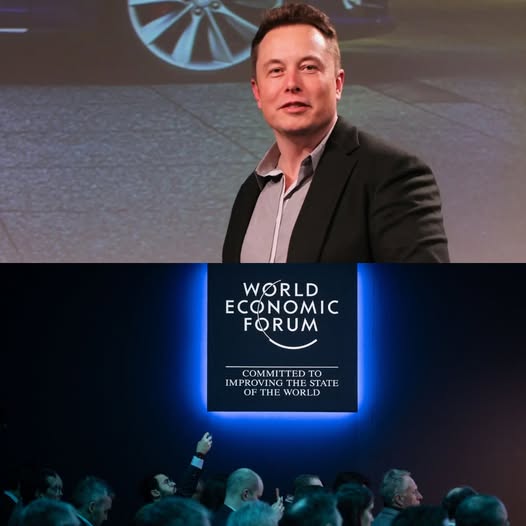
Davos, Switzerland – On May 15, 2025, as the World Economic Forum (WEF) prepares for its upcoming summer summit, Elon Musk’s complex relationship with the organization remains a topic of intrigue. The billionaire innovator behind Tesla, SpaceX, and X has long expressed mixed feelings about the WEF, oscillating between participation in its discussions and sharp criticism of its approach. While Musk aligns with the forum’s sustainability goals through Tesla’s mission, his disdain for global elites and bureaucratic inefficiencies highlights a fundamental tension in their relationship.
Musk’s engagement with the WEF dates back to at least 2017, when he spoke at Davos on climate change and the future of energy, aligning Tesla’s electric vehicle push with the forum’s focus on sustainable development. Tesla’s commitment to reducing carbon emissions—producing over 1.5 million EVs in 2024, per company reports—mirrors the WEF’s advocacy for net-zero goals, as outlined in its 2025 Global Risks Report. Musk has acknowledged this overlap, stating in a 2023 X post, “Tesla’s mission to accelerate the world’s transition to sustainable energy isn’t far from what the WEF claims to want.” His recent collaboration with Saudi Arabia, announced on May 14, where Aramco invested billions in Tesla’s expansion, further ties his business interests to global sustainability efforts, a WEF priority.
Yet, Musk’s critiques of the WEF are equally prominent. He has repeatedly accused global elites, often represented by forums like the WEF, of perpetuating inequality through corporate monopolies and short-sighted policies. In a May 12, 2025, interview at the Saudi-U.S. Investment Forum, Musk lambasted such organizations, saying, “The WEF spends too much time on bureaucratic discussions and not enough on real-world solutions. We need action, not endless panels.” This echoes his 2022 X post where he called the WEF “an unelected world government,” reflecting his broader disdain for centralized authority, as seen in his critiques of EU tech regulations and U.S. government inefficiencies.
Musk’s frustration stems from his belief that large international bodies often stifle innovation. He has pointed to the WEF’s stakeholder capitalism model—promoting collaboration between governments, businesses, and civil society—as a breeding ground for inefficiency. In a 2024 interview with The Wall Street Journal, Musk argued, “Global elites at places like Davos are more interested in maintaining power than solving problems like climate change or space exploration.” This stance aligns with his advocacy for entrepreneurial leadership, as seen in his recent Starbase project in Texas, where SpaceX employees voted on May 14 to establish a privatized city focused on innovation over bureaucracy.
Despite this, the alignment between Musk’s companies and WEF goals creates a paradox. Tesla’s advancements in renewable energy and SpaceX’s reusable rockets support the WEF’s push for sustainable technology, while xAI’s mission to understand the universe, highlighted at the Saudi forum, resonates with the WEF’s focus on frontier technologies. Posts on X reflect this duality, with users like
@GreenTechFan praising Musk’s sustainability efforts, while others, like
@NoGlobalElite, echo his anti-elite sentiment, using hashtags like #MuskAndWEF and #SustainabilityDebate to fuel the conversation.
The tension underscores a broader question: can Musk’s vision of innovation-driven solutions coexist with the WEF’s collaborative, multilateral approach? Critics argue that Musk’s disdain for bureaucracy ignores the need for coordinated global action on issues like climate change, where the WEF has facilitated agreements like the 2023 Global Methane Pledge. Yet, Musk’s point about actionable outcomes over discussion resonates in a world facing urgent crises, as seen in the WEF’s own warnings about climate inaction in its 2025 report.
As Musk continues to critique the WEF while indirectly advancing its goals, their relationship remains a complicated dance—one that reflects the broader challenge of balancing innovation with global cooperation in an increasingly divided world.