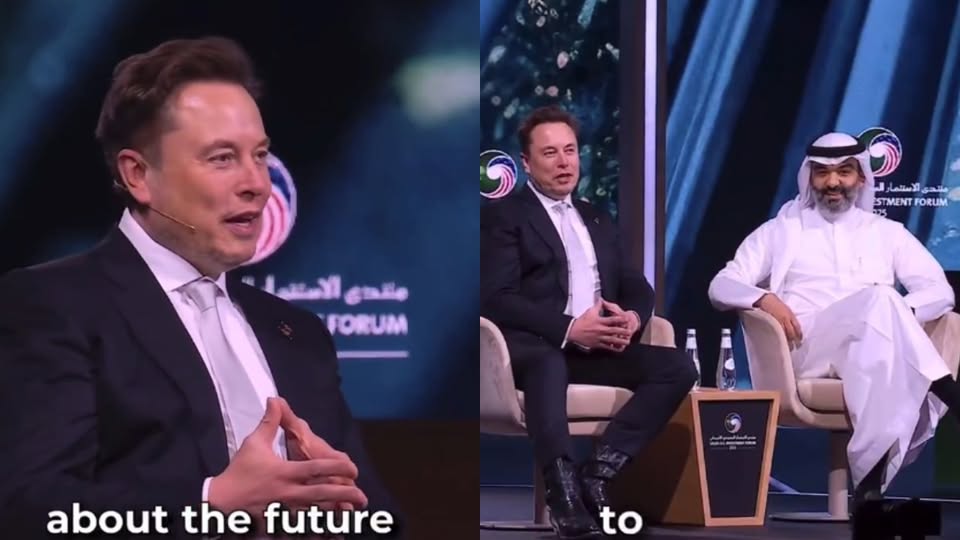
Riyadh, Saudi Arabia – On May 13, 2025, Elon Musk took center stage at the Saudi-U.S. Investment Forum in Riyadh, delivering a visionary speech alongside President Donald Trump and Crown Prince Mohammed bin Salman. The event, marking 92 years of U.S.-Saudi relations, highlighted Musk’s ambitious plans to transition economies from oil dependency to innovation-driven growth, with a focus on robotics, AI, and infrastructure. Musk’s appearance followed a high-profile lunch with the crown prince and Trump, underscoring the deepening ties between American tech leaders and the kingdom.
Musk began by showcasing Tesla’s Optimus robots, which he demonstrated to Trump and bin Salman earlier that day. “One of our robots did the Trump dance—the YMCA—which I thought was pretty cool,” Musk said, drawing laughter from the audience. He described Optimus as a step toward a future with “tens of billions” of humanoid robots, likening them to personal C-3PO or R2-D2 droids from Star Wars. Musk predicted these robots could unlock “immense economic potential,” potentially expanding the global economy tenfold, leading to a “universal high income” where goods and services are abundant. Citing Iain M. Banks’ Culture series as a non-dystopian vision of an AI future, he contrasted this with dystopian fears like Terminator, emphasizing a “Star Trek future” of exploration and prosperity.
The discussion turned to autonomous vehicles, with Musk proposing to bring Tesla’s robo-taxis—“robots on four wheels”—to Saudi Arabia, a move met with enthusiastic applause. He also thanked the kingdom for approving Starlink for maritime and aviation use, enhancing connectivity in the region. Musk’s vision extended to infrastructure, as he pitched The Boring Company’s tunneling technology to solve traffic issues. “Tunnels are underappreciated,” he quipped, noting their success in Las Vegas, where they “feel like teleporting” across the city, offering a potential solution for Riyadh’s urban congestion.
Musk also highlighted xAI, his AI venture, which aims to create a “maximally truth-seeking” AI to understand the universe. “The goal is to understand what questions we don’t even know to ask,” he explained, emphasizing curiosity as the driver of discovery. This aligns with Saudi Arabia’s push into AI, with the kingdom recently launching its state-run AI venture, Humain, and seeking U.S. technology to bolster its global standing, as reported by Reuters.
The forum, attended by global leaders like BlackRock’s Larry Fink and NVIDIA’s Jensen Huang, celebrated a $600 billion Saudi investment in the U.S., secured earlier that day, covering energy, AI, and infrastructure. Trump, who pushed for a $1 trillion commitment, sees this as a boon for American jobs, while Saudi Arabia aims to diversify its economy under Vision 2030. The reporter noted the historic partnership, emphasizing collaboration on a “factor-based economy” to power 20% of the global energy mix through AI and digital innovation.
However, Musk’s deep ties to Saudi Arabia—the Public Investment Fund is a major X shareholder, per a 2024 Human Rights Watch report—raise ethical questions, especially given the kingdom’s human rights record, including the 2018 Khashoggi murder. Trump’s business interests in the region, including luxury projects in Jeddah, further complicate the narrative, as noted by The Washington Post. While the economic benefits are clear, with potential job creation and technological advancements, the partnership risks prioritizing profit over principle, a tension that looms over the forum’s optimistic tone.
Musk’s speech painted a future of limitless potential, from robotic companions to AI-driven discovery, but the path forward requires navigating complex geopolitical realities. As the U.S. and Saudi Arabia deepen their 92-year partnership, the balance between innovation and accountability remains a critical challenge for leaders like Musk and Trump.