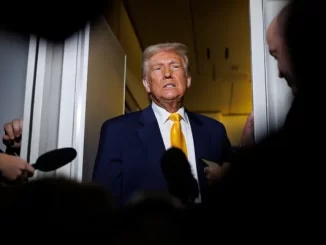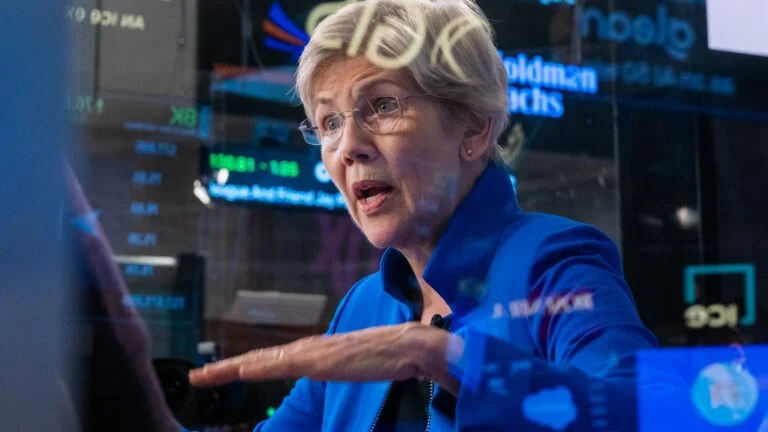
Senator Elizabeth Warren (D-Mass.) has sparked a firestorm with a bombshell claim, alleging that former President Donald Trump and his family are involved in a “crypto scam” that could net them over $60 million. According to a viral image, Warren exposed a $2 billion deal between Saudi-backed MGX and Binance, the world’s largest cryptocurrency exchange, which uses USD1—a stablecoin tied to the Trump family’s World Liberty Financial (WLF) venture. Calling the arrangement “totally insane,” Warren insists that “everyone should know about it,” raising serious concerns about corruption and foreign influence.
The deal centers on MGX, an Abu Dhabi-based firm with UAE government ties, investing $2 billion in Binance. On May 1, 2025, Eric Trump announced at a Dubai conference that the transaction would be settled using USD1, a dollar-pegged stablecoin launched by WLF, co-founded by Eric and Zach Witkoff. USD1 has rapidly risen to the seventh-largest stablecoin globally, with a market exceeding $245 billion, per CoinGecko data. Warren claims this deal could funnel more than $60 million to the Trump family, creating a potential conflict of interest given Trump’s political influence and the involvement of foreign entities.
Warren’s accusation, amplified on The Daily Show, aligns with broader Democratic concerns. On May 6, 2025, Warren and Senator Jeff Merkley (D-Ore.) urged a federal watchdog to investigate, warning that the Trump and Witkoff families could “indirectly” receive hundreds of millions, potentially enabling “grift.” They highlighted risks of foreign influence, noting that the UAE or Binance could gain favors from a Trump administration. Senator Richard Blumenthal (D-Conn.) echoed these concerns, launching an inquiry and calling the scheme “brazen corruption,” accusing Trump of “putting a for-sale sign in front of the White House.”
Public reaction is deeply polarized. On X, users like
@CalltoActivism support Warren, labeling the deal “corruption in plain sight,” while others, like
@DamianMSmith, dismiss it as a “hypocritical smear campaign.” News outlets, including The New York Times and CoinDesk, confirm the deal’s structure, noting that it formally links WLF to Binance—a company previously under U.S. scrutiny—raising questions about transparency. Meanwhile, Senator Chris Murphy (D-Conn.) introduced the Modern Emoluments and Malfeasance Enforcement (MEME) Act on May 6, 2025, aiming to ban senior officials from promoting financial assets like crypto, reflecting growing calls for accountability.
Critics, however, caution that Warren’s $60 million figure lacks clear evidence, appearing speculative. The deal itself, while ethically questionable due to its foreign ties and Trump’s involvement, isn’t illegal on its face. Binance, despite past regulatory issues, is a major global player, and stablecoins are increasingly used in large transactions. Still, the lack of transparency about USD1’s buyers and the potential for foreign influence—especially given Binance’s history and the UAE’s geopolitical interests—lends weight to Warren’s concerns. The Senate’s ongoing debate over stablecoin legislation, which Warren opposes, adds another layer of tension, as she fears deregulation could facilitate such deals.
This controversy fits into a broader pattern of scrutiny over Trump’s crypto ventures. Warren, a longtime crypto skeptic, has warned about deregulation under Trump’s influence, arguing it prioritizes personal gain over market oversight. WLF has been accused of blurring the lines between private enterprise and government policy, a concern amplified by Trump’s continued political clout as of May 2025. The deal’s timing—amid discussions of crypto policy—underscores the need for stricter oversight of political figures’ financial dealings in this rapidly evolving space.
While Warren’s claim demands further investigation, it highlights significant ethical and national security concerns. The polarized reactions reflect the broader political divide, with Democrats pushing for accountability and some dismissing the allegations as politically motivated. As this story develops, it serves as a stark reminder of the challenges in balancing financial innovation with political integrity in the crypto era.