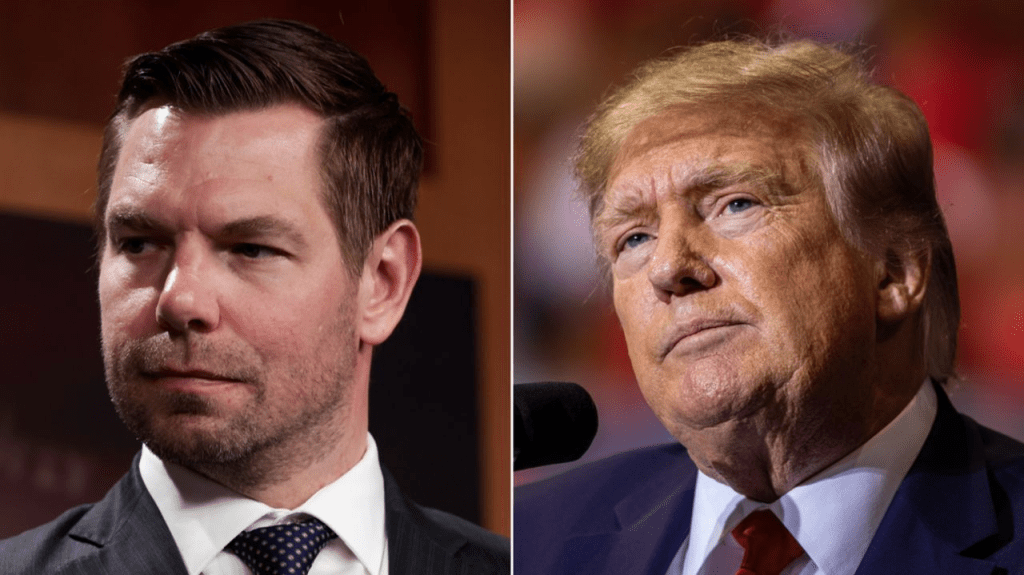
Representative Eric Swalwell’s recent statement has reignited scrutiny over former President Donald Trump’s connection to the Jeffrey Epstein case. Swalwell, a vocal Trump critic, suggested that Trump’s failure to sue Elon Musk over claims of his presence in Epstein’s files is a glaring admission of guilt. “No one who has walked Earth is more litigious than Donald Trump,” Swalwell declared. “If Trump is NOT in the files, he would have already sued Musk. The absence of Trump’s legal actions speaks VOLUMES.” As a journalist, I aim to unpack this provocative assertion, examining what Trump’s legal silence might signify in the context of his well-documented litigious history.
Trump’s reputation as a legal brawler is unmatched. Over decades, he has filed lawsuits against media outlets, political opponents, and even former associates, often using litigation as a tool to silence critics or shape narratives. From defamation suits against journalists to disputes over business deals, Trump’s legal playbook is aggressive and unrelenting. Given this history, Swalwell’s point carries weight: if Trump believed Musk’s claims were false, a lawsuit would seem almost inevitable. Musk, a polarizing figure himself, has not shied away from making bold statements, and his alleged reference to Trump in Epstein’s files would typically be the kind of provocation Trump pounces on.
Yet, as of July 2025, no such lawsuit has materialized. This absence is striking, especially given the gravity of the Epstein case—a scandal that continues to haunt powerful figures across industries. The files, which detail Epstein’s network of influential contacts, remain a lightning rod for speculation. Trump’s association with Epstein, though publicly limited to social encounters in the 1990s and early 2000s, has long been a point of contention. Critics like Swalwell argue that Trump’s failure to challenge Musk’s claims suggests there may be truth to them, or at least something Trump prefers to keep buried.
On the other hand, Trump’s defenders might argue that silence does not equal guilt. Legal battles are costly, both financially and politically, and Trump, now navigating the complexities of his post-2024 political career, may see little benefit in engaging Musk in court. A lawsuit could amplify attention to the Epstein files, potentially dragging Trump into a media firestorm he’d rather avoid. Moreover, Musk’s influence and unpredictable nature make him a formidable opponent, even for someone as litigious as Trump. Choosing restraint could be a strategic calculation, not an admission.
Still, Swalwell’s remark taps into a broader truth: Trump’s actions, or lack thereof, are rarely without purpose. His silence on this issue stands in stark contrast to his combative persona, raising questions about what lies beneath. Is it caution, indifference, or something more? The Epstein files remain a Pandora’s box, and until concrete evidence emerges, speculation will persist. For now, Trump’s decision not to sue Musk leaves room for doubt—and for critics like Swalwell to frame that silence as deafening.