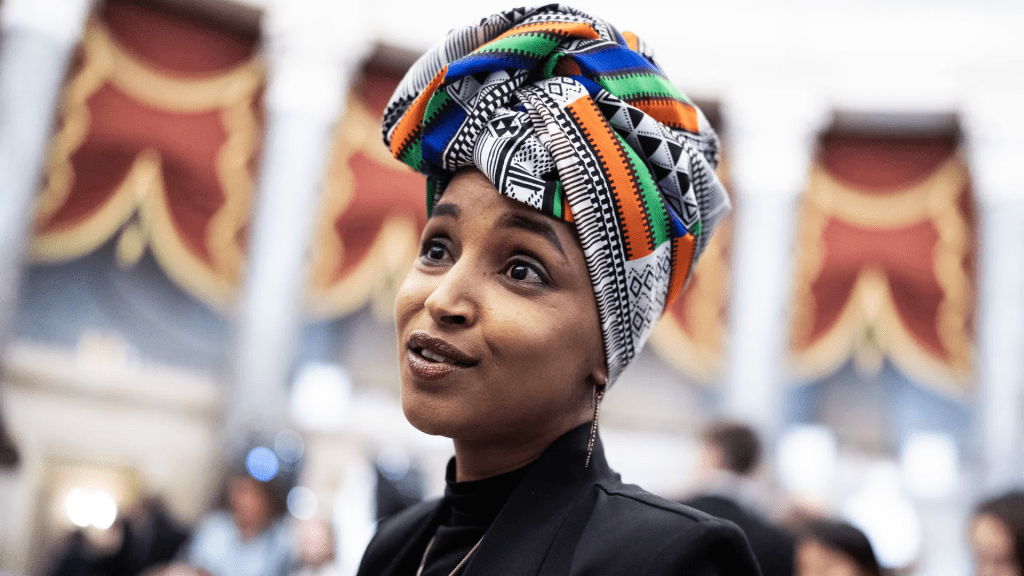
Representative Ilhan Omar’s recent statement that “we are turning into one of the worst countries on earth” has ignited a firestorm of controversy, with critics swiftly responding that if she feels that way, she should leave the United States. The Minnesota Democrat’s remark, made during a July 2025 speech addressing new immigration policies and welfare cuts, reflects growing alarm among progressive lawmakers over the direction of the Trump administration. Yet the backlash, particularly the “then leave” retort, underscores a deepening divide over free speech, patriotism, and the right to dissent in a polarized America.
Omar’s comment came in response to policies like the proposed “remigration” of 21 million undocumented immigrants and the defunding of programs like SNAP and Medicaid. She argued that these measures, combined with the termination of USAID and restrictive reproductive rights policies, signal a retreat from compassion and global leadership. Citing rising maternal mortality rates—37 per 100,000 live births in 2024, among the highest in developed nations—and increasing food insecurity affecting 13% of U.S. households, Omar painted a grim picture of a nation abandoning its values. Her words echo sentiments among some Democrats who view the administration’s agenda as eroding America’s moral standing.
The response was immediate and fierce. Conservative lawmakers and commentators seized on Omar’s statement, accusing her of disloyalty and ingratitude. The “then leave” refrain, a recurring jab aimed at Omar since her 2019 clashes with then-President Trump, resurfaced with renewed vigor. Critics argue that her critique dismisses America’s strengths, like its robust economy (3.2% unemployment in June 2025) and global influence. They point to her background as a Somali refugee who rose to Congress as evidence of the opportunities the U.S. offers, suggesting that her criticism borders on betrayal. Some even called for her resignation, framing her words as unpatriotic in a nation celebrating its 249th year of independence.
Omar’s defenders, however, see the backlash as a dangerous attempt to silence dissent. They argue that her role as a congresswoman is to hold the nation accountable, not to offer blind allegiance. The First Amendment, they note, protects her right to criticize, just as it did for figures like Frederick Douglass, who called out America’s hypocrisy on slavery during Fourth of July speeches. Supporters highlight Omar’s legislative record, including her advocacy for universal healthcare and refugee rights, as proof of her commitment to improving the country. They warn that demands for her to “leave” reflect a broader intolerance for voices—especially those of women of color—that challenge the status quo.
This clash is not new for Omar, one of the first Muslim women in Congress and a member of the progressive “Squad.” Her outspoken views on immigration, Israel, and economic inequality have long made her a lightning rod. In 2019, similar “go back” comments from Trump prompted a House resolution condemning his rhetoric as racist. Now, with a Republican-controlled Congress and a conservative Supreme Court, the stakes feel higher. Omar’s allies fear that the “leave” rhetoric could incite harassment or worse, citing a rise in political violence since the 2024 election.
The debate raises broader questions about what it means to be American in 2025. Is patriotism defined by unwavering praise, or can it include sharp critique aimed at making the nation better? Omar’s supporters argue that her words stem from a desire to hold America to its ideals of liberty and justice, while her critics see them as divisive and disrespectful. The tension mirrors broader societal rifts, with 62% of Americans in a 2025 Pew poll agreeing that political discourse has become too toxic to bridge.
As the nation heads toward the 2026 midterms, Omar’s statement and the backlash it provoked will likely fuel campaign narratives. Republicans may leverage the controversy to rally their base around “America First” themes, while Democrats could frame it as a defense of free speech and diversity. For now, Omar remains unapologetic, vowing to continue her advocacy. The “then leave” retort, however, signals a growing intolerance for dissent that could shape the nation’s political future. Whether America can reconcile these divisions or descend further into rancor will determine if Omar’s warning about becoming “one of the worst” proves prophetic—or a call to action for a better nation.