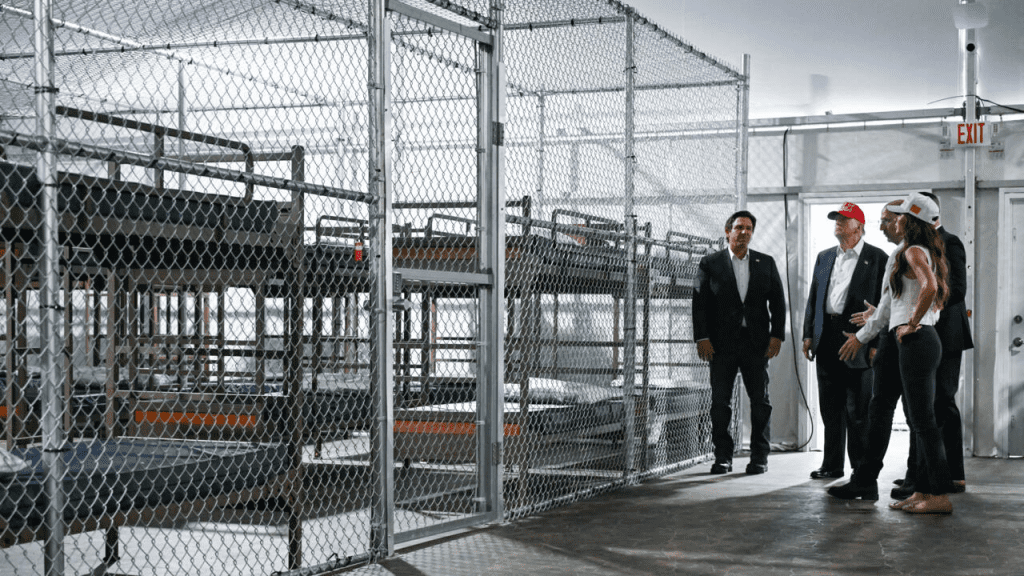
The newly opened migrant detention facility in Florida’s Everglades, ominously dubbed “Alligator Alcatraz,” has captured national attention for its remote location and formidable natural barriers. Situated at the Dade-Collier Training and Transition Airport, a 39-square-mile former airfield surrounded by alligator- and python-infested swamps, the facility is designed to hold up to 5,000 migrants awaiting deportation. President Donald Trump, during a July 1, 2025, tour, emphasized that for those detained, “the only way out is really deportation,” highlighting the site’s role in his administration’s aggressive immigration crackdown. But what makes this facility so inescapable, and why is deportation framed as the sole escape route?Located 45 miles west of Miami, “Alligator Alcatraz” leverages its environment as a natural deterrent. The facility, constructed in just weeks with heavy-duty tents and FEMA trailers, is encircled by the Everglades’ treacherous marshes, waterways, and wildlife. Florida Attorney General James Uthmeier, who coined the nickname, boasted that the site requires minimal perimeter security because “there’s not much waiting for them other than alligators and pythons.” Escaping would mean navigating a 40-mile trek through swamps teeming with predators, including alligators, bobcats, and Burmese pythons, or a 10- to 12-hour walk along a single road almost certain to lead to recapture. The facility’s 200 security cameras, 28,000 feet of barbed wire, and 400 security personnel further ensure that breakout attempts are futile.The Trump administration’s design for “Alligator Alcatraz” reflects a deliberate strategy to make escape a losing proposition. Unlike traditional urban ICE facilities, this remote site lacks nearby infrastructure, limiting access to legal support or media scrutiny. Detainees, many of whom are arrested during interior enforcement raids or border crossings, face a stark reality: the surrounding ecosystem is as much a jailer as the barbed wire. Trump himself, during his visit, quipped about teaching detainees to “run in a zigzag” to evade alligators, though experts note that such advice is flawed—running straight is the best defense against an alligator attack. His remarks underscore the facility’s psychological impact, framing escape as a deadly gamble.Deportation, as Trump and Homeland Security Secretary Kristi Noem have stressed, is the intended outcome for detainees. The facility, operational since July 1, 2025, is part of a broader push to expand ICE’s detention capacity, which has surged to 59,000 nationwide, a 50% increase since January. With a 10,500-foot runway, the site facilitates swift deportation flights, bypassing lengthy legal processes. Noem has encouraged “self-deportation” via the CBP Home app, promising assistance with plane tickets and even citing programs in countries like Panama and Guatemala to reintegrate returnees. However, critics argue that this option ignores the dangers many migrants face in their home countries, including violence and economic collapse.The facility has sparked outrage among immigrant advocates, environmentalists, and the Miccosukee Tribe, who call it inhumane and a threat to the Everglades’ fragile ecosystem. Detainees, housed in tents amid Florida’s sweltering heat and hurricane-prone summer, face risks from inadequate medical care and limited access to legal counsel. The site’s $450 million annual operating cost, partly funded by FEMA, has also drawn scrutiny, with critics like Representative Maxwell Frost labeling it a “cruel spectacle” that prioritizes political optics over human rights. Environmental groups have filed lawsuits, arguing that the construction violates federal law by bypassing required ecological reviews.For detainees, the message is clear: attempting to flee “Alligator Alcatraz” is a near-impossible task, with the Everglades’ natural perils and heavy security ensuring recapture or worse. The administration’s rhetoric, amplified by officials like Florida Governor Ron DeSantis, frames the facility as a “force multiplier” for mass deportations, with plans for similar sites in Louisiana and Alabama. Yet, the harsh conditions and remote location raise ethical questions about the treatment of migrants, many of whom have no criminal records. As the debate rages, “Alligator Alcatraz” stands as a stark symbol of the Trump administration’s immigration policy: for those inside, the only path to freedom is a one-way flight out of the country.