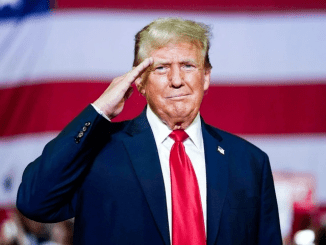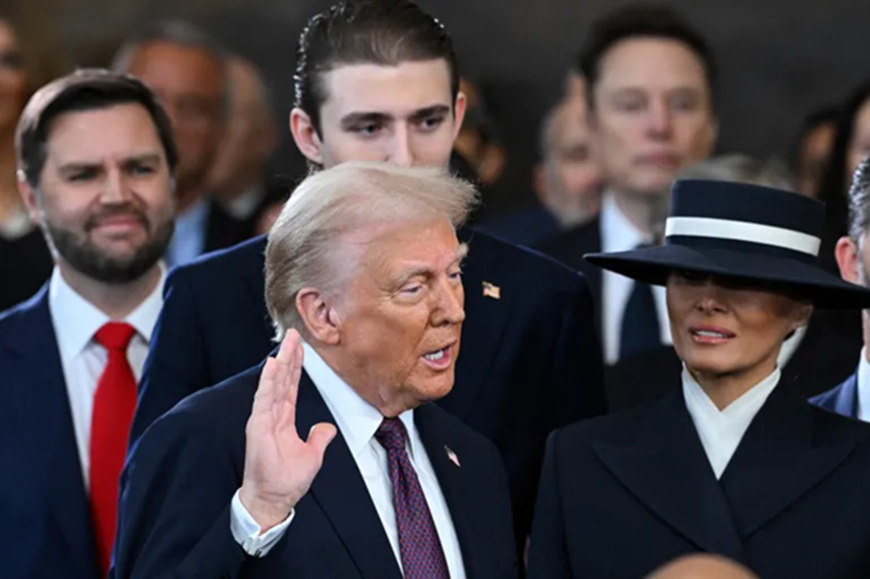
On June 26, 2025, President Donald J. Trump’s declaration—“I’m not the president of the world. I’m the president of the United States. And from now on, it’s going to be America First”—reaffirms the cornerstone of his second term. Delivered in a fiery address, the statement encapsulates Trump’s vision: prioritizing U.S. interests above global obligations. Five months into his presidency, actions like the Iran airstrikes, sweeping tax cuts, and border crackdowns reflect this pledge, galvanizing supporters while deepening divides. As America navigates a complex world, Trump’s unapologetic nationalism reshapes its role, sparking debate over sovereignty, alliances, and global leadership.
Trump’s America First doctrine drives his agenda. On June 22, U.S. B-2 bombers and Tomahawk missiles obliterated Iran’s nuclear facilities at Fordow, Natanz, and Isfahan, halting 400 kilograms of near-weapons-grade uranium, per the International Atomic Energy Agency. The strikes, executed without leaks by excluding Democratic leaders, earned 58% approval in a Rasmussen poll and praise from Israel’s Benjamin Netanyahu. A fragile Israel-Iran ceasefire, brokered on June 23, underscores Trump’s focus on U.S. security, protecting 8,000 troops at Al Udeid Air Base in Qatar and stabilizing oil markets at $68 per barrel. Supporters see this as rejecting globalist hesitancy for decisive action.
Domestically, Trump’s policies echo his U.S.-centric mantra. The “One Big Beautiful Bill Act,” nearing Senate passage, extends $4.3 trillion in tax cuts, saving families $3,677 annually, per the House Ways and Means Committee. Deregulation, slashing 15,000 federal rules, has spurred 300,000 manufacturing jobs, per the Bureau of Labor Statistics. Immigration enforcement, with $27 billion for ICE and a 20% drop in illegal crossings since January, addresses 2.5 million 2023 apprehensions under Biden. Trump’s personal funding of a White House flagpole and survival of a July 2024 assassination attempt amplify his patriotic image, with 96% GOP approval, per a Rasmussen poll, signaling party unity.
This nationalism rejects global frameworks like the United Nations, which Trump’s $25 billion budget cut targets, aligning with 60% of Americans who favor reduced UN engagement, per a Pew poll. His 2018 withdrawal from the Paris Climate Agreement and UN Human Rights Council set the tone, prioritizing U.S. economic interests over international mandates. His $200 billion China trade deals counter Biden’s 4.8% inflation, strengthening the dollar by 5%. Supporters argue this focus protects American workers and sovereignty, contrasting with Obama’s $150 billion Iran deal or Biden’s $6 billion humanitarian funds, seen as emboldening a regime chanting “Death to America.”
Critics, led by House Minority Leader Hakeem Jeffries, warn that Trump’s isolationism risks global stability. A 2025 Gallup poll shows 68% of Americans note rising polarization, with Democrats arguing that spurning allies—like France, which criticized the Iran strikes’ “legal vacuum”—weakens U.S. influence. The UN’s humanitarian aid, reaching 100 million people, and peacekeeping missions rely on America’s 22% budget contribution. Critics cite Biden’s $1.2 trillion infrastructure law and 15 million jobs as proof of balanced leadership, warning Trump’s $2.8 trillion deficit increase, per the Penn Wharton Budget Model, could strain the economy if oil prices spike due to Iran’s threats.
The “America First” ethos also fuels cultural battles. Trump’s bans on critical race theory and transgender mandates in schools resonate with 55% of Americans, per a Gallup poll, who prioritize traditional values. Yet legal challenges, like those against Wyoming’s voter ID law, highlight tensions over inclusivity, with 60% of Democrats viewing Trump’s policies as divisive, per Pew. His Truth Social post on June 24, calling globalists “enemies within,” rallies his base but alarms moderates, with 55% of independents wary, per a Morning Consult poll.
With 1,310 days left, Trump’s presidency tests his vow. Iran’s ceasefire fragility and potential cyberattacks, per a Department of Homeland Security alert, loom, as do labor shortages from deportations. Yet his base—76% of Republicans identifying as “MAGA,” per YouGov—sees a president delivering on promises. As Trump declared on June 22, “America’s safety comes first.” Whether this focus strengthens or isolates the U.S. divides the nation, with supporters cheering a leader who puts America above the world, while critics fear a retreat from global leadership. The path ahead will define not just Trump’s legacy but America’s place in a turbulent world.