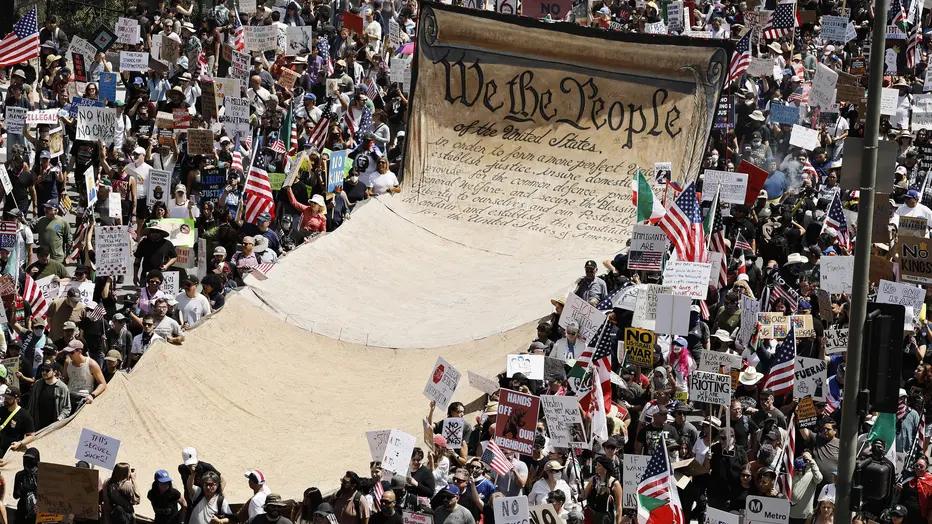
On June 14, 2025, millions of Americans took to the streets in over 2,000 cities and towns for the “No Kings Day” protests, a coordinated effort to denounce President Donald Trump’s policies. Timed to coincide with a military parade in Washington, D.C., celebrating the U.S. Army’s 250th anniversary and Trump’s 79th birthday, the protests aimed to reject what organizers called the administration’s authoritarian overreach. While supporters hailed the turnout as a historic stand for democracy, critics have labeled it one of the most misguided protests in U.S. history, arguing it misrepresented the military’s role and fanned division.
Organized by the 50501 Movement and a coalition of over 200 groups, including Indivisible and the ACLU, the protests targeted Trump’s immigration crackdowns, particularly the deployment of National Guard and Marines in Los Angeles to counter anti-ICE demonstrations. The “No Kings” theme, a nod to rejecting one-person rule, saw massive crowds in Philadelphia (100,000), Los Angeles (200,000), and Seattle (70,000), waving signs with slogans like “No thrones, no crowns” and chanting for democratic values. Organizers estimated 4-6 million participants, potentially rivaling the 2017 Women’s March as the largest single-day protest in U.S. history.
Critics, however, argue the protests were poorly conceived, conflating a celebration of the Army with Trump’s personal agenda. The decision to avoid Washington, D.C., was strategic, organizers said, to prevent giving Trump a pretext to crack down on demonstrators or claim they opposed the military. Yet, this choice left the protests vulnerable to accusations of sidestepping the very power they sought to challenge. In Philadelphia, where the flagship march drew thousands, speakers like Rep. Jamie Raskin (D-MD) framed the event as a defense of free speech, but detractors saw it as a performative stunt that ignored the Army’s milestone.
The protests were not without incident. In Los Angeles, clashes erupted when police used tear gas and less-lethal munitions after protesters allegedly threw objects, prompting organizers to condemn law enforcement’s “aggressive” tactics. In Virginia, a man was arrested for driving into a crowd, and in Utah, a shooting left one protester critically injured. These incidents, though isolated, fueled critics’ arguments that the protests invited chaos rather than constructive dialogue. In Minnesota, events were canceled after a politically motivated shooting killed a state lawmaker, yet thousands still marched, defying calls for restraint.
Supporters of “No Kings Day” argue it was a necessary response to Trump’s policies, including mass deportations and defiance of court orders, which they liken to monarchical overreach. “This is about rejecting authoritarianism,” said Ezra Levin of Indivisible, noting the protests’ peaceful intent. In contrast, critics contend the movement exaggerated Trump’s actions and alienated those who view military tributes as apolitical. The White House downplayed the protests, with Trump’s communications director claiming the military parade drew 250,000 attendees, far outshining the “minuscule” demonstrations—a claim disputed by organizers’ estimates.
The “No Kings Day” protests have sparked a broader debate about the role of public demonstrations in a polarized America. Were they a powerful stand against perceived tyranny, or a misdirected outburst that muddied a patriotic celebration? For some, the sheer scale of participation signaled a robust defense of democratic ideals; for others, it was a disorganized outcry that failed to engage the administration directly. As the nation grapples with rising tensions over immigration and governance, the legacy of “No Kings Day” remains contentious—a reflection of a deeply divided country.