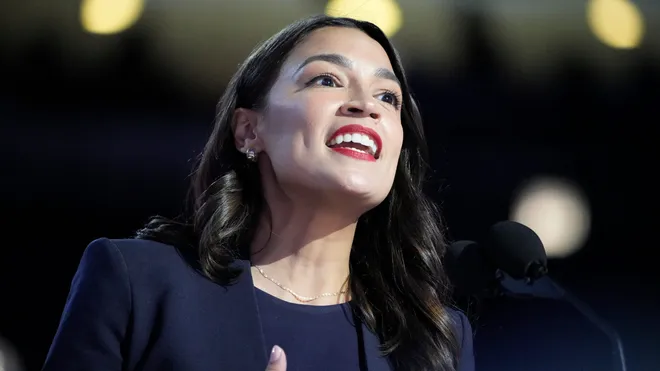
A June 2025 AtlasIntel poll has sparked controversy by claiming that Rep. Alexandria Ocasio-Cortez (D-N.Y.) is viewed more positively by Americans than President Donald Trump or former President Joe Biden, with 46% favoring AOC compared to 44% for Trump and 37% for Biden. The results, touted as evidence of AOC’s rising star, have drawn sharp skepticism from critics who argue the data is misleading, potentially manipulated, and fails to reflect the broader political landscape. As Trump’s second term fuels heated debates, the poll’s findings raise questions about methodology, bias, and the true pulse of American sentiment.
The AtlasIntel survey, conducted May 21-27 with 3,469 respondents, ranks AOC third among politicians, behind only Barack and Michelle Obama, with a net positive rating of +2 (46% favorable, 44% unfavorable). Trump, at 44% favorable and 55% unfavorable, and Biden, at 37% favorable and 55% unfavorable, trail behind. Supporters of the poll’s findings point to AOC’s “Fighting Oligarchy” tour with Sen. Bernie Sanders, which drew 30,000 attendees in a Trump-won California district, as evidence of her appeal. Her vocal opposition to Trump’s policies, like mass deportations and tariffs, resonates with progressives, with 64% of New York Democrats viewing her favorably, per a 2025 Siena survey.
Critics, however, cry foul, arguing the poll inflates AOC’s popularity. A 2019 Gallup poll showed her at a -10 net favorability (31% favorable, 41% unfavorable), and even in 2025, a Gallup survey found her significantly less popular than Trump among Republicans (93% favorable for Trump). Skeptics question AtlasIntel’s methodology, noting its D+9 lean in a 2026 generic ballot, which contrasts with other polls showing Republican gains. Some allege online manipulation, claiming Democratic activists skewed results, though no evidence confirms this. The poll’s timing—post-Trump’s 2024 victory—may also reflect transient anti-Trump sentiment rather than enduring support for AOC.
The broader context undermines the narrative of AOC’s dominance. Trump’s base remains fiercely loyal, with 90% of 2016 voters approving his performance, per a 2025 Gallup poll. His policies, including 142,000 deportations and the American Entrepreneurs First Act, align with 62% of Americans favoring stricter immigration enforcement, per a 2024 Pew survey. Biden’s low 37% favorability reflects disillusionment with his administration’s border policies, which saw 2.5 million migrant apprehensions in 2023. AOC’s progressive stances, like advocating for migrant rights and criticizing deportations, alienate moderates, with 55% of independents viewing her negatively in a 2025 Gallup poll.
Historical parallels add fuel to the skepticism. Weak history education—only 13% of eighth graders proficient in U.S. history, per a 2023 NAEP report—may leave voters susceptible to skewed narratives. Critics draw comparisons to past political exaggerations, warning that inflated polls could misguide Democratic strategy, as seen in the 2024 election’s missteps. Incidents like the Indiana teacher’s “8647” shirt controversy highlight the polarized climate, where AOC’s rhetoric often provokes backlash.
As the 2026 midterms loom, the claim that AOC outshines Trump or Biden seems overstated. Her strong New York base, where she won 68.9% in 2024, doesn’t translate nationally, with only 23% of Americans viewing her as a top Democratic leader, per a 2025 Newsweek poll. Trump’s enduring support and Biden’s lingering influence suggest the poll’s findings are an outlier, not a trend. The debate over AOC’s popularity reflects a broader struggle to define America’s political future amid division and distrust.